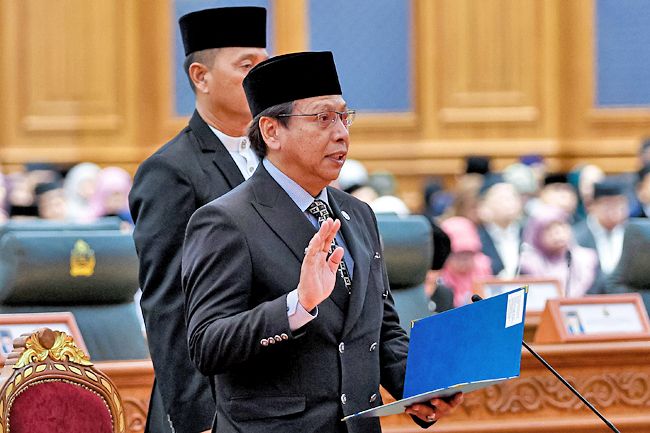
Brunei Darussalam took a significant constitutional step on Monday when four senior Cabinet ministers were formally inducted into the Legislative Council, underscoring the sultanate's structured approach to governance and legislative representation. The swearing-in ceremony, held on the opening day of the Second Meeting of the 22nd Legislative Council Session in Bandar Seri Begawan, followed the constitutional procedures established under Brunei's 1959 framework, which explicitly provides for executive officials to serve as ex-officio members alongside elected and appointed representatives.
The four ministers elevated to the chamber represent critical portfolios within Brunei's government apparatus. Datuk Seri Setia Awang Sufian Sabtu, who holds the position of Minister at The Prime Minister's Office with responsibility for Security and Law, brings oversight of the nation's security infrastructure and legal framework to the legislative body. Simultaneously, Datuk Seri Setia Awang Mohamad Azmi Mohd Hanifah, serving as Minister at the Prime Minister's Office with authority over Energy, Upstream and Downstream matters, will now contribute directly to deliberations affecting Brunei's crucial hydrocarbon sector and energy policy development.
The religious and transport portfolios also received enhanced legislative representation through the induction of two additional ministers. Pengiran Datuk Seri Setia Mohammad Tashim Pengiran Hassan, the Minister of Religious Affairs, joins the council with responsibility for matters concerning Islam's institutional and cultural role in Bruneian society. Complementing this is Datuk Seri Setia Awang Mohammed Riza Datuk Paduka Mohammed Yunos, the Minister of Transport and InfoCommunications, whose ministerial remit encompasses infrastructure development, connectivity initiatives, and the digital economy—sectors increasingly vital for regional competitiveness and pandemic-era adaptation.
The constitutional mechanism enabling such appointments reflects Brunei's hybrid governance model, which blends elements of absolute monarchy with structured consultative institutions. Unlike Westminster systems where ministers automatically obtain parliamentary seats, Brunei's ex-officio provision represents a deliberate constitutional choice to ensure that key executive figures maintain direct presence and voice within legislative proceedings. This arrangement facilitates streamlined communication between the executive and the council, reducing bureaucratic friction when policies require legislative scrutiny or resource allocation.
For Malaysian observers and regional analysts, Brunei's approach offers instructive parallels and contrasts. While Malaysia's cabinet ministers do not necessarily hold parliamentary seats, Brunei has chosen to embed senior executives within the Legislative Council framework itself. This reflects the sultanate's smaller governmental scale and the decision-makers' preference for administrative efficiency in a nation of approximately 450,000 people. The practice also reinforces executive accountability within the legislative sphere, as ministers must now defend their policies directly before their peers and address legislative concerns in real time rather than through delegated parliamentary representatives.
The ceremony was presided over by Pehin Orang Kaya Seri Lela Datuk Seri Setia Awang Abdul Rahman Datuk Setia Mohamed Taib, the Speaker of the Legislative Council, whose role encompasses overseeing parliamentary procedure and ensuring institutional integrity. The Speaker's presence at the swearing-in ceremony signifies the formal and ceremonial importance Brunei attaches to constitutional processes, demonstrating that even administrative transitions receive appropriate institutional recognition and documentation within the nation's governance framework.
Brunei's Legislative Council itself operates within a unique constitutional architecture. The body comprises members appointed by the Sultan, members elected through indirect consultation mechanisms, and now the ex-officio ministers. This layered composition reflects the sultanate's approach to governance, which prioritises stability, cohesion, and expert-informed deliberation over competitive parliamentary politics. The council functions primarily as an advisory and consultative body, with the Sultan retaining ultimate executive and legislative authority, yet it provides an institutional venue for policy discussion and subject-matter expertise.
The timing of these inductions during the Second Meeting of the current session suggests routine administrative succession, possibly following Cabinet reshuffles or newly appointed ministers entering their roles. Such ceremonies typically occur when the government reorganises its ministerial portfolios or when individuals newly assume Cabinet positions and must formally enter the legislative chamber. The ceremonial nature of the swearing-in underscores that even routine administrative appointments receive constitutional formality in Brunei, reinforcing the rule of law and institutional processes.
For the Southeast Asian region, Brunei's governance structures present an alternative model to the electoral democracies that dominate the Association of Southeast Asian Nations. The sultanate's consultative monarchy, while distinct from Malaysia's constitutional monarchy or Singapore's parliamentary republic, demonstrates that institutional stability and orderly governance need not rely exclusively on competitive electoral politics. This diversity of governance models within ASEAN itself reflects the region's philosophical pluralism regarding how states balance representation, efficiency, and strategic decision-making.
The inclusion of these ministers within the Legislative Council also strengthens their policy implementation capacity, as they can now participate directly in legislative debates and respond immediately to council members' questions or concerns about their respective portfolios. For security and law matters, energy policy, religious affairs, and transport and communications, this direct ministerial presence enables faster policy iteration and more nuanced legislative-executive coordination than would occur through intermediary representations.

