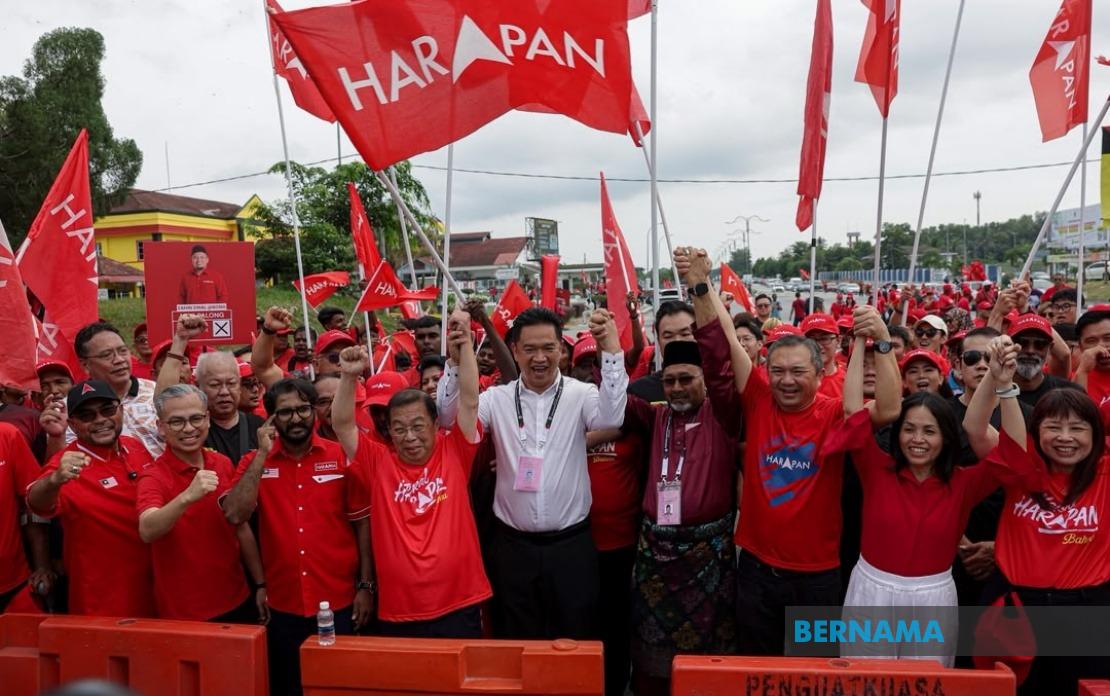
The Jeram Padang state seat in Jempol will be the focal point of a rare four-cornered electoral battle in the forthcoming 16th Negeri Sembilan State Election, marking the most fragmented contest in the constituency as nomination papers were officially closed on July 18. Returning officer Amino Agos Suyub confirmed the outcome following the conclusion of the nomination process at the Jempol District and Land Office Hall at 10 am, setting the stage for an unusually complex electoral scenario that will demand voters navigate multiple viable options across the political spectrum.
The four candidates vying for Jeram Padang represent a striking cross-section of Malaysia's political landscape. G. Manivannan carries the colours of Pakatan Harapan, the primary opposition coalition seeking to expand its footprint in the peninsular state. Incumbent Datuk Mohd Zaidy Abdul Kadir defends the seat for Barisan Nasional, which has governed Negeri Sembilan for decades and continues to anchor traditional support networks. R. Sri Sanjeevan, contesting on behalf of Parti Pribumi Bersatu Malaysia, represents a faction that has pivoted between coalitions and maintains a distinct political identity. Most notably, Dayana Dal of Parti Orang Asli Malaysia presents the only representative explicitly campaigning on indigenous community interests, underscoring how even state-level elections can reflect broader patterns of constituency mobilisation around ethnic and demographic lines.
The staggered submission of nomination papers, while procedurally routine, reflected the organisational readiness of each camp. Sri Sanjeevan and Dayana Dal filed their documents at 9.09 am and 9.12 am respectively, establishing their presence early in the morning. Manivannan, accompanied by PH Communications Director Datuk Seri Fahmi Fadzil, submitted his nomination at 9.17 am, a symbolic show of high-level party endorsement that underscored the coalition's commitment to the contest. Incumbent Mohd Zaidy completed the sequence at 9.20 am, securing his position as the defending champion in a race that has become significantly more crowded than typical state assembly contests in the region.
Beyond Jeram Padang, the Jempol constituency presents a more conventional political landscape across its three other seats. Serting faces a three-way contest between PH's Yaacob Mahmood, incumbent Mohd Fairuz Mohd Isa of Perikatan Nasional, and Bersatu's Muhammad Noraffendy Mohd Salleh, reflecting the broader fragmentation of Malaysia's opposition forces. This configuration, repeated across multiple seats, suggests that voters in some areas will enjoy genuine choice whilst others encounter clearer binary choices, raising questions about the coherence of anti-establishment voting patterns when multiple opposition-aligned parties compete.
The Palong seat follows a similar three-way template, with BN incumbent Datuk Mustapha Nagoor facing PH's Muhammad Zahin Zinal Abidin and Bersatu's Rebin Birham. This pattern of three-cornered contests, whilst less unusual than the four-way battle in Jeram Padang, still reflects the persistence of fractured opposition politics. Bersatu's decision to contest separately from PH, despite both claiming anti-BN credentials, continues to complicate the calculation of anti-establishment sentiment and makes predicting seat outcomes considerably more difficult than when polarisation between two major blocs was the dominant feature of Malaysian electoral contests.
Conversely, the Bahau state seat will witness a more straightforward engagement between two candidates representing the clearest ideological divide. Incumbent Teo Kok Seong of DAP, operating under the PH banner, will contest against MCA's Chong Fui Ming, the BN representative. This direct confrontation between established opposition and establishment forces, whilst seemingly anachronistic given Malaysia's more recent political volatility, maintains the traditional framework that has long defined electoral competition in certain constituencies. Bahau thus stands as a microcosm of older Malaysian politics, even as Jeram Padang and others illustrate how rapidly the political ecosystem has transformed.
The Electoral Commission has structured the election timeline to provide adequate preparation and voting opportunity. Early voting has been scheduled for July 28, accommodating voters unable to participate on the main polling day. August 1 is designated as polling day, granting both the candidates and electorate approximately a fortnight to campaign, mobilise supporters, and deliberate on their electoral preferences. This compressed timeframe, common in Malaysian state elections, nevertheless permits sufficient public engagement for candidates to present their cases to voters.
For Malaysian observers and political analysts, the emergence of multi-cornered contests in Jeram Padang and elsewhere signals the ongoing structural instability within the country's opposition movement. Bersatu's parallel candidacies suggest that despite nominal anti-establishment alignment, competing parties remain unwilling to subordinate their organisational identities to unified electoral strategies. This fragmentation typically favours the incumbent BN, which maintains more unified candidate selection and voter mobilisation machinery. The inclusion of Parti Orang Asli Malaysia, meanwhile, reflects broader movements toward indigenous political representation, though the party's electoral viability and success in translating community concerns into legislative influence remain uncertain.
Negeri Sembilan has traditionally been a BN stronghold, though recent state elections have demonstrated increasing competitive pressure from PH and other opposition forces. The state's political evolution often foreshadows national trends, and the degree to which fragmentation across multiple candidates impacts BN retention of seats will offer valuable indicators of whether fractured opposition politics systematically disadvantages anti-establishment vote-splitting. The contrast between Bahau's binary contest and Jeram Padang's four-way scramble will be particularly instructive for understanding how constituency-specific factors interact with broader political fragmentation.
The nomination process closure marks the transition from campaign preparation to active electoral engagement, with all candidates now formally committed to the contest. For voters in Jeram Padang, the four-cornered configuration introduces both greater choice and greater complexity, requiring careful assessment of candidate credentials, party platforms, and likelihood of converting preference into seat-winning outcomes. As Negeri Sembilan positions itself for the August 1 election, the diversity of contests across its various constituencies exemplifies how Malaysian politics continues to defy simple categorisation and reflects the multifaceted interests that drive contemporary electoral behaviour.

