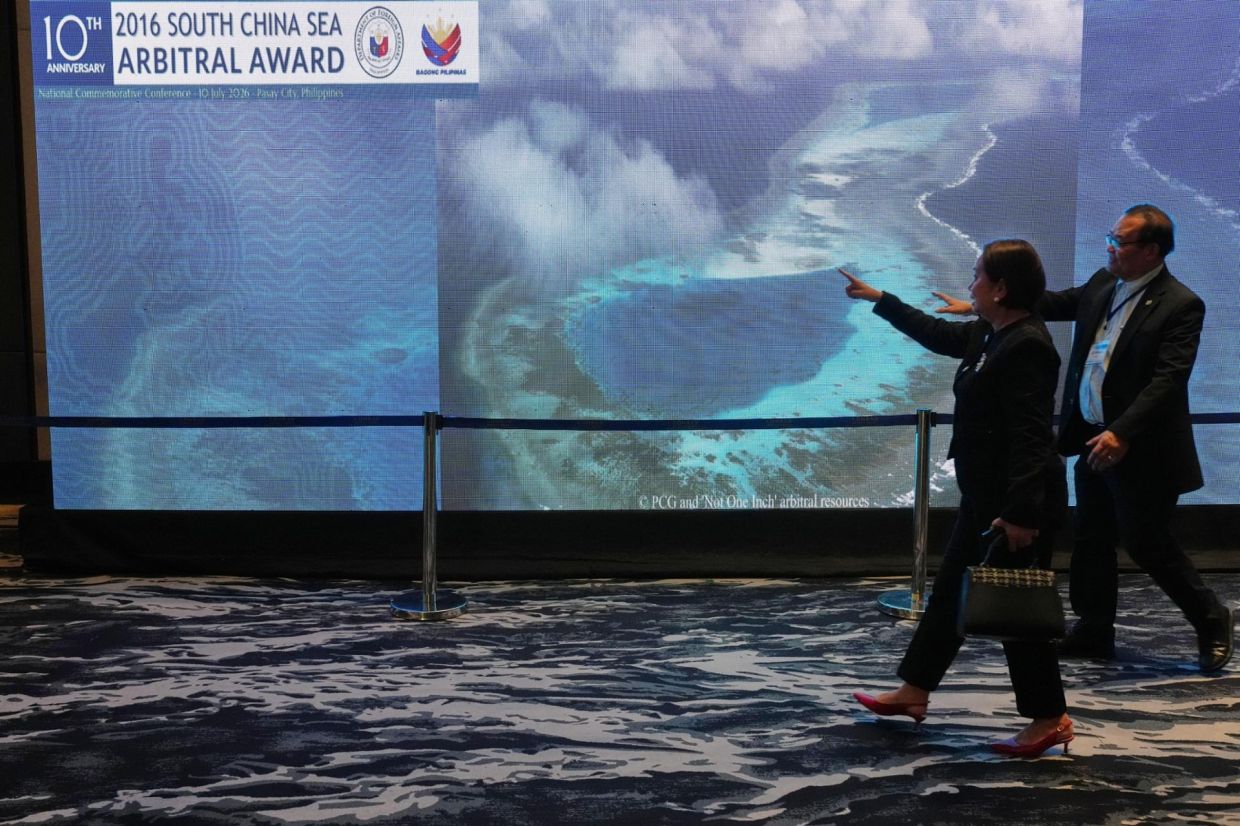
On Sunday, a coalition of 14 nations, led by the Philippines, commemorated a decade since the historic arbitral tribunal decision on the South China Sea, using the occasion to underscore the ruling's continued legal force and their shared commitment to maritime peace in the strategically vital waterway. The joint statement issued by the diverse group reflects growing international concern about escalating tensions in one of the world's most contested shipping lanes, where multiple overlapping territorial and maritime claims have sparked repeated confrontations between rival claimants.
The Philippines, alongside Australia, Canada, Estonia, Germany, Italy, Japan, Latvia, Lithuania, New Zealand, Romania, Slovenia, the United Kingdom and the United States, reaffirmed their support for the July 12, 2016 arbitral tribunal decision. This internationally recognised determination, rendered under the framework of Annex VII of the United Nations Convention on the Law of the Sea, settled several critical questions about maritime rights and territorial entitlements in the contested region. The signatories emphasised that the tribunal's findings remain "final, legally binding, and definitive between China and the Philippines" regarding the maritime claims and entitlements central to the case, leaving no ambiguity about the decision's enduring juridical status.
The 2016 tribunal delivered a watershed moment for maritime law in Southeast Asia. It invalidated China's expansive "nine-dash line" claim, which had underpinned Beijing's assertion of historic rights over the vast majority of the South China Sea. The arbitrators determined that China's historical rights arguments lacked legal foundation under international maritime law, a ruling with profound implications for the region's geopolitical balance. The tribunal further clarified that critical geographical features, including Panganiban Reef—known internationally as Mischief Reef—and Ayungin Shola, commonly called Second Thomas Shoal, fall squarely within the Philippines' exclusive economic zone, granting Manila fishing and resource rights in those areas.
The filing of the original arbitration case in 2013 represented Manila's bold decision to challenge China through international legal mechanisms rather than bilateral negotiation. This approach ultimately produced a decision that numerous countries now cite as the legal foundation for their own positions on maritime sovereignty and freedom of navigation throughout the region. For the Philippines and other Southeast Asian nations with overlapping claims in the South China Sea, the ruling provided a crucial reference point for asserting their rights against more powerful neighbours.
Beyond the specific territorial determinations, the joint statement reflects deeper anxieties among signatory nations about military and paramilitary activities that have increasingly characterised South China Sea interactions. The coalition voiced strong opposition to "destabilising or unilateral actions including by force or coercion," making explicit reference to the employment of coast guard vessels, military assets, and maritime militia organisations to "harass, obstruct, or intimidate lawful operations by other States." This language carries particular weight given numerous documented incidents where armed vessels have blocked, rammed, or fired upon fishing boats and civilian supply missions throughout the contested waters.
The signatories drew attention to how such confrontational tactics endanger civilian populations, including fishermen conducting lawful activities in their own nations' maritime zones. These operations have repeatedly resulted in injuries, property damage, and death, creating humanitarian dimensions to what remains fundamentally a geopolitical dispute. By highlighting the human cost of militarised approaches to maritime contestation, the coalition signalled that international opinion increasingly views aggressive policing of the South China Sea as incompatible with regional stability and prosperity.
The coalition's statement also reinforced the primacy of the United Nations Convention on the Law of the Sea as the governing framework for resolving maritime disputes. By calling for peaceful settlement through dialogue and lawful mechanisms consistent with international law, the countries implicitly endorsed the arbitral process itself as a preferable alternative to military assertion of claims or unilateral administrative actions. This positioning carries significance for other potential disputes across the Indo-Pacific, where similar arbitral mechanisms might provide pathways for resolving contested maritime boundaries without recourse to force.
Particularly noteworthy is the participation of major Western powers—the United States, United Kingdom, Germany and Canada—alongside regional stakeholders and smaller island nations. This coalition composition reflects a deliberate international strategy to demonstrate that support for rules-based maritime order transcends regional boundaries and represents a genuine global consensus rather than merely the preferences of regional powers opposed to China. The inclusion of European nations signals that maritime freedom and legal predictability constitute global public goods that extend far beyond Southeast Asian concerns.
The coalition's explicit endorsement of ASEAN's vision of the South China Sea as "a sea of peace, stability, cooperation, and prosperity driven by vibrant lawful commerce" positions the arbitral ruling as fundamental to achieving the region's aspirational objectives. For Malaysia, Vietnam, Thailand and other Southeast Asian nations dependent on the unimpeded flow of trade through these waters, the reaffirmation of legal arbitration over unilateral assertion constitutes a diplomatic foundation for resisting coercive behaviour. The anniversary moment thus served not merely as commemorative reflection but as a coordinated restatement of expectations for future conduct in the region's maritime spaces.

