The quarter-final clash between France and Morocco represents far more than a typical knockout fixture in a global sporting tournament. Beyond the tactical preparations and strategic analysis that precedes such meetings, this encounter carries the weight of a complex shared history, demographic ties and the intimate connections that bind two nations separated by geography but united by migration, culture and sport. The Boston setting, chosen as the venue for Thursday's match, adds an intriguing dimension to what would otherwise be charged with the heightened security and political undertones that such fixtures generate within France itself.
Historical ties between these two countries run remarkably deep. Morocco existed under French protectorate rule from 1912 until its independence in 1956, a period that fundamentally shaped the economic, educational and cultural landscape of both nations. The aftermath of colonialism has not resulted in a clean separation; instead, France and Morocco have maintained substantial connections through education systems, commercial endeavours and sustained migration patterns that continue to define contemporary demographics in both territories. This enduring relationship has seeped into the fabric of football, creating a uniquely complex dynamic where the sport reflects and amplifies the broader connections between populations.
The composition of Morocco's current squad tells this story with remarkable clarity. Six members of the national team were actually born on French soil, having entered the world within French borders before later committing themselves to represent Morocco internationally. Beyond these six, numerous additional players developed their craft within France's renowned football academy system or competed in Ligue 1, the French domestic professional league. Teenager Ayyoub Bouaddi exemplifies this phenomenon with particular vividness: born in France, educated at the prestigious Lille academy and capped by France at youth levels, he subsequently elected to represent Morocco at senior level, embodying the fluid footballing identities that characterise many players in this competition.
The relationship between Kylian Mbappe and Achraf Hakimi further illustrates these personal dimensions. Having spent years together at Paris Saint-Germain, the two players developed a friendship that transcends international rivalries, a bond that resonates through the broader French and Moroccan communities. Such individual connections, multiplied across the squad, create an emotional texture quite distinct from conventional international football encounters. Morocco's strategy of integrating its diaspora talent into national team development has proven remarkably successful, transforming what might have been a loss of potential players into a competitive advantage by drawing on a vast pool of dual-heritage athletes who possess European training and experience alongside Moroccan identity.
France arrives at this quarter-final as world champions from 2018 and as one of global football's established powers, carrying the tournament experience and attacking sophistication expected of a side genuinely challenging for another World Cup. Their squad composition has long reflected multicultural currents that run through French society, a diversity that has become characteristic of their football programme. However, Morocco has fundamentally shifted the dynamics of this fixture since their meeting in Qatar in 2022, a match France won convincingly by two goals to nil.
Morocco's trajectory through this tournament and beyond has rewritten the narrative entirely. Four years prior, they became the first African nation to reach a World Cup semi-final, an achievement that captivated global audiences and demonstrated that traditional football hierarchies were far more permeable than conventionally assumed. They arrived in Boston carrying not merely the status of compelling underdogs but as a genuinely competitive side with established infrastructure, systematic player development and demonstrable belief in their capacity to challenge the sport's traditional power structures. Their three-nil victory over Canada underlined the pace, tactical discipline and ambitious intent that propelled them back to the quarter-finals.
Boston provides a notably different setting from the intensity that surrounds such fixtures in France. The Moroccan community in the metropolitan area, while smaller and less immediately visible than in major French cities, represents an established network of families, professionals, students and business operators. For many supporters from both nations residing in the Boston region, this fixture threatens no clean division along national lines. Mohammed Saadi, a 57-year-old taxi driver, observed that French and Moroccan residents frequently inhabit the same residential buildings and neighbourhoods, where they will watch the match together before exchanging handshakes once the final whistle sounds. The cultural separation that might characterise such a fixture in Europe has little relevance here.
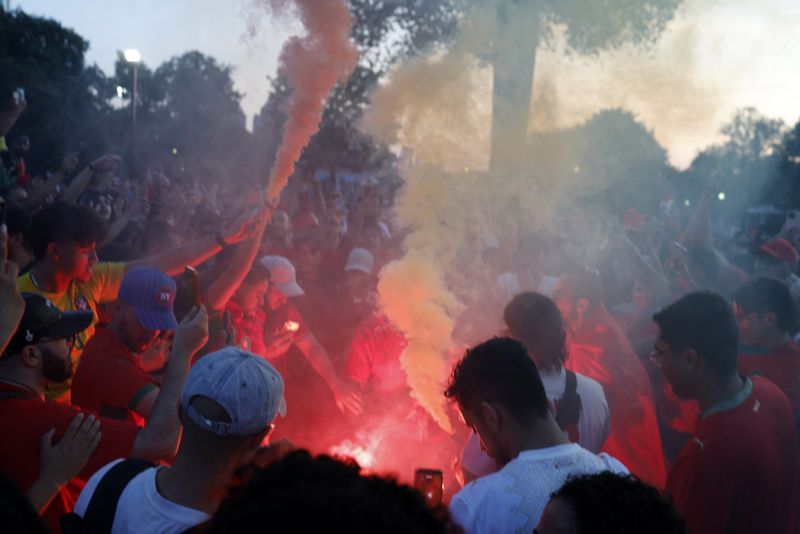
The gathering in Boston Common demonstrated the peaceful, celebratory atmosphere that characterised the pre-match buildup. Over one thousand supporters assembled to sing Dima l-Maghrib, a patriotic Moroccan anthem, and wave national flags in expressions of support that were entirely cordial rather than hostile. Youssef Bennani, a software engineer who travelled all the way from Finland to attend Morocco's matches throughout the tournament, described the Boston environment as optimal for the occasion, remarking on the ease with which supporters from both nations had mingled and the expectation that the match would resemble a celebration rather than a conflict.
The tactical implications favour neither side overwhelmingly. France possesses one of the tournament's most potent attacking forces, with players capable of decisive action in critical moments. Morocco, however, has demonstrated a sophisticated understanding of defensive organisation combined with devastating counter-attacking prowess. Their federation has deliberately pursued a strategy connecting domestic player development with the integration of European-trained talent, creating a hybrid model that provides both tactical coherence and individual quality. The rematch carries genuine uncertainty in ways that the initial encounter in 2022 did not, reflecting Morocco's evolution as a genuine challenger rather than a mere surprise package.
Beyond the ninety minutes of play, this fixture embodies something broader about contemporary international football and the ways in which migration, diaspora networks and personal relationships reshape the significance of international sport. France and Morocco are meeting not as straightforward adversaries but as nations whose histories, populations and futures remain deeply intertwined despite and because of their post-colonial relationship. Boston's role as neutral ground in this context allows the match to reflect these genuine connections rather than permitting them to be obscured by security concerns or political sensitivities.

