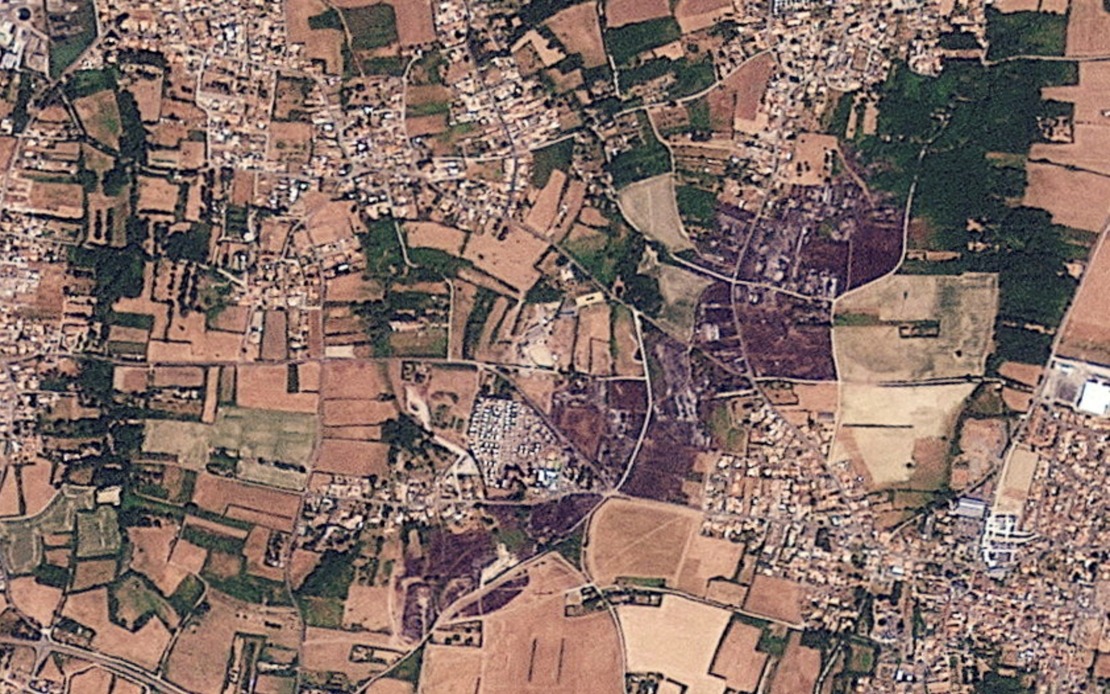
France is confronting one of its most challenging fire seasons in recent memory, with authorities mobilising hundreds of firefighters to combat spreading wildfires across multiple regions. Two active fires in the Fontainebleau forest, located southeast of Paris, have already destroyed approximately 1,920 hectares of woodland, with the smaller of the two fires continuing to expand despite intensive suppression efforts. The twin blazes represent a significant test for French emergency services and have prompted tough rhetoric from government officials regarding the prosecution of those responsible.
The first fire ignited on Sunday and has consumed around 1,500 hectares of forest, while a second outbreak, discovered subsequently, has destroyed between 300 and 400 hectares. Authorities have arrested two individuals suspected of deliberately setting the initial fire, signalling that deliberate arson is a primary concern during the current fire season. The arrests underscore a troubling pattern emerging across France, where officials have documented dozens of suspected intentional fire starts. By mid-July, French authorities had apprehended 59 people across the country on suspicion of deliberately igniting wildfires, indicating a systematic problem requiring both law enforcement intervention and legal reform.
French Transport Minister Philippe Tabarot has demanded stringent judicial responses to those responsible for starting fires, advocating for what he termed "very harsh sentences" against arsonists. His public statements reflect the government's determination to deter future offences through the threat of severe punishment. Notably, Tabarot acknowledged that the motivations behind deliberate fire-setting vary, with some perpetrators acting as common criminals and others potentially suffering from pyromania, a psychiatric condition characterised by compulsive fire-setting behaviour. He indicated that while confirmed arsonists should face "very severe penalties" through the criminal justice system, individuals with diagnosed pyromania may require medical intervention and psychiatric treatment alongside legal consequences.
The firefighting response has been substantial, with approximately 600 personnel deployed to the Fontainebleau operations alone as overnight suppression activities continued. The deployment of such a large workforce reflects the scale and complexity of managing forest fires in densely vegetated terrain, where erratic weather patterns and challenging topography can rapidly alter fire behaviour. Regional wildfire incidents elsewhere in France have similarly strained emergency services, forcing the allocation of firefighting resources across competing priorities.
Beyond the Fontainebleau situation, France's fire crisis extends across multiple regions and has created cascading impacts on civilian infrastructure. The Trevillach wildfire that erupted earlier in July in the Pyrenees-Orientales region in southern France damaged critical railway infrastructure, disrupting a major transport corridor. The Perpignan-Villefranche-Vernet-les-Bains railway route has been partially suspended, with France's national railway operator SNCF announcing that services between Ille-sur-Tet and Villefranche-Vernet-les-Bains would remain halted through at least July 20. This disruption affects both passenger connectivity and goods transportation, illustrating how environmental crises can create economic ripple effects throughout regional economies.
Wildfire activity has also affected regions in western and central France with contrasting characteristics. In Brittany's Côtes-d'Armor department on the Atlantic coast, a heath fire near Cap Fréhel forced the evacuation of more than 100 residents on Monday, though the blaze consumed a comparatively modest 38 hectares. The situation in Lozère, a department in the Occitanie region, proved more serious, with firefighters reporting that 107 hectares of land had burned. These incidents, while individually smaller than the Fontainebleau blazes, collectively demonstrate how wildfire pressure is distributed across France's diverse geography during periods of elevated fire risk.
The escalating number of suspected arson cases raises questions about preventive measures, enforcement capacity, and the adequacy of current legal frameworks. The fact that 59 individuals have been arrested on suspicion of deliberately starting fires within a single season suggests either a genuine increase in deliberately set fires or enhanced detection and prosecution efforts by authorities. Understanding which factor predominates has direct implications for resource allocation and policy responses. If intentional fire-setting has genuinely increased, authorities may need to investigate root causes, whether socioeconomic frustration, political protest, or individual psychological pathology, to develop targeted prevention strategies.
For readers in Malaysia and Southeast Asia, the French wildfire crisis offers instructive lessons regarding forest management, disaster response coordination, and the intersection of law enforcement with environmental crisis management. Southeast Asian nations, particularly those with significant forest resources in Indonesia, Malaysia, and Cambodia, face recurring transboundary haze problems driven partly by agricultural burning and partly by deliberate fires set during land disputes or agricultural conversion cycles. The French approach to prosecuting arsonists and distinguishing between criminal conduct and psychiatric illness could inform policymaking in the region, particularly as climate change increases fire frequency and intensity across tropical and subtropical Asia.
The immediate priority for French authorities remains containment and suppression of the active fires in Fontainebleau and other regions, with personnel working against summer heat and potentially dry conditions that exacerbate fire behaviour. Beyond immediate firefighting, the government faces the challenge of implementing judicial consequences that deter future arson while ensuring proportionate and humane treatment of offenders, some of whom may have underlying medical or psychological conditions. The broader context of climate change, which is lengthening fire seasons and altering vegetation patterns across Europe, suggests that France and other nations must simultaneously address both immediate crisis management and longer-term adaptation strategies to mitigate wildfire impacts in a warming world.

