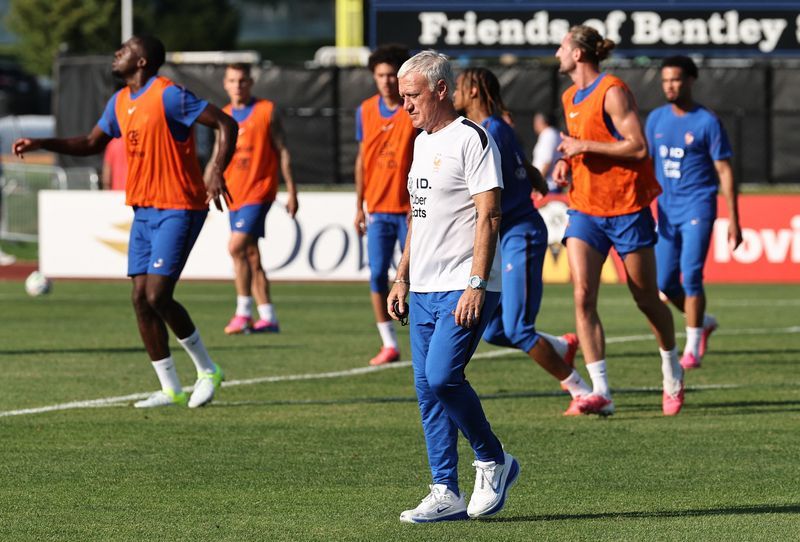
France breezed through the opening phase of the World Cup with a perfect record and clinical finishing, yet coach Didier Deschamps recognises that the knockout rounds demand a more complete defensive structure. The team's progression to face Sweden in the Round of 32 presents an opportunity to address the tactical vulnerabilities that have occasionally surfaced, particularly along the left side of their formation where positional fluidity and organisation could yet prove costly against more disciplined opponents.
The scope of France's offensive capability has been genuinely impressive through Group I, where they accumulated ten goals across victories against Senegal, Iraq and Norway without suffering a single defeat. The attacking trinity of Kylian Mbappé, Ousmane Dembélé and Michael Olise has provided France with what many observers regard as the tournament's most dangerous offensive force, combining creativity, explosive pace and clinical finishing in a manner that has left defences bewildered. This depth of talent extends beyond the frontline, with the bench strength including Bradley Barcola, Désiré Doué, Rayan Chérki, Jean-Philippe Mateta and Marcus Thuram—a roster of attacking alternatives that no competing nation can genuinely match.
Yet this defensive vulnerability on the left represents a nagging concern that Deschamps cannot afford to ignore as competition intensifies. Théo Hernández's performances at left-back have failed to demonstrate the requisite conviction, prompting the expectation that Lucas Digne will reclaim the position and provide both enhanced defensive stability and more reliable service from the flank. The potential adjustment would represent a marginal tactical shift rather than a fundamental restructuring, but the addition of Digne's experience and positional discipline could prove sufficiently meaningful against a Sweden side expected to adopt a deep defensive structure and exploit any transitional weaknesses.
The adjustments Deschamps is contemplating extend beyond the defensive line into the attacking setup itself. Bradley Barcola appears set to displace Désiré Doué on the left wing, offering the direct running style and pace in transition that complements France's overall attacking philosophy while providing natural width that can unbalance opponents defending compact formations. This modification aims to create a more harmonious and less fragmented left side, reducing the disjointed transitions that have occasionally exposed France to counter-attacking opportunities when possession shifts rapidly.
The return of William Saliba to the centre of the defence provides a further stabilising influence that should reinforce France's structural solidity. Saliba's presence offers positional assurance in a defensive unit that, despite their attacking brilliance, has sometimes been caught unaware by sudden changes in tempo. His contribution extends beyond simple defensive duties to encompassing leadership and communication, qualities that become increasingly vital as tournaments progress and matches demand greater mental resilience alongside tactical acuity.
Sweden present themselves as pragmatic adversaries rather than visionary opponents, having secured second place in Group F through a mixture of controlled performances and clinical finishing. Their opening demolition of Tunisia, a 5-1 victory, suggested genuine offensive potential, yet the subsequent 5-1 reversal against the Netherlands and a 1-1 draw with Japan revealed considerable inconsistency. The Scandinavian nation possesses the physical robustness and organisational framework to manufacture an uncomfortable evening for France should Deschamps' team lapse into impatience or abandon their structural discipline. Alexander Isak, Viktor Gyökeres and Anthony Elanga provide Sweden with genuine attacking threats, though few neutral observers genuinely envisage the squad matching France's relative quality or depth.
The transition from group-stage football to knockout competition represents a qualitatively different challenge that cannot be adequately understood through direct statistical comparison. The group phase permitted France to overwhelm opponents through superior talent, absorbing occasional defensive lapses without tangible consequence because their attacking output invariably proved decisive. The knockout format mandates greater economy and precision; any defensive error becomes potentially punitive, and the absence of second chances concentrates the mind considerably. The statistical record proves instructive—France have not suffered knockout elimination since 2014, with only the 2022 final defeat to Argentina interrupting an otherwise imperious record.
Observers with extensive international experience have expressed qualified confidence in France's capacity to progress. Gary Lineker, the former England international, acknowledged Sweden's attacking credentials while maintaining that France's superior firepower constitutes a decisive advantage. The presence of four genuine forwards admittedly creates certain counter-attacking vulnerabilities, as became evident during France's occasionally careless performance against Norway's secondary team, yet the underlying mathematical reality remains that France should accumulate more goals than their opposition across the ninety minutes.
Victory would position France to face either Germany or Paraguay in the subsequent round, continuing their progression toward what many regard as an achievable deep run. The combination of attacking ambition and defensive organisation that Deschamps implements against Sweden will ultimately determine whether France's tournament trajectory accelerates toward ultimate success or whether latent vulnerabilities become increasingly exposed as they encounter progressively stronger opponents.

