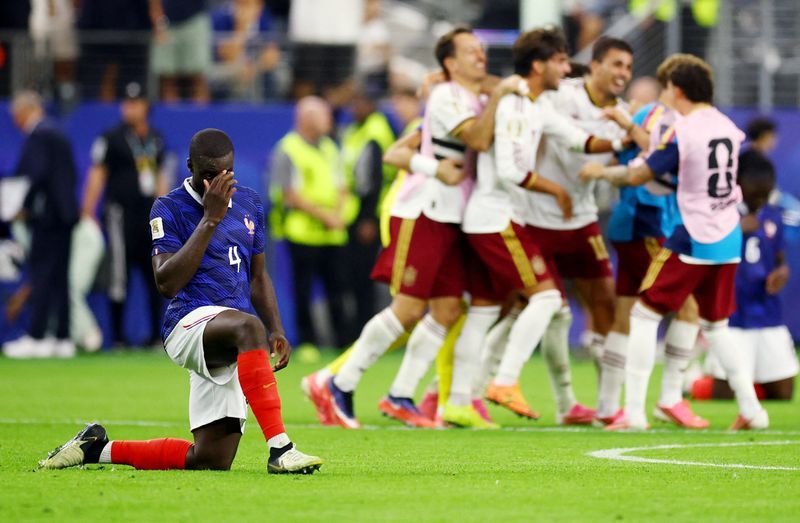
France's World Cup ambitions collapsed spectacularly on Tuesday evening in Arlington, Texas, when Spain dismantled the tournament favorites with a commanding 2-0 semi-final performance. Having been positioned as serious contenders entering the knockout stage, the French encountered their most searching examination yet and emerged with nothing to show for their efforts. Unlike their dramatic 2022 World Cup final appearance against Argentina, where they fought back from adversity before succumbing only to penalties, France offered no resistance this time. They were simply overwhelmed by a Spanish side that understood the contest far better than their opponents and executed their gameplan with clinical precision.
Coach Didier Deschamps was left to confront an uncomfortable truth after the match, acknowledging that his team had failed the most basic test of tournament football. "The players are devastated, but we have to be clear-headed: technically, we were second best. That is on us," he said, recognizing that there could be no excuses for the manner of the defeat. The assessment was brutally honest because it reflected a deeper problem: France's pre-match billing as favorites had obscured fundamental weaknesses in their setup and individual form that Spain ruthlessly exploited. Pundits and analysts who had backed the French to go far had fundamentally miscalculated the balance of power, and the players themselves had compounded this error through their own tactical misjudgments during the match.
Spain's young star Lamine Yamal had declared boldly in the buildup that France should fear the Spanish challenge, an assessment that proved prescient. Under Spain's control, France's midfield crumbled almost immediately, leaving their defense repeatedly exposed. The defensive pairing that Deschamps had deployed to protect his back line disintegrated under sustained pressure. Adrien Rabiot picked up an early yellow card that forced him to curtail his aggressive approach, while Aurelien Tchouameni, returning from a hamstring injury that had kept him sidelined for two previous matches, lacked the rhythm and physical robustness required to match Spain's tempo. The overloaded Spanish midfield moved the ball with mesmerizing control, dictating the pace of the encounter and suffocating France's attacking outlets.
Michael Olise emerged as the symbolic representation of France's comprehensive failure. Positioned as a generational talent and even entering conversations about elite individual honors, Olise appeared entirely out of his depth on the Dallas Stadium pitch. He surrendered possession twenty times during the match and completed not a single successful dribble, a stark indictment of a player whom France had relied upon to unlock Spain's defensive structure. Rodri, his opposite number, exemplified the gulf in class by moving through midfield with commanding authority, controlling proceedings and dictating where the game would flow. The contrast between the two midfielders crystallized France's broader struggles: where Spain demonstrated technical mastery and tactical intelligence, France offered confusion and reactive defending.
Beyond Olise, France's celebrated attacking players simply never arrived for the contest. Ousmane Dembele contributed virtually nothing to France's offensive endeavors, while Bradley Barcola and his replacement Desire Doue proved equally ineffectual in breaking down Spain's well-organized backline. Even Kylian Mbappe, who had carried considerable expectation heading into the knockout phase, failed to produce the decisive moment that might have changed the trajectory of the match. The crowd's loudest reaction came not from any French attacking thrust but from an appearance by former footballer David Beckham on the stadium's giant screen—a telling detail that underscored how thoroughly France had been neutralized. A forward line that had been heralded as one of the tournament's most potent attacking forces was rendered powerless by superior opposition.
Spain's two goals arrived from positions of overwhelming dominance. Mikel Oyarzabal converted a penalty in the twenty-second minute, punishing France's early defensive vulnerability. Pedro Porro then added the second goal just before the hour mark, essentially sealing the match as a contest. By this point, France had already ceded control and lacked either the tactical nous or the individual quality required to stage a comeback. The manner in which Spain had secured these goals, from a position of utter command, suggested that the deficit could have been substantially wider had Spain maintained their clinical finishing throughout.
French officials and observers have acknowledged that Spain deliberately slowed the tempo of the game, controlling possession and denying France the space to build attacking momentum. Rayan Cherki, who entered the match in the second half, recognized this tactical reality after the final whistle. "We knew their main strength was their ability to play at a false tempo (slow the game down). At times, we should have done the same. It was more difficult than we expected," he said. The admission underscored a fundamental strategic failure: France had failed to adjust their approach in real time, instead attempting to impose their preferred rhythm against an opponent determined to control the tempo. This passivity, combined with technical inferiority in midfield, created a chasm that France could never bridge.
The visual aftermath of the defeat encapsulated the devastation coursing through the French camp. Mbappe stood isolated on the pitch as the final whistle sounded, while several of his teammates dropped to their knees in despair. Others buried their faces in their hands, unable to process the magnitude of the collapse. All the rhetoric about cohesion, unity, and collective purpose that had been emphasized relentlessly in the buildup to the match suddenly seemed hollow. The emotional range on display suggested a group struggling to reconcile their pre-tournament expectations with the brutal reality of their performance.
For Malaysian and Southeast Asian observers, France's exit carries broader implications for how tournament favorites handle pressure and adapt tactically. The tournament has already demonstrated that superior pedigree and individual talent, while necessary, prove insufficient without the tactical flexibility and collective discipline that Spain exhibited. France's failure to adjust when their initial approach proved ineffective mirrors broader lessons about tournament football: rigid adherence to predetermined systems, when facing intelligent opposition, often results in disaster. Spain's performance vindicated the notion that tactical mastery, possession control, and the ability to dictate tempo can neutralize even the most individually talented squads.
The defeat represents not merely a disappointing elimination but a complete repudiation of the narrative that had surrounded France entering the tournament. Where confidence had bordered on arrogance, there now exists only the sting of underperformance. Deschamps must now confront uncomfortable questions about his tactical approach and selection decisions, while individual players like Olise will face scrutiny about whether they can truly deliver at the highest level when the competition intensifies. For Spain, the victory represents a statement of intent that they possess the organizational sophistication and individual quality to compete with any opponent. France's campaign, by contrast, has ended not with a whimper but with an outright rejection by a superior force.

