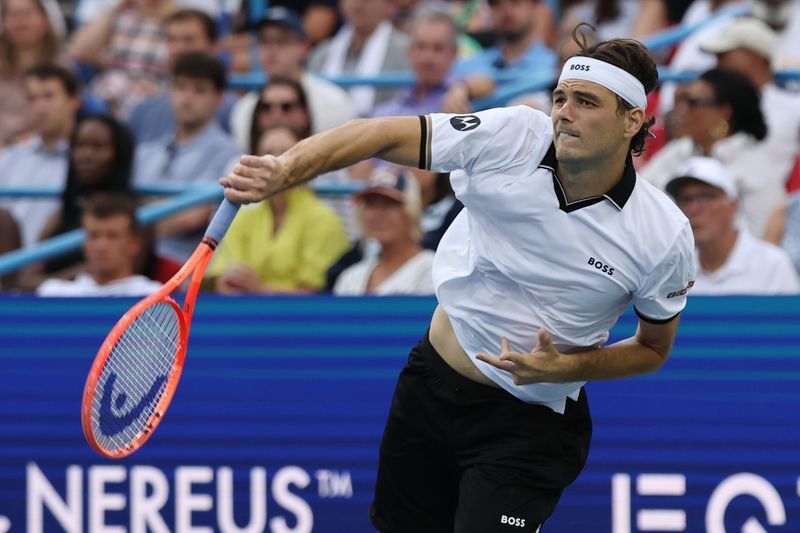
Taylor Fritz has secured his spot in the Washington Open final after a commanding display against fellow American Brandon Nakashima on Saturday, advancing with a 6-3 3-6 6-2 victory in what proved to be a tightly contested semifinal. The world number 10 and third seed navigated a concerning second-set reversal to ultimately control the match when it mattered most, booking what will be his 23rd ATP final appearance. Fritz's opponent in the championship match will be Spain's Rafael Jodar, who staged a memorable comeback from a set behind to defeat Chile's Alejandro Tabilo 6-7(6) 6-4 6-4 in the other semifinal.
Fritz's path to the final exemplified the often-narrow margins that separate victory from defeat in professional tennis at this level. The American struck 13 aces and produced 24 winners, demonstrating the aggressive ball-striking that has made him a formidable competitor on hard courts. Over the course of the match, he committed just 16 unforced errors, a disciplined showing that underscored his technical control. His opponent Nakashima, by contrast, struggled with consistency, recording 27 unforced errors despite his own strong moments throughout the encounter.
The opening set revealed Fritz establishing early dominance through superior serve placement and court positioning. After the set remained competitive through the early games, Fritz manufactured a crucial break at 4-3 and subsequently held serve with authority to close out the frame in 34 minutes. The American's ability to serve out that opening set would prove significant, as it gave him the psychological advantage of having taken the first step toward victory.
Nakashima, however, demonstrated the mental resilience required at this level by bouncing back emphatically in the second set. Seeking his first ATP 500 final, the young American targeted Fritz's serve aggressively, breaking through to establish a 3-1 lead. Nakashima then held serve for love at 5-2, appearing poised to force a deciding set on his own terms. He duly completed the set two games later, with Fritz appearing temporarily rattled by Nakashima's sustained pressure and improved execution on return of serve.
The third set, however, belonged entirely to Fritz. The 28-year-old reasserted his dominance from the opening game, breaking Nakashima's serve immediately and then holding to love to establish a commanding 3-0 advantage. This early cushion proved decisive, as Fritz maintained his elevated standard of play throughout the remainder of the set, ultimately closing out the match and securing his passage to the final.
Fritz attributed his victory to crucial moments of execution when matches are decided. "Grabbing that break in the third set made the difference," he explained in his post-match comments. "It was really a narrow margin the whole time. Not a lot of chances either way. First set I took my chance, in the second set he did. I played a really good break point in the third set, and I dug very deep to just keep holding." His assessment highlighted the competitive equilibrium that characterized much of their encounter, with incremental advantages accumulating into a final margin of victory.
Jodar's pathway to the final proved equally compelling, if from a different narrative standpoint. The Spanish teenager entered the match against Tabilo as the underdog in conventional rankings terms, yet his trajectory over recent months has been nothing short of remarkable. Forced to recover from losing the opening set in a tiebreak at 6-7(6), Jodar demonstrated the mental fortitude required to mount a successful comeback at professional level. He seized his opportunities in the second set to claim a decisive break, then continued that momentum through the third set to secure his 6-4 6-4 victory.
Jodar's resurgence on court was underpinned by improved mental resilience and tactical adjustment. "I knew I was playing well, having opportunities," he reflected after his victory. "Accepting all the moments that I didn't break in the first set and the beginning of the second set, accepting those moments helped me get the break in the second set. From then, I started playing with more rhythm with my serve, so mentally I was very good today." His comments underscored how elite tennis increasingly hinges on psychological management as much as technical excellence.
The significance of Jodar's performance extends beyond this single tournament. His accomplishments in Washington represent the culmination of a meteoric rise through professional tennis ranks over the past several months. Just several months ago, the teenager was ranked outside the top 100, yet his exceptional clay-court season fundamentally altered his trajectory. Critically, Jodar secured his maiden ATP title at the Grand Prix Hassan II in Morocco, a breakthrough moment that legitimized his growing reputation as an emerging force in international tennis.
This ascent becomes even more striking when contextualized against his previous encounter with Tabilo. In March at Indian Wells, Tabilo dispatched Jodar decisively with a 6-1 6-2 scoreline, suggesting a substantial gulf in quality between the two competitors. Saturday's reversal of that result, achieved through sustained improvement and greater consistency under pressure, illustrates the rapid skill development characteristic of young players transitioning into their peak competitive years. The Spanish teenager's emergence has significant implications for future ATP rankings and tournament seeding.
Jodar's Washington performance will translate directly into ranking points that propel him into the top 20 of the world rankings when the latest standings are released on Monday. This milestone represents a watershed moment for the 19-year-old, confirming that his recent successes reflect genuine, sustained progress rather than isolated hot streaks. For Southeast Asian tennis enthusiasts and observers tracking the development of young international talent, Jodar's trajectory offers instructive lessons regarding the compressed timeframes within which elite professional tennis careers can reshape themselves through targeted improvement and breakthrough tournament results.
The Washington Open final will pit Fritz's established credentials and hard-court expertise against Jodar's youthful momentum and recent-found consistency. Fritz enters as the more experienced finalist and favored competitor, yet Jodar's demonstrated ability to overcome adversity and execute under pressure suggests the championship match will provide compelling competitive theater.

