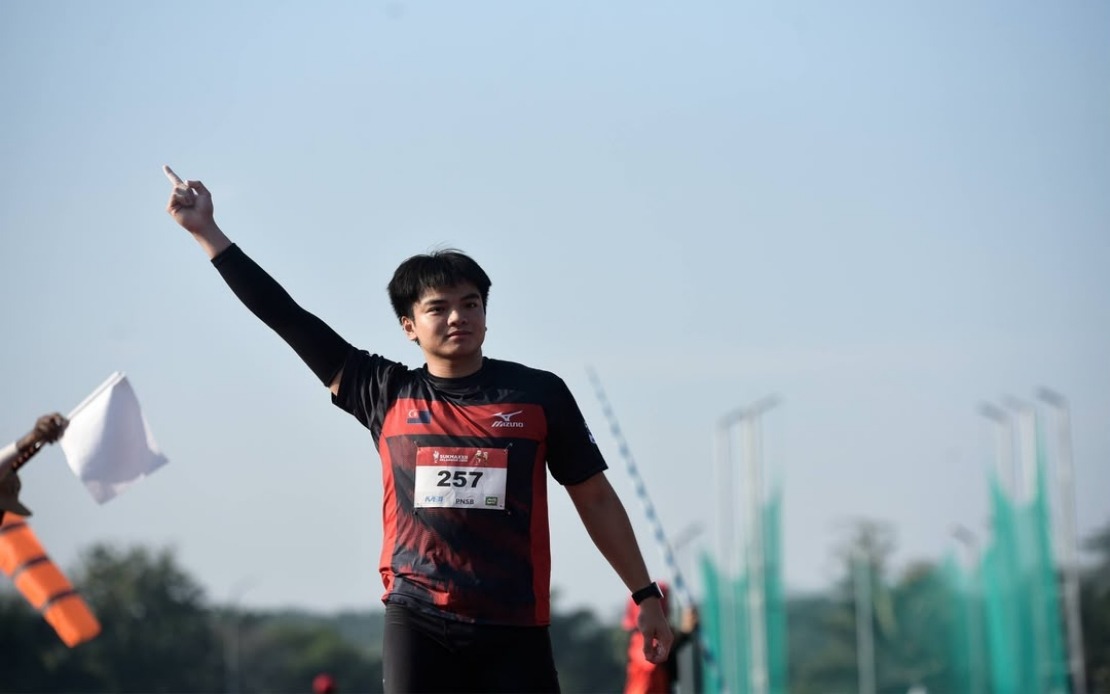
Johor's Chai Kai Le has become the latest Malaysian sporting success story, but his path to glory was paved with an unlikely beginning. The 18-year-old shattered a 26-year-old Malaysia Games javelin record at SUKMA 2026, held at the Universiti Putra Malaysia Sports Centre, with a commanding second-attempt throw of 64.44 metres. His achievement eclipsed the previous mark of 62.33 metres set by Sarawak's Kho Mei Kuan during the 2000 edition in Penang, marking a significant milestone for Malaysian athletics as the Games prepare for the Selangor 2026 edition.
What makes Kai Le's breakthrough particularly compelling is how his sporting journey began in an entirely different discipline. Before becoming a record-breaker in javelin, the pre-university student at Bukit Jalil Sports School was a competitive badminton player during his school years. It was during one of these badminton sessions that a perceptive teacher noticed something distinctive about his technique—specifically, the explosive speed and precision with which he released the shuttlecock. Rather than dismiss the observation as inconsequential, this teacher made a suggestion that would fundamentally alter the trajectory of Kai Le's athletic career.
The transition from badminton to javelin occurred when Kai Le was in Standard Six, a relatively late entry point compared to many elite throwers who specialise in track and field from younger ages. However, his natural athleticism and the kinetic awareness developed through badminton proved transferable. Once he committed to javelin, Kai Le invested himself fully in understanding the mechanics of the sport. He attended training sessions diligently and made deliberate efforts to learn from more experienced competitors, spending time observing senior athletes during competitions and studying their techniques.
Kai Le's articulation of his early motivations reveals the psychological drivers that often propel young athletes towards excellence. Watching accomplished throwers achieve distances that seemed almost incomprehensible to him as a beginner inspired a clear aspiration: to one day join their ranks and demonstrate comparable capability. This combination of hero worship and tangible goal-setting is a familiar pattern among successful Malaysian athletes who rise through domestic competition.
Underlying this personal determination, however, has been the foundational support provided by his father, Chai Yin Huan. In Malaysian sporting contexts, parental investment—both financial and emotional—frequently determines whether talented young athletes can sustain their development through the critical teenage years. Kai Le's father demonstrated unwavering commitment by financing physiotherapy and medical treatment whenever injuries occurred, purchasing replacement equipment as training wear deteriorated, and maintaining consistent encouragement throughout setbacks. Significantly, Chai Yin Huan never pressured his son to achieve elite status; rather, he emphasised personal excellence and long-term health as the primary objectives.
The past year has tested both the athlete and his family's resolve considerably. Kai Le has battled a succession of injuries affecting his back, right shoulder, and elbow—a troubling constellation of problems for someone whose sport demands explosive rotational power and shoulder stability. These injuries remain incompletely healed, creating a precarious situation where further training risks exacerbating existing damage. Yet rather than withdraw from competition, Kai Le continued training and competing throughout this period, including a significant appearance at the Indonesia Open earlier in 2024.
At the Indonesia Open, Kai Le delivered a performance that validated his perseverance through pain. He established both a personal best and the national under-20 record with a throw of 65.65 metres—a distance that exceeded even his SUKMA record and demonstrated that his potential extends considerably beyond what he has already achieved. This trajectory suggests that the injuries, while limiting, have not fundamentally compromised his athletic development or his capacity for progressive improvement.
Kai Le's immediate ambitions reflect the competitive pathway available to Malaysian athletes within regional competition structures. He has explicitly targeted a 70-metre throw as his next objective, viewing this milestone as instrumental to qualifying for the 2027 Southeast Asian Games. This target, while ambitious, sits comfortably within the realm of possibility given his recent performances and his age—elite javelin throwers typically reach their peak performances in their mid-to-late twenties, suggesting Kai Le has substantial room for development. To support this progression, he has arranged a one-month training stint in Japan scheduled for early next year, recognising that exposure to coaching and training environments at the highest international level can accelerate improvement.
The significance of Kai Le's record extends beyond the individual achievement. In the Malaysian sporting landscape, track and field remains less prominent and less financially supported than football or badminton, meaning that record-breakers in athletics often receive proportionally less public attention and sponsorship than their counterparts in other sports. Yet athletics records represent fundamental human achievement—they measure objective performance against historical benchmarks and provide concrete evidence of national sporting capacity. A 26-year-old record standing in 2024 suggests that Malaysian javelin has experienced limited progression at the elite level, making Kai Le's breakthrough potentially transformative for the sport's profile within the country.
Kai Le's candid assessment of his situation—"if you really want it, it will come"—captures an important philosophy about elite athletic achievement in Malaysia's context. Resource constraints, injury management challenges, and limited international exposure are persistent obstacles for Malaysian athletes, yet determination and consistent effort have repeatedly proven sufficient to overcome these barriers. His progression from schoolboy badminton player to record-breaking javelin thrower demonstrates that athletic talent can emerge unexpectedly and that responsive coaching combined with family support can nurture that talent effectively. As Kai Le pursues the 70-metre mark and qualification for the Southeast Asian Games, he represents both continuity in Malaysian athletic achievement and the potential for further progression if support systems remain in place.
Looking forward, Kai Le's journey invites reflection on talent identification in Malaysian sports systems. Many potentially elite athletes may never receive the opportunity that his badminton teacher provided—a moment when an observant coach recognised capability in an unexpected context and channelled it productively. As Malaysia continues developing its sports talent pipeline, replicating this model of identification and thoughtful redirection could unlock capabilities currently remaining dormant within the broader school-age population. Kai Le's success, therefore, transcends his individual record; it illuminates possibilities for systematic improvement in how Malaysian sports institutions discover and nurture emerging talent.

