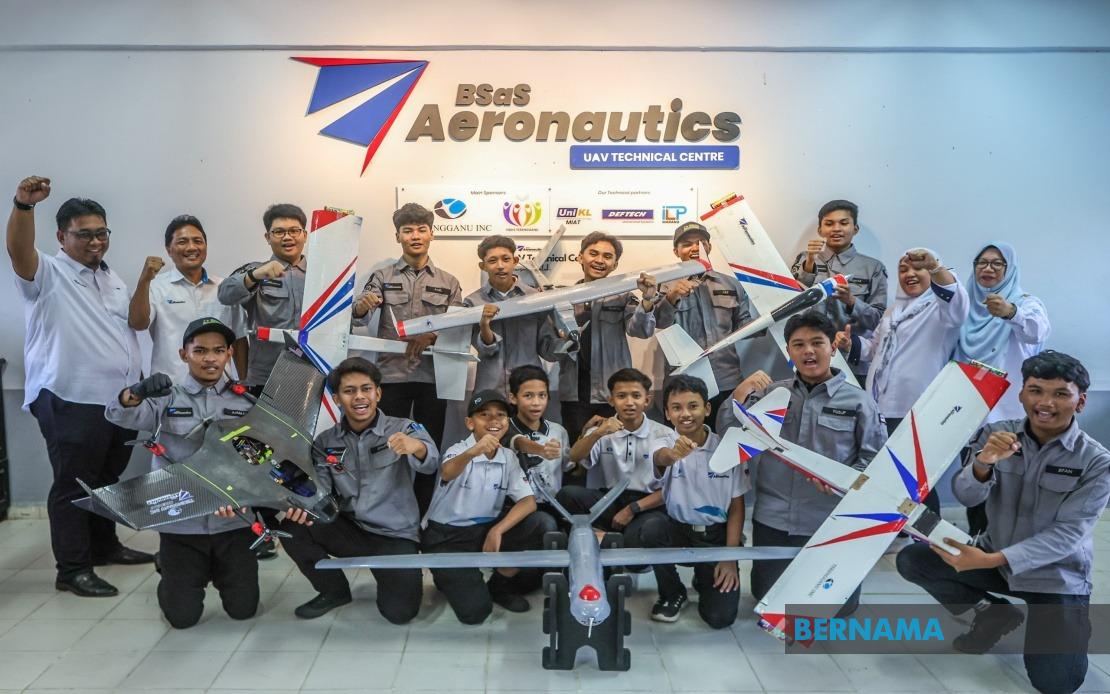
At SMK Bukit Sawa in Marang, an unconventional classroom experiment is transforming how a generation of Malaysian teenagers engages with advanced technology. What began as one English teacher's personal enthusiasm for remote-controlled aircraft has evolved into a structured educational initiative that has already produced five fully functional unmanned aerial vehicles and sent former students into aircraft engineering programmes at university. The TI-BSAS UAV In School programme represents a distinctive attempt to bridge the gap between theoretical physics and practical aerospace engineering, offering secondary school students genuine hands-on experience with cutting-edge technology.
Badrul Hisyam Zakaria, the English educator who spearheads the initiative, has guided 35 students through the vehicle design and construction process since the programme's inception in 2023. Each UAV that emerges from the school's workshops costs between RM6,000 and RM10,000 to build, with students learning to apply industrial techniques adapted for smaller scales. Rather than treating aircraft construction as abstract theory confined to textbooks, students engage directly with GPS integration systems, aircraft specifications, and the material sciences involved in aviation engineering. The pedagogical approach mirrors practices in advanced technical schools globally, yet its implementation in a rural Terengganu setting demonstrates commitment to democratising access to aerospace education beyond urban centres.
Terengganu Incorporated has proven instrumental in sustaining this ambition, committing RM75,000 in corporate social responsibility funding since the programme's launch. The initial RM45,000 investment in 2023 provided foundational resources, while an additional RM30,000 allocation in 2026 ensures continuity and expansion. For a state-based company, channelling such investment into student technological development reflects strategic thinking about workforce development in high-value sectors. The funding specifically targets B40 group students, ensuring that families facing economic constraints can participate in opportunities typically available only to more affluent households. This targeting addresses a persistent inequality in STEM education access across Malaysia's socioeconomic spectrum.
The programme's competitive validation arrived when SMK Bukit Sawa captured the championship title at the UAV Avionics Integration Challenge for secondary schools during the MyAERO Challenge 2026 competition held at MAEPS in Serdang, Selangor. This victory extends beyond institutional prestige; it signals that student-built systems can perform competitively against vehicles from other schools, validating the educational methodology and motivating continued participation. Competitive exposure compels students to refine design processes, troubleshoot failures, and iterate solutions under performance pressures that mirror genuine engineering environments. Success at this level generates momentum that sustains commitment among younger cohorts watching their older peers earn recognition.
Evidence of long-term impact already exists. Two former SMK Bukit Sawa students who participated in the UAV programme have progressed to aircraft engineering studies at Universiti Kuala Lumpur, while three others have advanced to matriculation-level science programmes. These trajectories suggest the initiative successfully influences career direction for participating students, converting exposure into sustained academic pursuit. Badrul Hisyam projects that within three or four years, the school will produce its first graduate aircraft engineer, fundamentally altering the institution's identity as a contributor to Malaysia's aerospace sector. This timeline reflects realistic expectations; educational interventions require sustained nurturing before yielding professional outputs.
The technological sophistication within the programme has progressed measurably. Earlier generations of student-built UAVs relied upon pre-programmed GPS coordinates for target detection, a functional but relatively static approach. Current development efforts incorporate artificial intelligence systems capable of visual target identification, elevating complexity and reflecting technological evolution within commercial aerospace applications. This upgrade trajectory prevents stagnation and maintains student engagement with advancing industry standards. Students designing AI-integrated systems gain exposure to machine learning principles, computer vision algorithms, and autonomous decision-making frameworks relevant to emerging aerospace applications globally.
Beyond individual student advancement, the programme embodies a strategic Malaysian objective: reducing technological dependence upon foreign suppliers and developing indigenous capacity for UAV development and production. Malaysia's aerospace sector has historically relied substantially upon imported systems and foreign technical expertise. By cultivating domestic talent beginning at secondary education level, the initiative contributes to building an extended pipeline of engineers capable of designing, manufacturing, and maintaining locally-produced UAV systems. This has implications for national security, economic sovereignty in high-technology sectors, and Malaysia's competitive positioning within Southeast Asian innovation ecosystems.
The collaboration structure itself merits attention. Partnership between a secondary school, state education authorities, and corporate sponsors demonstrates how distributed responsibility for technical education can function in Malaysian contexts. Badrul Hisyam coordinates vision and curriculum design; the Terengganu State Education Department provides institutional legitimacy and systemic integration; Terengganu Incorporated supplies sustained financial resources; and participating companies offer technical guidance and industry connections. This polycentric approach diffuses accountability and resource burden, making sustainable programmes more feasible than models depending upon single institutional champions or one-off government allocations.
For Malaysian policymakers observing skills shortages in STEM fields, the SMK Bukit Sawa model offers instructive lessons. Early exposure to sophisticated technology within school settings, combined with clear career pathway visibility through university placements and industry connections, appears to successfully convert student interest into sustained professional development. The programme demonstrates that geographical location in Terengganu rather than proximity to Kuala Lumpur's major research institutions need not constrain participation in advanced technical education. Students benefit from access to equipment, expertise, and competitive opportunities that would once have required relocation to metropolitan areas.
Looking forward, the question becomes whether this model can replicate across other Malaysian secondary schools, particularly in less-developed regions. Replication would require identifying enthusiastic educators willing to champion such programmes, securing corporate sponsors committed to sustained multi-year funding, and integrating technical education with existing curricula without overwhelming teachers already managing standard academic loads. The success at SMK Bukit Sawa suggests these barriers are surmountable, yet scaling requires institutional commitment beyond individual enthusiasts. If Malaysia aims to compete globally in aerospace technology and produce sufficient engineers for sector expansion, multiplying such programmes becomes strategically essential rather than merely beneficial.

