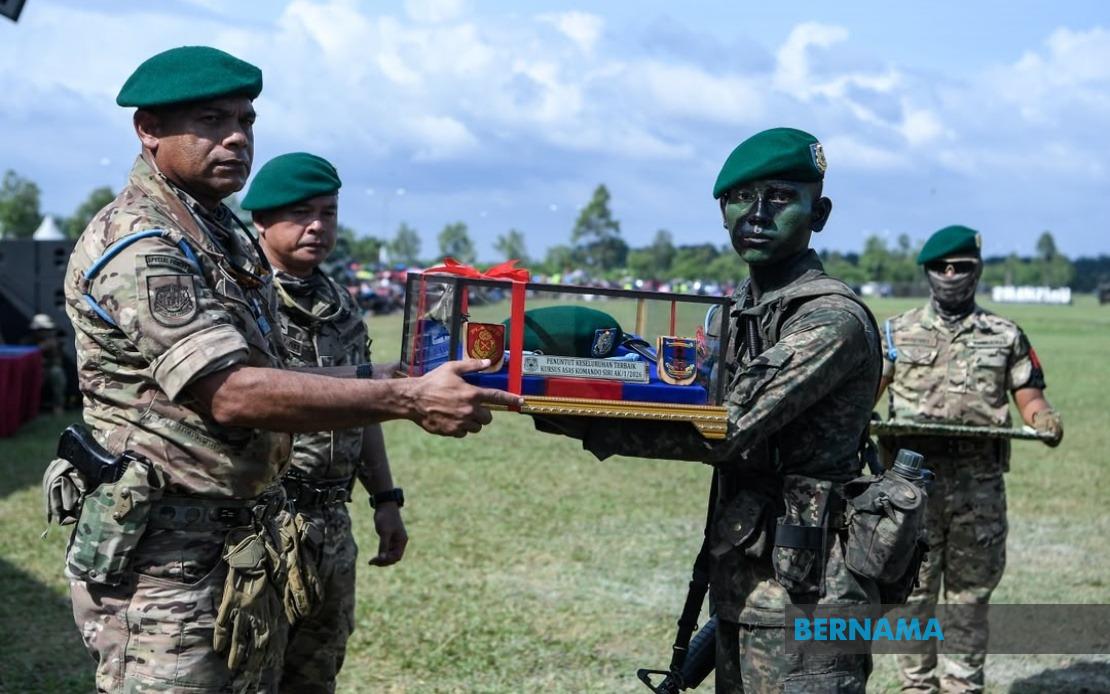
Second Lieutenant Muhammad Fadli Jamalluddin's path to becoming the Best Overall Trainee of the Basic Commando Course Series AK/1/26 was anything but straightforward. The 24-year-old officer from Ampang, Kuala Lumpur, had previously failed to complete the Basic Commando Course Series 3/2024, a setback that could have discouraged many from pursuing such a demanding career trajectory. Instead, he returned to the challenge with renewed determination, ultimately triumphing among a select cohort of military professionals at the conclusion of the gruelling three-month programme held at Universiti Sultan Abdul Halim Mu'adzam Shah in Kuala Ketil.
For Muhammad Fadli, the journey into Malaysia's elite military forces began long before his formal training commenced. His aspiration to serve in uniform took root during his secondary school years, a conviction that guided his decision to pursue tertiary studies at the National Defence University of Malaysia (UPNM). Following his graduation, he enlisted with the Royal Malay Regiment in 2024, setting the stage for his subsequent application to join the challenging world of special operations. This methodical progression reflects a deep-seated commitment to military service that extended beyond typical career considerations into matters of personal honour and family expectations.
The motivation driving Muhammad Fadli through such demanding physical and psychological trials runs considerably deeper than personal ambition. As the third of five siblings, he carries aspirations not merely for his own advancement but for his father's wellbeing and sense of pride. This familial dimension took on particular poignancy when his father suffered a stroke more than a year ago, transforming the commando course completion from a career milestone into something far more emotionally significant. The achievement, Muhammad Fadli reflected after the closing ceremony, represented the most meaningful gift he could offer his parents and broader family unit, especially given his father's inability to attend the ceremony in person.
The path to the final award proved far from assured. During week eight of the demanding course, Muhammad Fadli encountered another critical juncture when he failed one of the essential training exercises—a failure that threatened to force him to repeat the entire programme from the beginning. The emotional weight of this moment cannot be understated; having already endured more than 100 kilometres of relentless endurance marching and countless other physical ordeals, falling short at such an advanced stage tested his resolve in ways that extended beyond mere physical conditioning. He openly acknowledged the tears shed in response to this setback, a human response that underscored the psychological intensity of commando training.
Where many trainees might have accepted the advice of colleagues to withdraw from the programme, Muhammad Fadli instead fundamentally reframed his understanding of failure. Rather than viewing it as a terminal verdict on his suitability for commando service, he reconceptualised the setback as an opportunity to demonstrate the very qualities that elite military units seek in their personnel: adaptability, mental resilience, and an capacity to function effectively under extreme duress. This philosophical shift proved instrumental in his decision to continue, ultimately validating his gamble through his subsequent performance and final recognition.
The Basic Commando Course Series AK/1/26 that Muhammad Fadli completed represents one of Malaysia's most rigorous military training regimens. The three-month duration belies the intensity of the curriculum, which deliberately integrates demanding land and sea training elements designed to stress both physiological systems and psychological fortitude to their absolute limits. Trainees must develop not only exceptional physical conditioning but also the mental acuity and decision-making capacity required for special operations work. Muhammad Fadli, who holds a Bachelor's degree in Global Policing and Intelligence with Honours, possessed the intellectual foundation for such work, but translating theoretical knowledge into practical performance under extreme conditions requires a qualitatively different skill set.
The distinction between becoming a commando and becoming a commando officer introduces an additional layer of complexity to the already formidable challenge. Muhammad Fadli emphasised this distinction in post-course reflections, noting that officer-level commandos must combine physical prowess with sophisticated cognitive capabilities. Many special operations require meticulous planning, sound tactical decision-making, and the ability to lead teams through unpredictable and hazardous environments. These requirements mean that selection processes deliberately eliminate individuals who possess either physical strength or mental capability in isolation; candidates must demonstrate excellence across both dimensions simultaneously.
The cohort that successfully completed the Basic Commando Course Series AK/1/26 comprised five officers and 33 other ranks, a small group reflecting the inherently selective nature of commando training. Not all who commence the course complete it; attrition rates in such programmes typically run substantially higher than in regular military training, a reflection of both the physical demands and the deliberate psychological testing built into the curriculum. Muhammad Fadli's achievement of Best Overall Trainee status positioned him not merely as a successful graduate but as the outstanding performer within this already-elite group.
The formal recognition of his achievement came through the presentation of the Best Overall Trainee award by Colonel Nordin Abu, Commandant of the Special Warfare Training Centre (PULPAK), at the closing ceremony. This institutional recognition carries significant weight within military hierarchies, signalling not merely completion of requirements but demonstrated excellence across the spectrum of commando competencies. For a young officer at the beginning of his career, such recognition can substantially influence trajectory and future assignment opportunities within Malaysia's special operations community.
Muhammad Fadli's journey holds particular resonance for broader considerations about resilience, motivation, and the nature of military excellence in contemporary armed forces. His initial failure, rather than serving as a disqualifying factor, ultimately contributed to a more complete demonstration of the psychological qualities that effective commandos require. The ability to absorb failure, reframe setback as opportunity, and return to a challenge with renewed determination reflects a maturity and self-awareness increasingly recognised as essential for special operations personnel. Furthermore, his transparent acknowledgement of emotional responses—the tears, the doubts, the moments of weakness—humanises military excellence in ways that combat the occasionally-distorted mythology surrounding commando forces.
For Malaysian military recruitment and retention strategies, Muhammad Fadli's example illustrates the value of persistence in identifying and developing exceptional personnel. The decision to attempt the course a second time represented a calculated risk; success could establish a career trajectory of distinction, while failure would carry psychological costs. Yet the willingness of institutional structures to provide second opportunities, combined with individual determination to pursue excellence, produces precisely the calibre of officer that modern special operations require. His achievement in 2026, following his 2024 setback, demonstrates that military training systems functioning at their best identify potential beyond initial performance, creating pathways for redemption and ultimate realisation of talent that might otherwise remain underdeveloped.

