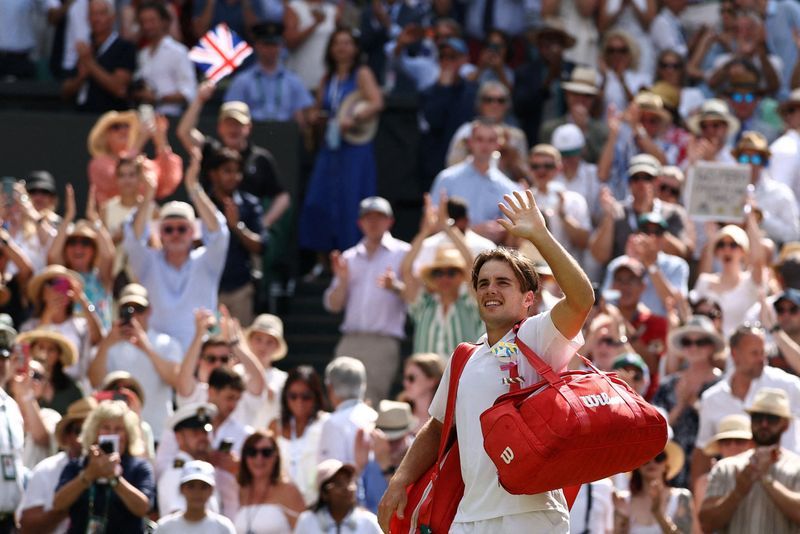
Arthur Fery had resigned himself to a leisurely escape when he received his wildcard entry to Wimbledon. The 23-year-old British player, ranked 114th in the world, had booked a holiday to Greece with friends and fully expected to be poolside by now, enjoying the Mediterranean sunshine rather than contending for silverware on the All England Club's hallowed grass courts. Instead, his Greek getaway evaporated as he kept winning, advancing through round after round to accomplish something no other wildcard had managed in a quarter-century—reaching the men's semi-finals at tennis's most prestigious tournament.
Fery's unexpected journey through the draw proved so remarkable that his own social circle had difficulty believing in the possibility of his success. One friend, doubting the prospect of extended matches, had travelled to Greece ahead of schedule, effectively writing off Fery's tournament hopes. The gamble backfired spectacularly. By the time reality caught up with his friend, Fery was still alive in the competition, and the early departure had to become a retreat back to London to cheer on the rising star. It's a poignant reminder of how rarely athletes in any sport defy expectations so thoroughly that even those closest to them struggle to process the magnitude of the turnaround.
The momentum Fery generated transcended the confines of professional tennis. Over the past eleven days, the French-born player captured the imagination of the entire British sporting public in a way few athletes manage. His support base expanded dramatically as he overcame five opponents to reach the semi-finals, with the backing extending far beyond the Wimbledon crowd. England's World Cup football team recorded a video message of encouragement, while members of the royal family—Queen Camilla and Princess Kate—attended matches to witness his performances firsthand. This convergence of national attention, rare even for established British champions, underscored the fairy-tale quality of his run.
The scale of Fery's achievement becomes clearer when considering his previous experience at major tournaments. Before this month, he had won only two matches in total across all Grand Slam competitions. His ranking at 114th placed him in that vast middle ground of professional tennis where most players struggle to secure the resources and opportunities needed to break through to consistent winning. A wildcard entry—essentially a gift from tournament organisers—represented a chance to gain exposure against elite opposition, not necessarily a platform for historic advancement. Yet here he stood, having navigated the unpredictable nature of best-of-five-set play to reach the semi-finals, where his journey ended when Alexander Zverev defeated him in straight sets on Friday.
While Zverev's victory halted Fery's incredible momentum, the German's clinical performance could not diminish what the British player had already accomplished. The mental and physical demands of deep Grand Slam runs at such an elevated level typically require years of preparation and incremental improvement. Fery had condensed a developmental arc into two weeks, learning how to manage pressure, maintain fitness in demanding conditions, and execute under the scrutiny of unprecedented media attention. His ranking, which stands to improve dramatically—projected to reach the mid-30s—reflects only the surface-level impact of his performance.
Fery's own perspective on his future demonstrates mature awareness of the challenges ahead. He acknowledges that significant ranking improvement brings new pressures and expectations from multiple constituencies. His current ATP ranking will now unlock entry into tour-level events throughout the year, opening doors that remained closed during his career as a lower-ranked player. This access to regular competition against top professionals represents the kind of structural advantage that compounds over seasons, allowing players to accumulate match experience and refine their games against elite opposition. For Fery, the next twelve months could prove transformative in establishing whether his Wimbledon success represents the beginning of a sustained rise or a spectacular outlier.
The implications for Southeast Asian tennis observers warrant attention. While Fery's nationality is British, his run demonstrates how grasscourt mastery remains achievable through unconventional pathways. The rise of young players from lower rankings—particularly those with strong serve-and-volley games suited to grass—challenges conventional wisdom about the necessity of junior pedigree and consistent junior ranking progression. For aspiring players across the region, Fery's trajectory offers both inspiration and cautionary lessons about the importance of taking advantage of tournament opportunities whenever they arise.
Fery's immediate plans involve recovery and reflection. He has explicitly stated that he requires substantial rest to process the whirlwind of the past fortnight and rebuild mentally before returning to competition. The hardcourt season in North America beckons, culminating with his debut at the U.S. Open at Flushing Meadows—another prestigious stage that seemed distant just weeks ago. That American swing will provide an early indication of whether his grass-court brilliance translates to other surfaces, a crucial test for any emerging player.
The financial rewards accompanying Fery's semi-final appearance—£900,000—afford him practical benefits that extend beyond the psychological boost of performance recognition. This prize money substantially exceeds what most players at his ranking would normally accumulate, providing resources for improved training facilities, coaching staff expansion, and the general infrastructure necessary to support sustained excellence. That upgraded holiday he mentioned, whether he eventually takes it to Greece or elsewhere, pales in comparison to the long-term advantages this tournament run has created.
Fery's story captures something essential about professional sports in the modern era: the persistence of genuine unpredictability within highly structured competitions. Despite tennis's tendency toward predictability at the elite level, a young player with limited Grand Slam experience can still capture the public imagination through a combination of skill, mental fortitude, and fortunate draw positioning. As Fery looks toward establishing himself as a permanent fixture on the professional tour, the memory of his Wimbledon adventure will serve as both inspiration and benchmark—a reminder of what becomes possible when everything aligns correctly.

