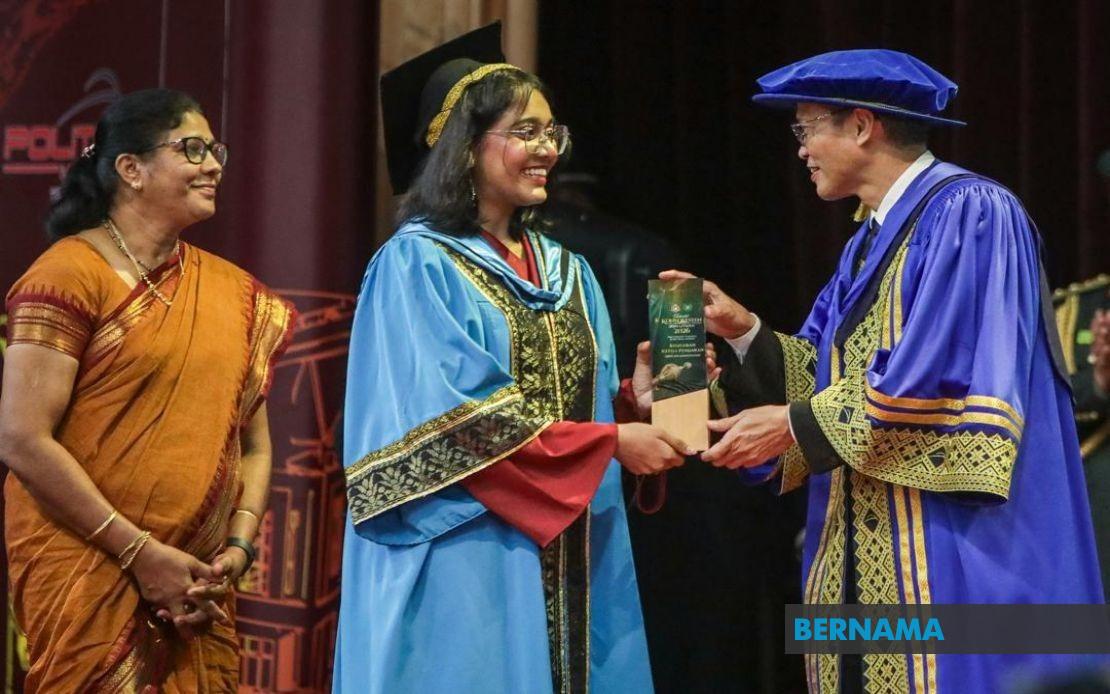
Teerti Ganapathi Rao's journey through the Diploma in Digital Technology programme at Politeknik Tuanku Syed Sirajuddin (PTSS) in Arau became a testament to human resilience when she not only completed her studies but earned top institutional honours despite enduring profound personal loss. The 22-year-old received the Director-General's Award and the Academic and Co-Curricular Excellence Award during the 2026 Northern Zone Polytechnic and Community College Convocation Ceremony, completing a remarkable three-year journey marked by both tragedy and triumph.
The circumstances surrounding her success make her achievement particularly poignant. Teerti lost her father while sitting for her Semester Two examinations in 2023, a period that would have tested the resolve of even the most determined student. Rather than allowing grief to derail her academic plans, she channelled the memory of her father's encouragement into her studies, ultimately graduating with a cumulative grade point average of 3.61. Speaking to reporters after the ceremony at Dewan Harumanis, she reflected on the unexpected nature of the recognition, expressing surprise and profound gratitude at being selected for such prestigious awards.
The foundation of Teerti's determination lay in the paternal guidance she received before her father's passing. As the youngest of four siblings, she had initially contemplated abandoning her diploma aspirations to pursue a foundation programme instead. Her father's consistent counsel to complete the diploma became her anchor during the darkest period of her academic life. She has described clinging to that advice as the catalyst that sustained her through examinations, assignments and the emotional turbulence of grief, ultimately carrying her across the graduation finish line.
Beyond academic performance, Teerti demonstrated sustained excellence across multiple semesters and dimensions of student life. She received the Head of Department's Award for Semesters One, Three and Four from the Department of Information and Communication Technology, recognising consistent scholarly achievement throughout her course. This pattern of recognition underscored that her Director-General's Award represented not a single moment of brilliance but rather sustained dedication across her programme of study.
Her contributions extended significantly into co-curricular and leadership domains, areas that often distinguish exceptional graduates from merely competent ones. Teerti served as a member of the Student Representative Council (MPP), where she developed crucial soft skills in leadership, communication and collaborative teamwork. These experiences prepared her not merely as a technologist but as a rounded professional capable of working effectively within organisational structures and diverse teams—competencies increasingly valued by Malaysian employers across the technology sector.
Teerti's intellectual engagement transcended campus boundaries during her polytechnic years. She represented PTSS in a collaborative programme and seminar paper presentation at Universiti Putra Indonesia, gaining exposure to international academic contexts and regional research collaborations. For her final-year capstone project, she developed the Koop Printing System, a software solution engineered to enhance operational efficiency within cooperative printing service management. This practical, problem-solving orientation reflects the applied technology focus that characterises polytechnic education in Malaysia.
Language proficiency emerged as another notable dimension of her profile. Beyond the expected fluency in Bahasa Melayu and English, Teerti demonstrated functional capability in Mandarin, Tamil and Telugu—languages reflecting Malaysia's multicultural fabric and valuable in an increasingly globalised technology sector. She also possesses foundational knowledge of French, Japanese and Korean, suggesting intellectual curiosity and openness to cross-cultural communication that positions her advantageously for future international career opportunities.
Looking forward, Teerti's ambitions extend well beyond her diploma. She is awaiting results from her application to pursue a Bachelor's degree in Information Technology, with Universiti Malaya listed as her preferred institution. Her stated long-term goal encompasses doctoral-level study, indicating her intention to pursue not simply professional practice but potentially research and innovation within her chosen field. This trajectory, from polytechnic diploma through undergraduate and postgraduate levels, represents an increasingly common pathway for high-achieving Malaysian technology students seeking to reach senior professional and research positions.
Teerti's interest in information technology originated earlier than many peers, sparked at age 16 when friends introduced her to computers and coding through the medium of video games. Rather than remaining a casual interest, this early exposure evolved into serious professional intent. She articulates a thoughtful understanding of the learning process, noting that while the IT field presents genuine challenges, systematic study and conceptual understanding progressively render complex ideas more accessible. This pedagogical insight suggests maturity beyond her years and realistic expectations about the demands of advanced technology education.
The 2026 Northern Zone Polytechnic and Community College Convocation Ceremony, graced by Raja of Perlis Tuanku Syed Sirajuddin Jamalullail, recognised 6,104 graduates from institutions across Perlis, Kedah and Penang. Within this cohort of thousands, Teerti's recognition for dual achievement—exceptional scholarship combined with meaningful co-curricular contribution—positioned her among her institution's most accomplished students. Her story resonates particularly with Malaysian audiences as a contemporary example of how polytechnic education, traditionally positioned as vocational-technical training, increasingly produces graduates with research interests, international exposure and sophisticated intellectual aspirations.
Teerti's experience carries broader implications for understanding student resilience and institutional support within Malaysian polytechnics. Her ability to persist through bereavement while maintaining academic standards raises questions about the psychological support systems available to students experiencing trauma, as well as the intrinsic motivation and family cultural values that enable some individuals to channel grief into purposeful achievement. Her success suggests that polytechnic students, often characterised as practically oriented, frequently possess the intellectual capacity and determination to succeed at university and postgraduate levels when given opportunity.
As Malaysia increasingly emphasises technical education and technology sector development, graduates like Teerti embody the potential within polytechnic institutions to produce not merely skilled technicians but thoughtful professionals capable of contributing meaningfully to innovation, research and organisational leadership. Her multilingual capability, international exposure and demonstrated commitment to continuous learning position her as representative of a new generation of Malaysian technology professionals equipped for roles transcending traditional boundaries between vocational and university education.

