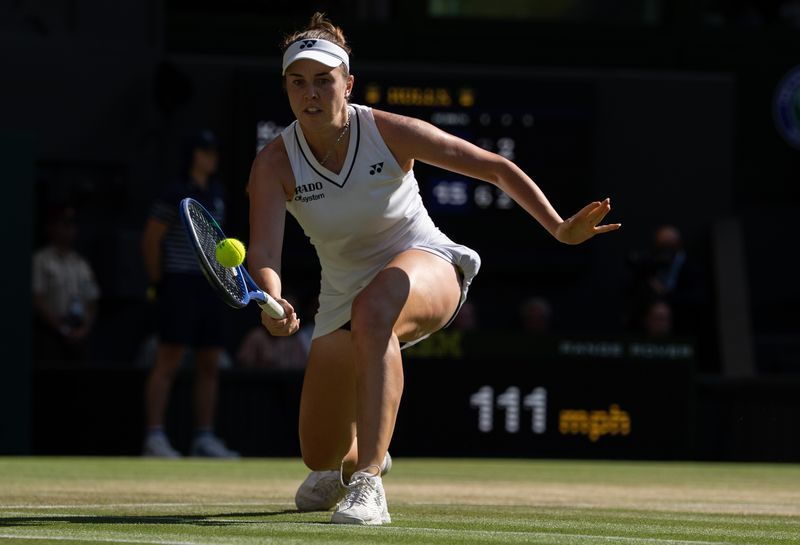
Linda Noskova's Wimbledon triumph stands as one of tennis's most remarkable demonstrations of psychological resilience, with the 21-year-old Czech ninth seed capturing the women's singles title by defeating compatriot Karolina Muchova 6-2 5-7 6-3 on Saturday at the All England Club. The victory gains added significance when viewed against the backdrop of Noskova squandering five consecutive match points during the contest—a sequence that would have consigned most players at her career stage to lasting tournament regret.
The trajectory of the match itself appeared straightforward when Noskova established commanding control in the opening two sets. Leading 5-2 in the second set, she wielded the power to seal victory within minutes, with the coveted Venus Rosewater Dish appearing within touching distance on Centre Court. Yet what unfolded instead became a masterclass in competitive adversity. Muchova held serve at 2-5 despite facing a match point; she double-faulted on another opportunity when serving at 5-3, the pressure visibly affecting her execution; and a fifth match opportunity disappeared in the ninth game. Rather than the expected coronation, Muchova engineered an improbable comeback, reeling off five successive games to force a third-set decider that had seemed inconceivable minutes earlier.
The psychological impact of this reversal manifested visibly as Noskova returned to her chair, visibly shell-shocked and covering her ears to muffle the crowd's roars. Her body language suggested a player grappling with the notion that victory had slipped irretrievably beyond her grasp. However, during a crucial comfort break, a moment of clarity proved transformative. As she walked past the trophy display, Noskova's attention fixed on the Wimbledon trophies, and she made a quiet declaration to herself that would reshape her mental approach for the final set.
In the immediate aftermath of her victory, Noskova articulated the precise moment that reversed her psychological trajectory. She explained to reporters that the bathroom interlude—where she splashed cold water on her face to reset her equilibrium—served as a physical reset, but the true catalyst emerged when she caught sight of the championship trophies. Standing before them, she made an unmistakable vow: she would claim the larger trophy regardless of circumstance, refusing to accept the consolation of runner-up status given how closely she had approached ultimate victory.
This mental reframing proved decisive when she resumed play in the third set. Holding serve in the opening game represented a crucial moment of momentum reversal, one that Noskova herself identified as fundamentally altering the dynamic of the deciding set. The act of holding serve immediately after facing the possibility of defeat created a psychological inflection point—a moment when the pendulum swung decisively in her favour. From that juncture, her technical game rekindled; the timing on her groundstrokes returned, her footwork regained its precision, and her serve became a reliable weapon rather than a source of vulnerability.
When Noskova reached match points again at 5-3 in the third set—more than an hour after her first such opportunity—she would not squander another. This time, she converted decisively, ensuring that the trophy she had envisioned during her moment of crisis would indeed find its way into her possession. At 21 years old, she became the third Czech woman to claim the Wimbledon singles title within four years, and the youngest women's champion since compatriot Petra Kvitova won the first of her two titles in 2011.
For Malaysian and Southeast Asian observers, Noskova's achievement resonates beyond the immediate tennis narrative. Her story exemplifies how psychological preparation and emotional resilience often determine outcomes in high-pressure competitions, a lesson applicable across professional and personal contexts. Her reflective post-match comments revealed a player whose emotional maturity far exceeds her chronological age, speaking openly about the influence of her mother Ivana, who died from cancer two years prior. This personal context infuses her Wimbledon victory with deeper meaning—not merely a sporting accomplishment but a tribute to family loss and the enduring drive to honour absent loved ones through achievement.
Beyond competitive tennis, Noskova demonstrates a philosophical orientation that distinguishes her from contemporaries focused solely on sporting glory. Her documented charitable work in Zanzibar, where she volunteered at a school during her off-season, alongside her vocal commitment to environmental conservation, positions her as an athlete conscious of responsibilities extending beyond tournament victories. She has articulated clear intentions to pursue environmental volunteering in the years ahead and carries a broader worldview informed by experiences in developing contexts.
Noskova's background also differentiates her journey. Growing up in a Czech village surrounded by forest has shaped her values and perspective, fostering a grounded temperament that manifested during Saturday's championship contest. When conventional wisdom suggested that squandering five match points would precipitate psychological collapse, she instead demonstrated the emotional equilibrium and mental flexibility to recalibrate her approach. The nose ring that marks her appearance symbolizes an individualistic spirit that extends into her thinking and decision-making.
The implications of her victory extend across European tennis, where Czech women have established themselves as formidable forces at the sport's highest echelon. The nation's consistent production of world-class female players reflects robust institutional support and competitive culture, yet Noskova's triumph suggests a new generation poised to sustain this tradition. Her capacity to navigate pressure, learn from setbacks, and maintain perspective during moments of acute disappointment provides a template for how younger players might approach future Grand Slam opportunities.
Looking forward, Noskova has emphasized her intention to permit the magnitude of her achievement to settle upon her consciousness. She acknowledged that the preceding two weeks—encompassing both her journey through the tournament and the intensity of the final itself—represent an experience she will never entirely forget. This measured reflection, combined with her demonstrated mental fortitude, suggests that a player capable of managing such extraordinary pressure at age 21 likely possesses the psychological foundations for sustained success at tennis's highest level.

