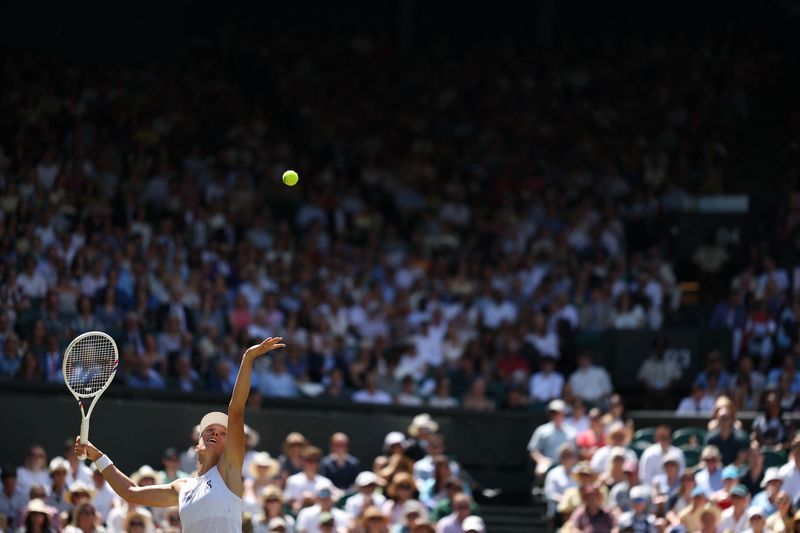
Alexandra Eala's remarkable run at Wimbledon reached new heights on Saturday when the rising Filipino star engineered one of the tournament's biggest shocks, ousting Poland's Iga Swiatek, the defending champion and third seed, in a fiercely contested third-round encounter at the All England Club. The final scoreline of 7-6(9) 6-2 masked the intensity of a battle that captivated Centre Court spectators during a sweltering afternoon in London, marking a watershed moment in the 20-year-old's fledgling professional career.
Swiatek arrived at this year's Wimbledon already burdened by questions about her form and mental resilience on the grass. Though her triumph last summer had finally silenced critics who questioned her ability to perform on the sport's fastest surface, the Polish star had limped into the All England Club following an early defeat at the Bad Homburg preparation event. Her path through the opening two rounds—victories over Taylor Townsend and Karolina Pliskova—suggested a player gradually finding her rhythm, yet the consistency that had defined her clay-court dominance remained elusive on the unforgiving grass.
Eala's left-handed weaponry proved particularly troublesome for Swiatek from the opening rallies. The Filipino's aggressive baseline game, powered by exceptional shot-making and tactical acumen, immediately unsettled the Pole, who found herself frequently pushed back and forced into defensive positions. The opening set epitomised this high-octane contest, with neither player conceding ground easily until Eala claimed the tiebreaker at 9-7, a thrilling decider that left Swiatek visibly frustrated. The three-time Grand Slam champion's courtside behaviour deteriorated as the set concluded, with animated gesticulations toward her coaching box and a racket slam on her chair signalling mounting frustration.
Eala, however, fed off the electric atmosphere and the palpable support from the crowd. When the second set began, she seized the momentum with devastating efficiency, earning a double break to establish a commanding 3-0 lead. Though Swiatek mounted a brief recovery, breaking back once and threatening to narrow the deficit, Eala's nerve held firm. The Filipino closed out the match decisively with a trademark forehand winner, securing passage to the fourth round and a tantalising encounter with Jasmine Paolini, the 2024 runner-up.
In her post-match remarks, an emotional Eala gave voice to the profound personal significance of her achievement. She articulated the journey from her childhood in the Philippines, when she trained daily alongside her brother and grandfather after school, wearing the inexpensive equipment of a young athlete without elite resources—ruffled socks and light-up shoes—before rising to compete against the world's best on tennis's most hallowed ground. Her humility was evident as she acknowledged that while her achievement might appear modest compared to the decorated careers of legends like Serena and Venus Williams or the multiple Grand Slam titles accumulated by Swiatek, for a player from her background, reaching the second week of a Grand Slam represented the culmination of years of sacrifice and dedication.
Yet beneath Eala's emotional gratitude lay a steely determination. She emphasised that her satisfaction with this victory remained incomplete, that the emotional outpouring reflected the magnitude of the occasion rather than complacency about her prospects. This mental resilience, evident in her clinical performance under pressure, suggests a competitor who views each victory as a stepping stone rather than a destination. Her comments about seizing opportunities when they arise, framing them as blessings earned through sustained effort, revealed the mindset of an athlete who recognises that such chances rarely materialise repeatedly.
The significance of this upset extends beyond the immediate tournament context. Eala had previously met Swiatek twice before, falling to the Pole in their Miami encounter last year but gaining revenge on the clay courts of Madrid. The grass-court victory, however, carries different weight. It demonstrates that Eala's game possesses the versatility to trouble elite opponents across different surfaces—a crucial attribute for sustained success at the highest level. The confidence gained from defeating the previous year's champion could prove transformative for her trajectory, particularly as she navigates what promises to be an extremely challenging fourth-round contest against Paolini, a player who came excruciatingly close to claiming Wimbledon's title just months earlier.
For Swiatek, the defeat represents a significant setback in her attempt to establish herself as a consistent threat on grass. The Pole's struggles this season, punctuated by early exits from preparation events and now an unexpected third-round elimination in defence of her title, raise questions about her mental approach and physical preparation for tournaments outside her clay-court comfort zone. Her aggressive displays of frustration on court, while understandable given the circumstances, also suggest an athlete perhaps struggling to process the pressure of maintaining elite status across multiple surfaces simultaneously.
The match also highlighted the evolving depth of women's professional tennis. The rise of players like Eala, who combine technical excellence with unwavering mental fortitude, reflects the increasing competitiveness of the sport. A generation of players from diverse geographic backgrounds, supported by modern training infrastructure and global pathways to professional opportunities, are now capable of challenging the established elite with remarkable consistency. For Southeast Asian tennis, Eala's advancement represents a watershed moment, bringing visibility to the region's emerging talent and demonstrating that success at the highest levels of professional sport remains achievable for dedicated athletes from developing tennis nations.
As Eala prepares for her encounter with Paolini, she carries not only the momentum from defeating one of the sport's most formidable competitors but also the knowledge that a young girl from the Philippines, training in modest circumstances with her family, has now graced Centre Court at Wimbledon during the sport's most prestigious fortnight. Whether she can maintain this extraordinary level and mount a serious challenge to the tournament's remaining contenders remains to be seen, but she has already accomplished something that will resonate far beyond tennis circles in her home country.

