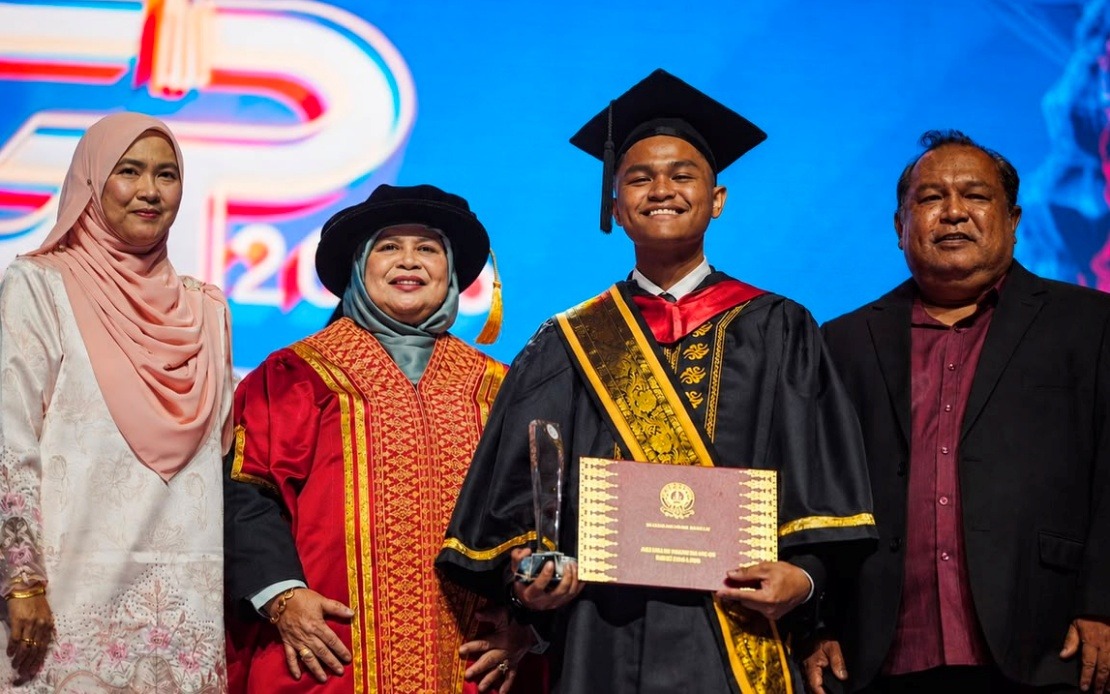
Muhammad Aaqif Dino Faezal's trajectory through Malaysia's education system exemplifies how strategic institutional support can transform student potential into tangible international achievement. The 19-year-old, who began his secondary education at MARA Science Junior College Tun Ghafar Baba in Melaka, has secured admission to study geology at Imperial College London beginning this September—a milestone that would have remained financially unattainable without intervention from Majlis Amanah Rakyat (MARA). His selection as the 2026 MARA College Graduate Icon on August 20 underscores not merely academic excellence but a comprehensive commitment to personal development that increasingly defines competitive higher education pathways in the region.
The financial architecture underpinning Aaqif's transition to elite tertiary education reveals the persistent structural barriers facing talented Malaysian students from middle-income households. He received comprehensive sponsorship through MARA's Young Talent Development Programme to undertake the International Baccalaureate Diploma Programme at Kolej MARA Banting from 2024 through May 2026. In his own assessment, without this targeted financial intervention, the compounded costs of overseas accommodation, tuition and living expenses would have rendered such aspirations prohibitively expensive. This constraint, he explained during his interview with the national news agency, represented perhaps the most formidable obstacle between ambition and execution—a reality that resonates across Southeast Asia where geographic mobility remains stratified by family wealth.
Aaqif's academic performance during his two years at KMB provides concrete evidence of how institutional investment yields measurable returns. His examination results in the IBDP assessment last May totalled 44 out of 45 points, positioning him among the highest-performing cohorts emerging from the college in recent years. Yet MARA's evaluation framework, particularly in identifying the annual College Graduate Icon, prioritizes multidimensional development beyond numerical assessment. The award recognises candidates demonstrating exceptional academic results alongside demonstrated leadership capability, community contributions and identifiable potential to become influential figures advancing Malaysian interests internationally. This holistic lens reflects evolving employer and institutional expectations that pure academic credentials increasingly require complementary soft skills and demonstrated civic engagement.
During his tenure at KMB, Aaqif held the position of president of the Students' Representative Council, navigating the complex interpersonal dynamics inherent in student leadership roles. Beyond administrative responsibilities, he participated extensively in co-curricular and community service initiatives, earning recognition through the KMB Best Graduate Award and the Co-curricular Icon Award presented at the MARA Professional College and MARA College Inspiration Awards Day. These involvements represent more than resume augmentation; they furnished practical experience in consensus-building, organisational management and cross-sectoral communication—capabilities increasingly essential for professionals operating in multinational environments or leading complex technical projects.
The strategic value of MARA's intervention extends beyond individual social mobility to Malaysian national interests in retaining high-potential graduates within professional networks connected to domestic development priorities. Aaqif has articulated specific intentions to leverage his geology training and international experience toward contributions in Malaysia's hydrocarbon and renewable energy sectors. This alignment between personal career trajectories and national development objectives—whether intentionally cultivated through programme design or organically emerging from beneficiary motivations—suggests how scholarship mechanisms function as soft power infrastructure. Graduates positioned within prestigious international institutions maintain ongoing professional and personal connections to Malaysian institutions, potentially facilitating knowledge transfer, collaborative research and professional networks that strengthen domestic technical capacity.
Arfaseela Amir, serving as KMB's director, situated Aaqif's achievements within MARA's institutional philosophy emphasizing balanced human development. Her characterisation of the college's mission—producing graduates who combine intellectual rigour with robust character formation—reflects broader global trends wherein educational institutions increasingly recognise the inadequacy of purely cognitive development. Aaqif's ability to function simultaneously as an effective leader while maintaining collaborative relationships with institutional management suggests emotional intelligence and political acuity extending beyond technical academic domains. For Malaysian employers and policymakers evaluating workforce readiness in competitive international sectors, such integrated capabilities assume heightened significance.
The trajectory from MRSM through KMB to Imperial College London also illustrates how Malaysia's tiered educational institutions function as a talent pipeline, with selective colleges serving as preparation grounds for competitive international entrance processes. MRSM facilities, operating under MARA stewardship, maintain responsibility for identifying promising lower-secondary students, while colleges like KMB provide concentrated instruction in internationally-recognised curricula that bridge Malaysian qualifications frameworks with global university admissions standards. This sequential structure requires substantial public investment but potentially optimises outcomes by concentrating resources on demonstrably high-potential cohorts, a model increasingly adopted across Southeast Asian nations pursuing competitive positioning in global knowledge economies.
Aaqif's personal reflection on receiving the Graduate Icon designation emphasises the emotional and relational dimensions underlying his educational journey. His characterisation of the recognition as partial homage to family, educators, peers and institutional collaborators reveals sociocultural contexts in which achievement remains understood as fundamentally collective rather than purely individual. This framing, common across East and Southeast Asian contexts, contrasts with Western educational narratives frequently emphasising individual merit divorced from systemic support structures. His acknowledgment of familial and institutional contributions, alongside candid recognition of challenges and sacrifices, models the psychological integration increasingly expected of leaders navigating cross-cultural professional environments.
The implications for Malaysian education policy merit careful consideration. MARA's investment in Aaqif represents significant capital allocation—encompassing tuition, accommodation, institutional support and administrative resources across multiple years—justified through competitive selection and rigorous performance monitoring. The Young Talent Development Programme's targeting of International Baccalaureate preparation indicates deliberate alignment with globally-recognised academic currencies, acknowledging that domestic qualifications alone may limit competitiveness in elite international admission processes. As Malaysian policymakers contemplate education financing amid competing budgetary pressures, MARA's model of concentrated support for high-potential beneficiaries offers evidence that selective scholarship approaches, properly targeted and monitored, generate demonstrable international achievement and institutional prestige.
Aaqif's anticipated enrolment at Imperial College London this September continues a tradition of Malaysian students contributing to the institution's diversity and international cohort composition. Imperial's geology programme, particularly research-focused dimensions addressing resource extraction and environmental management, aligns strategically with Malaysia's economic structure and emerging energy transition imperatives. His presence in the programme augments Malaysian institutional visibility within elite academic spaces while positioning him as a future bridge between international technical networks and domestic sectoral requirements. Should his career development proceed through anticipated channels—graduate-level specialisation, professional practice in energy sectors, potential return migration—his trajectory exemplifies optimal outcomes for targeted scholarship investment.
The broader significance of Aaqif's achievement transcends individual biographical interest. His journey illustrates how Malaysian institutions operating within regional contexts confront persistent challenges in talent development and international competitiveness. MARA's sustained commitment to identifying and nurturing high-potential students, supported through systematic educational infrastructure and competitive selection mechanisms, generates individuals capable of operating effectively within elite international institutions. As Southeast Asian nations intensify competition for global talent and institutional prestige, supporting mechanisms enabling students like Aaqif to translate domestic promise into international achievement represent strategic national investments with implications extending well beyond individual educational outcomes toward long-term economic and institutional positioning within globalised knowledge networks.

