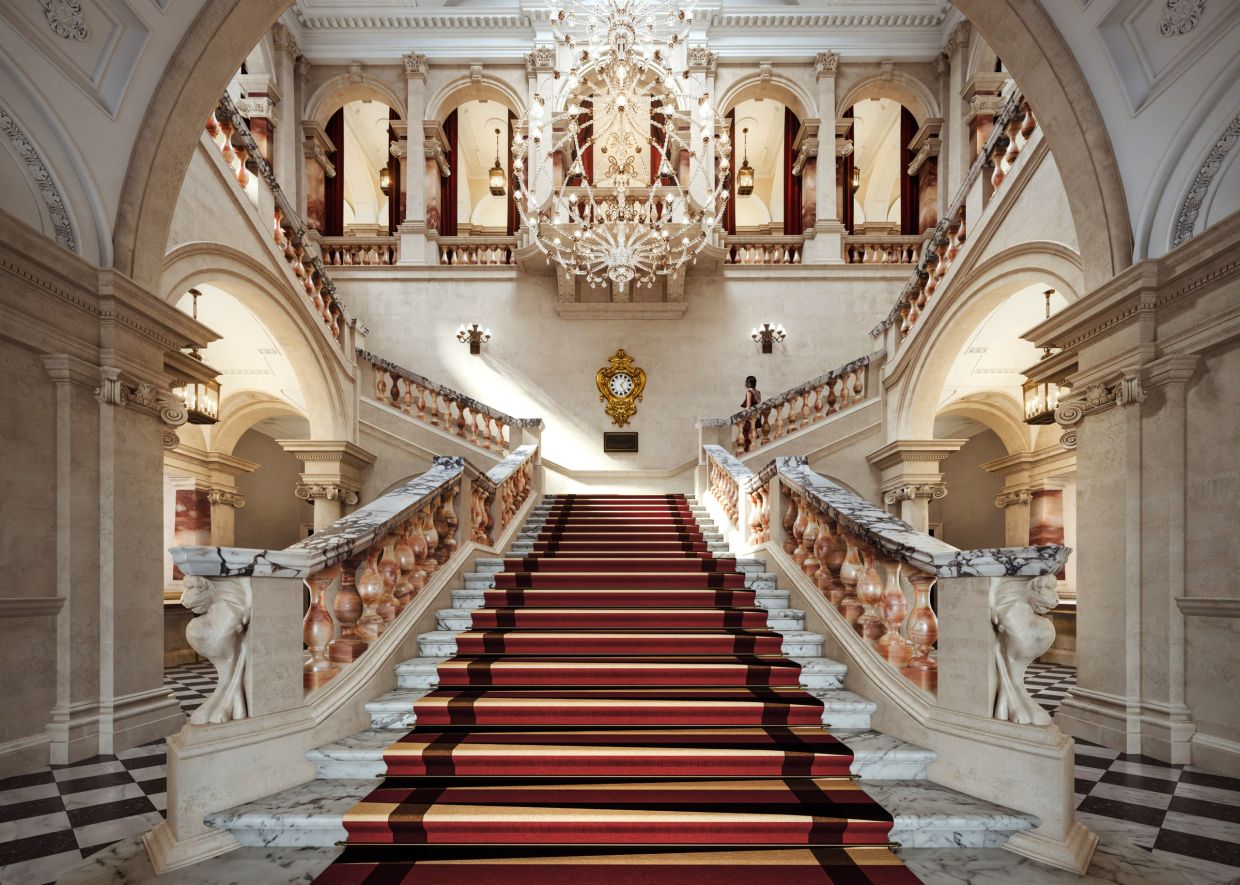
London's hospitality landscape is undergoing a remarkable transformation as some of Britain's most historically significant government buildings find new purpose as luxury hotels. At Raffles London, nestled within the former Old War Office on Whitehall, guests can enjoy cocktails in a basement that once served as an intelligence hub for British spymasters. A few blocks away, the NoMad London occupies a converted magistrates court in Covent Garden, where visitors can explore prison cells connected to trials of historical figures like Oscar Wilde. Meanwhile, the Chancery Rosewood in Grosvenor Square now welcomes travellers to what was formerly the United States Embassy, one of the world's most prestigious diplomatic postings. These establishments are not simply offering thread-count linens and acclaimed dining venues; they are commodifying access itself—the chance to inhabit spaces that were once impenetrable to all but the nation's most elite. Guests are paying more than £1,000 per night for this privilege, reflecting the premium placed on authentic historical experience in the contemporary luxury market.
This phenomenon extends beyond London's borders. Across Europe, governments are discovering that converting surplus administrative buildings into hotels solves multiple problems simultaneously. Former government ministries in Paris and Lisbon have undergone similar transformations, while Rome's historic central bank headquarters has also reopened as a hotel. These conversions align with broader fiscal pressures facing European governments seeking to reduce maintenance costs and facility overheads while funding relocations to modern, efficient office spaces. However, London has emerged as the epicentre of this trend, with the British government divesting itself of an unprecedented volume of properties no longer required by a smaller, more agile civil service. Luxury hotel developers have become the unlikely custodians of Britain's institutional architecture, a development that raises both opportunities and questions about the nation's relationship with its public heritage.
The appeal of these conversions lies partly in the irreplaceable character embedded within older institutional buildings. As John O'Ceallaigh, associate director at hospitality consultancy PRCO, explains, these structures arrive pre-equipped with dominating facades, soaring ceilings, and period architectural details that no contemporary construction can replicate. The marble and ornament already exist; developers need only repurpose rather than recreate. Yet the deeper attraction operates on a psychological and cultural level. In an era marked by widespread disengagement from political institutions, there exists a peculiar appeal—almost transgressive in nature—to socialising and sleeping within spaces that formerly represented concentrated governmental power. O'Ceallaigh describes this sensation as "strangely subversive," noting that many travellers find particular satisfaction in being granted permission to occupy venues that were previously sealed off from public access. This paradox of enjoying democratised access to temples of authority creates a distinct luxury proposition that generic new hotels simply cannot manufacture.
Admiralty Arch exemplifies the scale of London's ongoing transformation. This grand neoclassical structure, positioned between Trafalgar Square and Buckingham Palace as an Edwardian gateway, served as government offices until 2011 and hosted legendary figures including Louis Mountbatten, Winston Churchill, and Ian Fleming. The building stands along one of London's most ceremonially significant routes, used during Trooping the Colour and royal processions. Later this year, it will reopen as a Waldorf Astoria following acquisition and redevelopment by the Reuben Brothers. Jamie Reuben, principal at the development firm, frames the conversion as returning a national monument to public life, expanding access to both Londoners and international visitors. The project represents an attempt to reconcile private investment with public cultural stewardship—a delicate balance that underpins much of London's heritage hotel strategy.
The practical rationale behind these conversions is equally compelling. London's office market, whilst recovering from pandemic-induced disruption, has become increasingly selective. Modern occupiers prioritise energy efficiency, environmental credentials, advanced building systems, and amenities designed to lure remote workers back to physical spaces. Established government buildings frequently fail to meet these criteria, harbouring ageing mechanical systems, outdated electrical and plumbing infrastructure, and inefficient cellular office layouts that resist adaptation to contemporary work practices. Hotels, by contrast, offer considerable flexibility in spatial repurposing. Bright perimeter rooms naturally become guest suites, whilst darker interior spaces convert efficiently into kitchens, spas, storage facilities, staff areas, and service corridors. This functional adaptability has made hospitality development the most economically viable pathway for preserving these buildings.
Geoff Hull, director at EPR architects, notes that Britain's fundamental requirement for large government buildings has shifted dramatically over recent decades. Hybrid working arrangements and reduced civil service employment have contracted demand for traditional office accommodation. Simultaneously, private developers possess capital resources and risk tolerance that government agencies no longer command. The Hinduja Group's redevelopment of the Old War Office and the Reuben Brothers' work on Admiralty Arch demonstrate the scale of private-sector commitment required for these transformations. Raffles London's reopening in 2023 followed £1.4 billion in expenditure, including three additional floors added above the original structure and six basement levels excavated beneath it. Such investments demand hotel-grade revenue projections to justify the complexity involved.
That complexity should not be underestimated. Historic building conversion demands navigation of fire regulations, structural assessment, water ingress mitigation, and modern mechanical systems integration. Because many properties receive protected status, even minor interventions such as creating new doorways require approval from local planning authorities in consultation with Historic England. The Old War Office renovation consumed eight years from inception to opening. At this site, architects successfully persuaded Historic England to permit additional entrances, fundamentally transforming a fortress-like structure into a permeable hotel that activates Whitehall through public restaurants, bars, and gathering spaces. This architectural negotiation—converting institutional severity into hospitality warmth—represents a critical challenge in converting power centres into welcoming commercial venues.
The financial arrangements surrounding these disposals have generated substantial public scrutiny. The British government sold Admiralty Arch in 2012 for approximately £60 million and the Old War Office in 2016 for £350 million. These transactions and resulting conversions have attracted criticism, with some commentators characterising the Old War Office sale as "public theft." David Brock, head of Historic England's government historic estates unit, acknowledges the risks inherent in disposing strategically located historic buildings, yet maintains that hotel conversions often represent preferable alternatives to vacant deterioration. The civil service's reduced bureaucratic footprint means government offices increasingly sit underutilised. From a heritage preservation perspective, adaptive reuse—even within commercial contexts—may serve institutional architecture better than abandonment.
Hotel operators have recognised that contemporary luxury travellers increasingly reject cookie-cutter standardised accommodation in favour of experiential authenticity. Richard Tubb, project director at EPR who led the NoMad transformation, articulates this shift explicitly: guests desire places with narratives, genuine local character, and the sensation of authentic location rather than interchangeable corporate properties. The NoMad London leverages this appetite by housing the Bow Street Museum of Crime & Justice, narrating stories of London's pioneering law enforcement history. Raffles offers guided tours detailing hidden institutional secrets—tales of Boy Scouts cycling through wartime corridors delivering dispatches, or of MI5 officers sharing intelligence in what is now the Spy Bar. Online reviews consistently highlight these heritage narratives, with guests particularly praising the historical tours and distinctive atmospheric qualities. The authenticity itself has become luxury's primary differentiator.
London's luxury hotel market remains remarkably resilient despite geopolitical uncertainty and post-Brexit tax-free shopping elimination in 2021. The number of rooms commanding rates above $1,000 nightly continues expanding, reflecting sustained international demand from affluent travellers. Average daily rates and revenue per available room in the city's luxury segment have continued rising throughout the current year. According to real estate analytics firm CoStar, heritage buildings substantially strengthen this appeal. Cristina Balekjian, director of hospitality analytics at CoStar, explains that such properties lend themselves naturally to luxury positioning precisely because they possess distinctive character impossible to replicate across competing properties. Where contemporary construction favours standardisation and economies of scale, historic buildings offer irreproducible architectural and cultural specificity.
This transformation raises important implications for how societies balance heritage preservation, fiscal management, and commercial development. These conversions demonstrate that adaptive reuse need not mean cultural dilution; carefully considered hotel development can simultaneously serve commercial viability and public access goals. Yet the £1,000-plus nightly tariffs mean these heritage experiences remain accessible primarily to affluent international visitors rather than ordinary Londoners. Whether future governments will ensure adequate public programming and access at these sites, or whether heritage becomes exclusively a luxury commodity, remains an open question as more institutional buildings enter the hospitality market. The trend reflects both the resourcefulness of private capital in solving public sector challenges and the persistent tension between privatisation and stewardship of nationally significant spaces.
As Admiralty Arch and other formerly inaccessible buildings prepare to welcome paying guests, London's experiment in heritage hotel conversion will increasingly define how historic institutional architecture functions within contemporary urban economies. The success of Raffles and NoMad suggests substantial consumer appetite for staying within restored power centres, yet the premium pricing underscores a fundamental reality: democratising access to these spaces may paradoxically require restricting it to those with considerable disposable income. This contradiction sits at the heart of London's transformation from governmental seat to hospitality destination.

