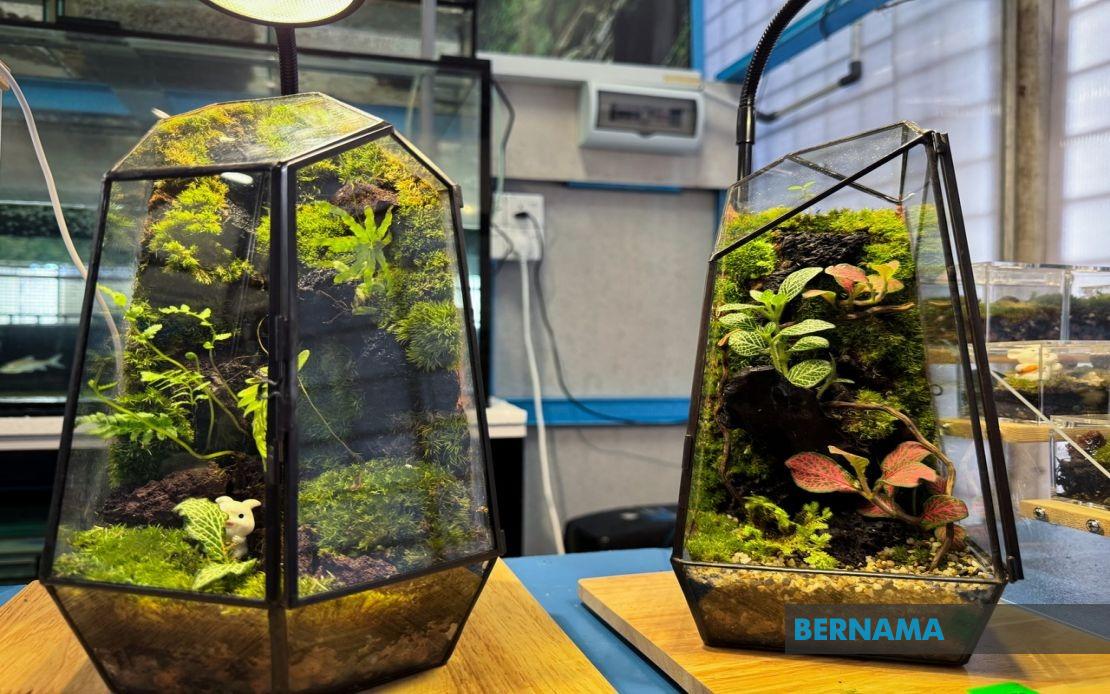
Muhammad Syukur Abdullah's journey from casual YouTube viewer to skilled terrarium entrepreneur demonstrates how creative passion, combined with structured learning, can blossom into a sustainable venture. The 21-year-old Aquaculture Technology Diploma student at Jeli Polytechnic has built a growing business crafting intricate miniature glass gardens from recycled containers and second-hand materials, with prices ranging from RM10 to RM570 depending on complexity and design style.
The Bukit Mertajam, Penang native's introduction to terrariums came through casual browsing during his high school years, when a YouTube video sparked his curiosity enough to attempt his first creation. What might have remained a one-off experiment instead evolved into persistent exploration, as Muhammad Syukur invested time watching additional tutorials and refining his technique through trial and error. This self-directed learning phase proved formative, establishing the foundational skills that would later underpin his professional development in the field.
Recognising the potential depth of knowledge required to sustain plant life in closed glass ecosystems, Muhammad Syukur made a deliberate educational pivot by enrolling in the Aquaculture Technology Certificate programme at Jerantut Community College, Pahang, in 2022. During his two years there, he moved beyond hobby-level experimentation to acquire structured knowledge about plant biology, care protocols, and the environmental conditions necessary for long-term plant survival in terrarium settings. This formal training provided the scientific foundation that distinguishes his approach from casual hobbyists, enabling him to understand and manipulate humidity, drainage, and soil composition to extend plant longevity.
The transition from learning to professional practice accelerated during a five-month industrial training stint at Gardenroad Aquatic in Shah Alam, Selangor, where Muhammad Syukur was exposed to commercial terrarium production techniques and industry standards. This practical apprenticeship boosted his confidence considerably, convincing him that his skills had marketable value. By 2022, he began offering terrariums for sale through Facebook and Marketplace, initially on a modest scale that accommodated his continuing education commitments.
Since commencing his Diploma studies at Jeli Polytechnic earlier this year, Muhammad Syukur has expanded his activities beyond personal sales to establish institutional reach. He founded the Green Vista Club, a student organisation supervised by Aquaculture Technology lecturer Zalina Che Manan, which serves dual purposes: providing a campus community for enthusiasts and creating a platform for knowledge dissemination beyond the student body. Notably, the club has begun conducting educational outreach sessions with kindergarten teachers, positioning terrariums as accessible educational tools for younger audiences and expanding the ecosystem's pedagogical applications.
The technical mastery Muhammad Syukur has developed encompasses three distinct terrarium varieties, each presenting unique design and maintenance challenges. Waterless landscapes represent the most stable format, requiring minimal intervention once established. Aquascapes recreate fully submerged underwater environments, demanding careful attention to aquatic plant selection and water chemistry. Paludariums, the most complex category, integrate terrestrial and aquatic zones within a single ecosystem—typically featuring dramatic elements like miniature waterfalls—requiring the creator to maintain vastly different environmental conditions within confined spaces. This technical repertoire distinguishes his offerings from basic competitors and justifies premium pricing for elaborate designs.
The construction process itself embodies layered methodology reflecting his scientific training. Foundation layers of clay balls combined with black soil and dry moss create a moisture-retention substrate that prevents waterlogging while maintaining consistent humidity—a critical balance that separates thriving terrariums from failed attempts. Upon this base, Muhammad Syukur constructs the aesthetic framework using materials chosen for both visual appeal and longevity, with spiderwood particularly favoured for its rot-resistance and sculptural qualities. Plant selection—typically fittonia, ferns, and miniature bonsai—depends on client specifications and desired thematic outcomes, whether forest-inspired naturalism, elaborate diorama fantasies, or stylised Japanese and Iwagumi designs.
Customer preferences reveal interesting market patterns. Diorama-style terrariums, which create elaborate miniature scenes evoking fantasy landscapes, command particular popularity, suggesting consumers value narrative and imaginative immersion alongside horticultural interest. The diversity of design options available—from forest environments to formalised Japanese aesthetics—indicates that terrariums function simultaneously as living plants and decorative art objects, appealing to audiences seeking alternatives to conventional houseplant displays. This dual functionality creates pricing flexibility, with simpler constructions starting at RM10 and elaborate custom pieces commanding substantially higher investment.
Production workflow reflects careful quality control. Muhammad Syukur creates between five and ten terrariums monthly across three size categories—mini, standard, and premium—with individual construction timeframes ranging from one hour for simple designs to a full day for intricate compositions. Critically, each completed terrarium undergoes one to two weeks of post-production observation before customer delivery, allowing Muhammad Syukur to verify plant adaptation and identify problems before handover. This commitment to quality assurance minimises post-sale complications and reinforces customer satisfaction.
Maintenance requirements remain modest but non-negotiable. Owners must monitor humidity and lighting conditions consistently, with watering typically needed once or twice weekly depending on environmental factors. This relatively light maintenance burden makes terrariums accessible to people who lack experience with conventional houseplants, particularly appealing to urban Malaysian residents with limited space and expertise. The closed-system design also conserves water compared to traditional potted plants, aligning with sustainability consciousness increasingly prevalent among younger consumers.
Despite his commercial success, Muhammad Syukur confronts genuine operational constraints. Balancing full-time diploma studies with customer production demands rigorous time management, occasionally forcing difficult prioritisation choices. His reluctance to offer inter-state delivery, citing fragility concerns during transit, significantly constrains market expansion beyond Peninsular Malaysia's northern regions. Establishing reliable shipping protocols for delicate glassware and living plants represents a frontier challenge that, if resolved, could unlock substantial growth opportunities across the Malaysian market and potentially into ASEAN neighbours.
Muhammad Syukur's trajectory illustrates a compelling model of youth entrepreneurship emerging from vocational education pathways. His success originated not from privileged access or inherited networks but from persistent curiosity, strategic education-seeking, and willingness to integrate formal learning with practical experience. As vocational institutions across Malaysia increasingly emphasise entrepreneurial development alongside technical training, students like Muhammad Syukur demonstrate viable pathways toward self-employment and small business creation, particularly in creative and sustainability-focused sectors resonating with millennial and Gen-Z values.

