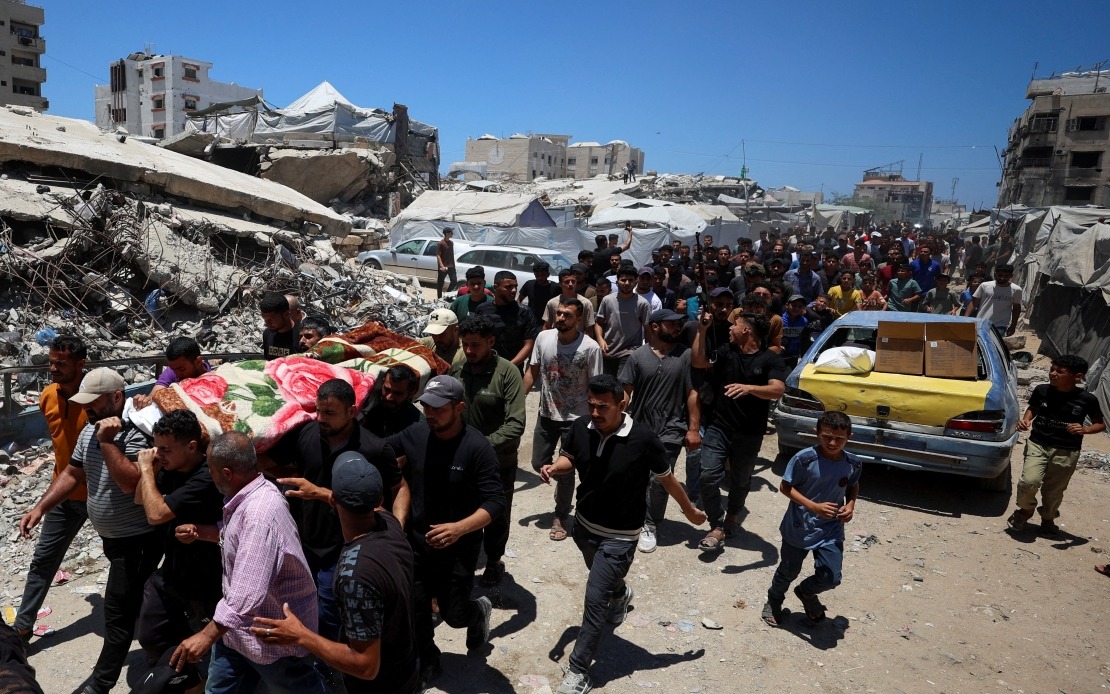
The humanitarian catastrophe unfolding in Gaza has reached another grim milestone, with Palestinian officials documenting 1,021 additional deaths since the implementation of the ceasefire agreement. The cumulative toll now stands at 73,032 fatalities since hostilities erupted in October 2023, according to data released by the Palestinian Prime Minister's Office this week. The sustained loss of life despite the supposed cessation of major combat operations underscores the fragility of the agreement and the continued vulnerability of Palestinian civilians to military operations in the enclave.
Conditions within Gaza have deteriorated markedly rather than improved following the ceasefire announcement, with the Palestinian Government Communication Centre warning that essential humanitarian access remains severely constrained. Israeli military bombardments have persisted in various locations including Nuseirat, Al-Mawasi, Khan Younis and Gaza City, preventing meaningful relief efforts. The supply of clean drinking water, one of the most fundamental human necessities, has become critically scarce, forcing the majority of Gaza's population to depend entirely on whatever humanitarian aid can reach them. This absence of basic utilities represents a public health emergency that extends beyond immediate conflict casualties.
The destruction wrought upon Gaza's infrastructure has been staggering in scale. Approximately 76.6 per cent of the enclave's housing has been destroyed or severely damaged by military operations, leaving nearly one million Palestinians living in makeshift tent settlements. These displaced populations face exposure to the elements, disease outbreaks and psychological trauma, whilst restrictions on humanitarian movement continue to prevent adequate shelter materials, medicine and food from entering the territory. The scale of displacement rivals some of the largest refugee crises in modern history, yet occurs within a confined geographic area where escape to neighbouring countries remains extremely limited.
Children have borne a disproportionate burden throughout the conflict. United Nations Children's Fund data reveals that 265 Palestinian children have been killed and more than 400 others injured since the ceasefire took effect. These figures demonstrate that the agreement has failed to provide meaningful protection for the most vulnerable population segment. The psychological consequences of such losses, combined with malnutrition and disease exposure among children living in tent camps, will likely produce long-term developmental and health impacts affecting an entire generation.
Humanitarian organisations have documented systematic obstruction of relief operations by Israeli authorities. International aid agency Oxfam presented evidence to the United Nations Security Council detailing how restrictions continue to block the delivery of life-saving assistance across Gaza. The disconnect between the ceasefire declaration and the practical reality of humanitarian access represents a critical failure of the agreement's implementation. Without sustained, unimpeded access to deliver food, medicine, fuel and reconstruction materials, the humanitarian situation will continue spiralling regardless of active combat operations.
Beyond Gaza, the occupied West Bank is experiencing a surge in forced displacement driven by settler violence and military enforcement. The United Nations Human Rights Office has documented significant increases in Palestinians being driven from their homes through coordinated settler attacks, military-ordered demolitions, movement restrictions and eviction notices. In refugee camps including Jenin, Tulkarem and Nour Shams, military operations since January 2025 have displaced over 33,000 Palestinians. This pattern of displacement across occupied territories suggests a broader strategy extending well beyond Gaza's borders.
Agricultural devastation represents an additional economic catastrophe for Palestinian communities. The Palestinian Ministry of Agriculture recorded the destruction of 7,258 trees, including 1,270 olive varieties that took decades to mature, alongside approximately US$5.17 million in overall agricultural losses. Settler and military attacks have targeted the economic foundation of rural Palestinian life, destroying assets that provide both livelihood and food security. Arson attacks on two mosques in Jiljilya and Mazra' al-Nubani villages represent additional dimensions of the conflict extending into cultural and religious targeting.
The situation extends into detention facilities, where Palestinian prisoners' rights advocates report deteriorating conditions, severe overcrowding and alarming disease transmission rates. These facilities house thousands of Palestinian detainees held under military administration, where basic medical care and sanitation standards appear inadequate. The treatment of detained populations remains a persistent concern regarding international humanitarian law compliance throughout the broader conflict.
Some Palestinian institutions have remarkably continued essential functions despite the surrounding devastation. The Palestinian education system has prepared approximately 91,000 students, including roughly 37,000 in Gaza, for this year's General Secondary Education Examination. For the third consecutive year, Gaza's students are sitting these crucial examinations electronically, a necessary adaptation reflecting the impossibility of traditional examination conditions. This persistence of educational continuity, even in such dire circumstances, demonstrates Palestinian institutional resilience, though the long-term educational and developmental consequences of years spent in conflict zones will likely prove substantial.
The international legal dimensions of the conflict remain contested. Palestinian authorities argue that Israeli control over planning and construction decisions at the Ibrahimi Mosque in Hebron violates the 1997 Hebron Agreement and breaches international law regarding religious and cultural sites. Such disputes over governance of disputed territories add another layer of complexity to the underlying conflict whilst humanitarian needs mount exponentially. The continued accumulation of violations and breaches demonstrates how structural issues perpetuate the cycle of suffering affecting millions of Palestinians across Gaza and the West Bank. For Southeast Asian observers, the situation illustrates how protracted conflicts become increasingly difficult to resolve as grievances accumulate and populations endure multi-generational trauma.