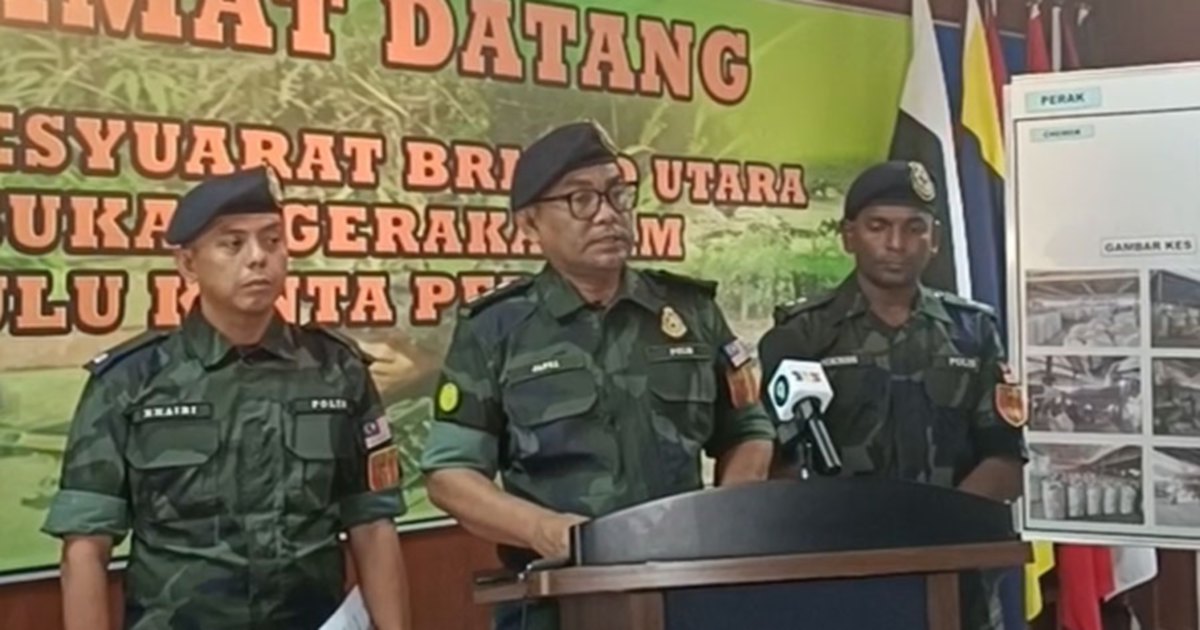
Malaysia's General Operations Force Northern Brigade has struck a significant blow against illegal mining operations in the peninsula's northern corridor, detaining 30 individuals and recovering minerals and industrial machinery valued at RM31.7 million across Perak and Kedah. The coordinated enforcement action represents an intensification of authorities' efforts to combat the lucrative but environmentally damaging underground economy that has long plagued Malaysia's mineral-rich states.
The illegal mining sector has become increasingly sophisticated and organised in recent years, operating through networks that extract, process, and distribute minerals while evading detection and taxation. These operations typically target tin, gold, and other valuable minerals found in abundance across peninsular Malaysia's geological formations. The scale of this particular seizure—involving both raw mineral stocks and processing machinery—indicates that authorities have disrupted not merely small-scale artisanal extraction but rather an established supply chain with infrastructure designed for commercial-scale operations.
Perak and Kedah have long battled the illegal mining plague, which ravages landscapes, contaminates water supplies, and destabilises local communities. The two states sit atop some of Malaysia's richest mineral deposits, making them perpetually vulnerable to organised illegal extraction schemes. Beyond environmental concerns, these operations represent substantial economic leakage as minerals leave the legitimate economy without taxation or regulation, depriving government revenues that could fund public services and infrastructure development.
The Northern Brigade's operation exemplifies the operational strategy increasingly adopted by Malaysian law enforcement agencies, which recognise that disrupting the entire value chain proves more effective than targeting isolated mining sites. By seizing processing equipment alongside raw minerals, authorities have eliminated assets that would require significant capital to replace, thereby degrading operational capacity and raising the cost threshold for would-be operators attempting to resume activities in the region.
The apprehension of thirty suspects suggests the operation extended beyond casual detection of minor infractions; this scale indicates authorities conducted sustained surveillance and intelligence gathering, possibly coordinating across multiple agency jurisdictions. Such investigative intensity demands substantial resources, reflecting official concern about the operation's scope and the sophistication of networks involved.
From a Malaysian perspective, these enforcement actions carry implications beyond immediate disruption of individual operations. The illegal mining economy intersects with broader questions about resource governance, organised crime, and state capacity to police vast areas effectively. Eastern Perak and northern Kedah contain remote terrain where government monitoring remains challenging, creating operational space for illicit activities that formal institutions struggle to contain.
The economic significance of the seizure merits attention when contextualised against Malaysia's broader mining sector. While Malaysia maintains substantial legitimate tin, bauxite, and other mineral extraction, the shadow mining economy represents forgone government revenue and distorts commodity markets by flooding them with unregulated supply. This undermines legitimate miners' competitiveness and contributes to price depression in global markets where Malaysian minerals compete.
Environmental restoration costs associated with illegal mining frequently exceed the seizure values in enforcement operations. Abandoned mining sites create ecological damage requiring expensive remediation—degraded landscapes, altered hydrology, contaminated watercourses, and destroyed vegetation that native communities depend upon. The RM31.7 million in confiscated assets pales beside the environmental and social costs of years of uncontrolled extraction.
Internationally, Malaysia's enforcement actions against illegal mining receive scrutiny in contexts beyond security concerns. Global supply chains increasingly demand evidence that mineral sources comply with responsible sourcing standards, meaning illegal extraction not only violates domestic law but potentially excludes Malaysian minerals from premium international markets. Companies maintaining ethical procurement standards avoid materials lacking clear provenance and regulatory compliance.
The GOF's Northern Brigade operation also signals tactical evolution in Malaysian law enforcement approaches to organised resource crime. Rather than reactive responses to detected activity, authorities demonstrate capacity for planned, intelligence-led operations that target entire networks simultaneously, suggesting improved inter-agency coordination and information-sharing capabilities among enforcement bodies.
Looking forward, the effectiveness of such operations will depend upon sustained follow-through. Security forces must maintain pressure in identified hot zones, prevent rapid reinvestment of confiscated assets into replacement machinery, and ensure that prosecutions result in meaningful consequences for detained individuals. Without persistent enforcement presence, criminal networks typically re-establish operations within months, merely relocating slightly to avoid previously raided areas.
For residents of affected communities and environmental advocates monitoring Malaysian resource governance, these enforcement actions represent progress yet underscore the ongoing battle. The scale of illegal mining operations persisting despite law enforcement efforts indicates that addressing the underlying economic incentives—which make illegal extraction more profitable than legitimate alternatives—remains essential for achieving sustained compliance. Enhanced regulation of legitimate mining, transparent tender processes for extraction licenses, and development initiatives in mining communities could help address root causes driving participation in illegal schemes.
The arrest and seizure operation demonstrates that Malaysian authorities possess capacity to disrupt organised illegal mining. Whether these tactical victories translate into strategic transformation of the sector depends upon institutional commitment to sustained enforcement, legal consequences that deter future participation, and policy reforms addressing structural factors perpetuating the illegal mining economy.

