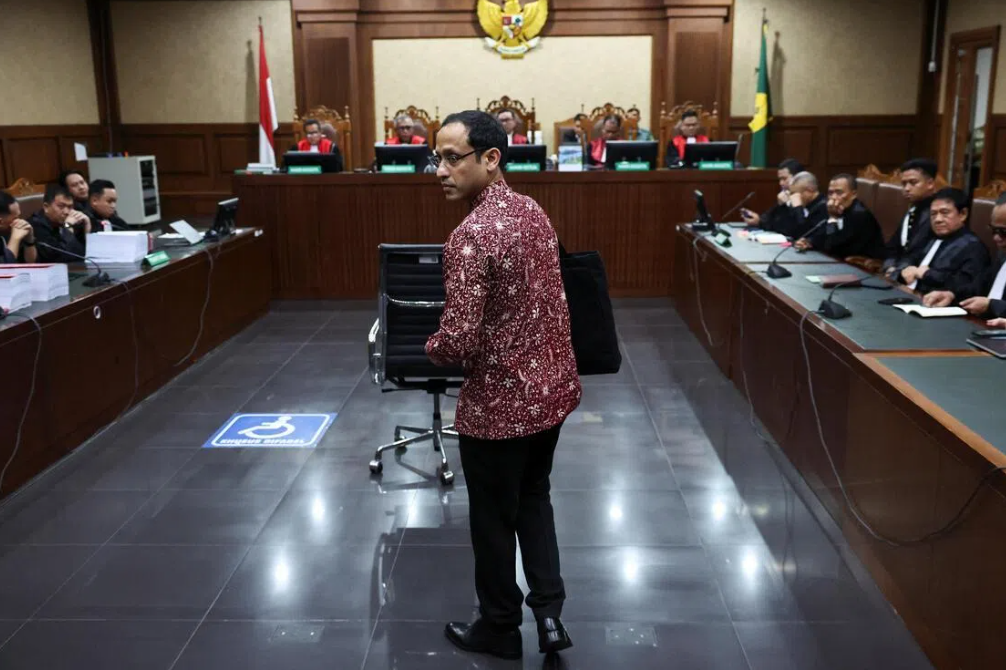
Indonesia's most prominent technology entrepreneur has been handed a decisive defeat in court, with Nadiem Makarim receiving a 10-year prison sentence for corruption connected to a massive school laptop purchase scheme. The Jakarta Corruption Court delivered its verdict on Tuesday, concluding one of Southeast Asia's most closely watched corruption trials and marking a dramatic fall from grace for the Harvard-educated businessman once touted as emblematic of a new breed of reform-minded Indonesian leaders. Beyond the primary custodial sentence, the court imposed a 1 billion rupiah fine and ordered Makarim to repay 809.6 billion rupiah in restitution, with an automatic five-year extension to his imprisonment should he fail to meet the financial obligation.
The prosecution's case centred on the Chromebook procurement initiative launched between 2020 and 2022, when Indonesian schools transitioned to remote instruction amid the Covid-19 pandemic. Officials sought to distribute approximately 1.1 million devices to educational institutions across the archipelago, a digitalisation effort that seemed aligned with Makarim's mission to modernise government services. However, prosecutors alleged the scheme resulted in state losses totalling 2.18 trillion rupiah and accused Makarim of orchestrating the programme to benefit Gojek's parent company, PT Aplikasi Karya Anak Bangsa, while personally gaining 809 billion rupiah through related transactions.
In delivering the ruling, chief judge Purwanto articulated the court's reasoning with specificity, stating that the panel had confirmed Makarim's guilt on the basis that the policy's conception and execution demonstrated "an abuse of authority intended to unlawfully benefit certain parties." The five-judge panel found that Makarim had "consciously and intentionally directed the Chromebook procurement policy" with motivations designed to "strengthen the strategic business relationship between Google and the corporation he founded." The judges characterised such conduct as fundamentally incompatible with ministerial obligations, declaring it "highly reprehensible" given the oath of office that should constrain official action.
Makarim's trajectory from celebrated entrepreneur to convicted felon represents one of Indonesia's most striking reversals. He co-founded Gojek before joining President Joko Widodo's administration in 2019, having built the company into a massive ecosystem encompassing motorcycle taxis, courier services, food delivery, and the GoPay digital payments platform. By 2019, the venture had secured unicorn status with valuations approaching US$10 billion, establishing Makarim as a symbol of Indonesia's digital ambitions and attracting his recruitment into government precisely to infuse technology-driven thinking into bureaucratic institutions. The very digitalisation initiatives that defined his ministerial legacy subsequently became the foundation for charges filed against him in January 2026.
Prosecutors had originally demanded significantly harsher penalties than those ultimately imposed, seeking an 18-year sentence, a 1 billion rupiah fine, and 5.6 trillion rupiah in restitution. Their case incorporated evidence from pre-ministerial studies conducted in 2018 suggesting that Chromebook laptops would prove inadequate in remote and rural regions lacking dependable internet infrastructure—a finding that prosecutors argued demonstrated the programme's unsuitability from inception. Additionally, prosecutors referenced an August 2019 group chat discussion concerning a Chromebook-focused digitalisation plan that occurred before Makarim's formal cabinet appointment, implying advance planning inconsistent with impromptu pandemic response.
Throughout the proceedings, Makarim mounted a vigorous defence, consistently denying the charges and asserting that the prosecution's allegations lacked foundation. His legal team contended that the procurement initiative represented a good-faith endeavour undertaken during one of Indonesia's most consequential disruptions to maintain educational continuity. They emphasised that Makarim personally received no financial compensation from the programme and highlighted that approximately 97 per cent of the 1.1 million Chromebooks had been successfully distributed to 77,000 schools by 2023, suggesting substantial policy implementation. Notably, prosecutors alleged that Google's investment in Gojek had influenced the Chromebook selection, though Google itself was not indicted in the matter.
The case transcended typical legal proceedings, generating extraordinary public engagement that illuminated broader anxieties within Indonesia's professional and entrepreneurial communities. Dozens of Gojek drivers attended courtroom sessions demonstrating solidarity, while court proceedings were livestreamed to accommodate widespread public interest and coordinate social media watch parties. The Jakarta Corruption Court accepted amicus curiae filings supporting Makarim's position, an exceptional step reflecting the case's significance beyond conventional legal parameters. On one occasion, Makarim arrived at proceedings dressed in Gojek driver attire before changing into traditional batik, symbolically maintaining connection to his commercial origins despite the formal proceedings.
Makarim's family background as the son of prominent lawyer Nono Anwar Makarim and grandson of an Indonesian independence struggle figure added dimensional complexity to his public persona. As the trial advanced toward conclusion, Makarim increasingly framed the proceedings as extending beyond technical disputes over purchasing decisions, instead positioning the case as consequential for Indonesia's capacity to attract talented professionals into public administration. In his defence presentation on June 23, he appealed to the judges' consideration of broader societal implications, arguing that the outcome would influence whether young Indonesians and diaspora members would view public service as a viable career path. Speaking directly to the bench, he posed a fundamental question: "Is this country still safe for us to serve?"
The sentencing carries implications extending throughout Southeast Asia's emerging market economies, where countries competing for talented entrepreneurial figures increasingly seek to integrate private-sector innovators into government modernisation efforts. The Malaysian context proves particularly relevant, as regional governments similarly attempt to attract technology founders and digital entrepreneurs into administrative roles while navigating corruption prevention mandates. Makarim's conviction demonstrates the precarious position occupied by such individuals when large-scale procurement decisions become entangled with prior business interests, regardless of policy outcomes or implementation success rates.
On the eve of sentencing, Makarim expressed continued confidence in Indonesia's judicial institutions through a statement posted via his legal team's LinkedIn account, declaring his persistent belief in justice despite exhausting months of litigation. The statement represented a notable restraint, avoiding the confrontational tone that might have emerged following such a substantial sentence diverging from his position. His invocation of judicial integrity and continued faith in the system, even while facing incarceration, suggested an effort to preserve his legacy as someone committed to institutional values rather than vengeful resistance. The conviction ultimately transforms Makarim into a cautionary figure for Indonesia's professional class, illustrating the substantial legal risks accompanying public service appointments for individuals maintaining significant private-sector interests or histories.

