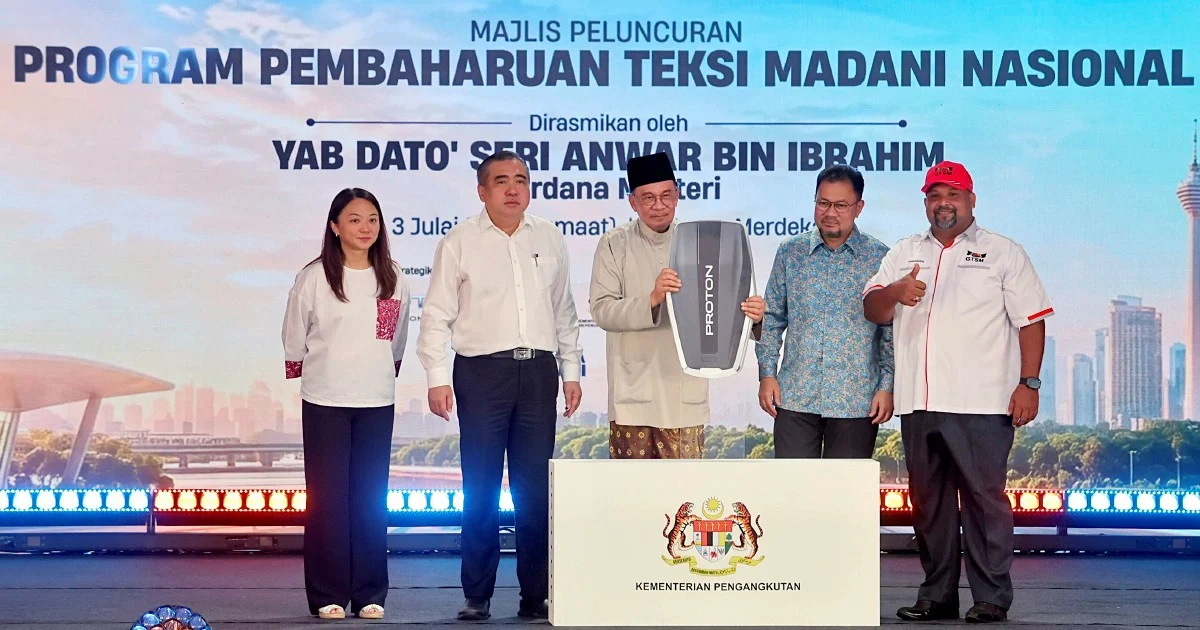
Prime Minister Datuk Seri Anwar Ibrahim revealed today that the government has committed an extra RM10 million towards a matching grant initiative aimed at supporting the replacement of older taxi vehicles. The announcement underscores the administration's continued focus on modernising Malaysia's ground transportation sector, a key component of broader urban mobility and economic recovery strategies.
The matching grant programme operates on a cost-sharing model where the government contributes funds alongside private operators and taxi companies, reducing the financial burden on individual drivers who often lack sufficient capital for major vehicle acquisitions. This approach has gained traction internationally as governments recognise that replacing ageing vehicle fleets addresses multiple policy objectives simultaneously—improving air quality, enhancing passenger safety, and supporting the livelihoods of transport workers who form a significant portion of the informal economy.
For Malaysian taxi operators, particularly those operating in Kuala Lumpur and other major urban centres, vehicle replacement remains a persistent challenge. Many taxis in circulation today exceed their economically viable lifespan, leading to higher maintenance costs and reduced fuel efficiency. The RM10 million injection represents recognition that while individual operators bear the primary cost responsibility, government intervention through matching grants can catalyse fleet modernisation without placing the entire burden on already-stretched transport entrepreneurs.
The timing of this announcement carries significance within Malaysia's broader economic context. As the nation seeks to strengthen post-pandemic recovery and maintain investor confidence in infrastructure and service sectors, visible improvements to public-facing industries like taxi services contribute to perceptions of urban modernisation. Visitors and residents alike notice whether taxis appear well-maintained and reliable, and fleet age directly impacts both reliability and the experience of users.
Matching grant schemes represent a middle path between purely private-sector solutions and full government subsidisation. By requiring operators to contribute matching funds, the model ensures that recipients have genuine skin in the game, reducing moral hazard while stretching public resources. The government's willingness to co-invest signals confidence in the taxi industry's viability and importance to urban transport ecosystems that remain dependent on these services despite the rise of ride-hailing platforms.
From a regional perspective, Malaysia's approach to taxi fleet modernisation reflects broader Southeast Asian trends. Countries across the region grapple with balancing traditional transport modes against digital disruption. Rather than abandoning regulated taxi services entirely, governments have increasingly recognised value in selective modernisation that allows these services to compete more effectively with app-based alternatives while maintaining regulatory oversight and safety standards.
The programme's details regarding eligibility criteria, grant quantum per vehicle, and implementation timeline warrant closer examination for operators considering participation. Typically, such schemes establish age thresholds for vehicles considered candidates for replacement, specify required safety and environmental standards for replacement vehicles, and outline the administrative process for accessing matching funds. Clear communication of these parameters proves essential for ensuring widespread uptake and preventing bottlenecks in processing applications.
Environmental implications of fleet replacement deserve emphasis. Older vehicles generally produce significantly higher emissions per kilometre than modern models equipped with contemporary pollution control technology. In Malaysian cities where air quality periodically deteriorates to unhealthy levels, the environmental multiplier effect of replacing hundreds of ageing taxis could meaningfully contribute to improvement. This dimension, though sometimes overlooked in transport policy discussions, increasingly influences international development institutions' support for such initiatives.
The announcement also reflects implicit recognition of challenges facing Malaysia's taxi industry amid changing consumer preferences and transport technology disruption. While ride-hailing services have captured market share in urban areas, traditional taxis retain advantages including availability in areas where app-based services maintain limited presence, regulatory oversight that provides consumer protections, and acceptance among demographic segments preferring conventional hailing methods. Strategic investment in modernising these services represents tacit acknowledgment that a diversified ground transport ecosystem serves public interest better than markets dominated by single providers or technologies.
Operators seeking to access the RM10 million programme should investigate whether existing applications remain under consideration or whether new application windows have opened following this announcement. Government transport agencies responsible for administration will likely publish detailed guidelines specifying application procedures, deadlines, and documentation requirements. For individual taxi drivers and small operating companies, understanding these mechanisms early provides competitive advantage in securing limited matching grant resources.
The broader policy question underlying this initiative concerns how Malaysia positions its urban transport system for the next decade. Autonomous vehicles, electric powertrains, and subscription-based mobility models are all emerging, yet large populations remain dependent on conventional taxis for daily transportation needs. Strategic investments in selective modernisation of existing systems, rather than wholesale replacement with entirely new technologies, may represent pragmatic governance that improves current service quality while remaining open to future innovations.
Future assessments of this programme's success will depend partly on uptake rates among eligible operators and the measurable improvements in taxi fleet age, emissions profiles, and service reliability following the replacement initiative. Policymakers in other Southeast Asian nations may similarly consider such programmes as models for balancing transport modernisation with social protection for workers dependent on traditional mobility services. The RM10 million commitment, while specific to Malaysia, signals broader regional policy momentum toward strategic intervention in ground transportation sectors.

