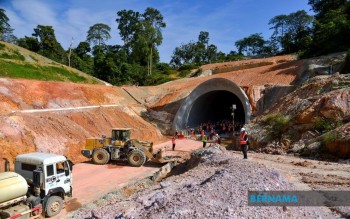
Malaysia's Cabinet has given the go-ahead to 46 separate undertakings across the Pasir Puteh parliamentary seat in Kelantan, committing RM207.2 million in public funding through 2026. The initiative represents a strategic pivot toward transforming the region into a logistics and manufacturing nexus, leveraging the East Coast Rail Link's cargo operations as the centrepiece of broader economic rejuvenation efforts.
Deputy Economy Minister Datuk Mohd Shahar Abdullah outlined the government's vision during parliamentary proceedings on July 13, explaining that the projects span land acquisition, site preparation, and basic infrastructure construction intended to support industrial operations in proximity to the Pasir Puteh ECRL Station. This integrated approach stems from detailed planning under the ECRL Integrated Land Use Master Plan, a comprehensive framework designed to harmonise transportation, logistics, and manufacturing activities across the corridor.
The strategic geography of Pasir Puteh provides a compelling economic foundation for this expansion. The ECRL Station sits within reach of the Tok Bali Supply Base, a facility that currently serves maritime and energy sector operations. This spatial relationship creates a natural ecosystem where rail-connected cargo handling, warehousing, and value-added manufacturing can coexist and reinforce one another. Officials argue that such proximity advantages remain largely untapped, representing genuine opportunity for private sector participation and direct employment creation across multiple skill levels.
Mohd Shahar emphasised that the funding allocation reflects a deliberate policy shift within the 13th Malaysia Plan framework, which prioritises regional specialisation over generic development. Rather than applying identical templates across constituencies, policymakers now assess local comparative advantages—whether logistics, tourism, agriculture, or energy—and channel resources accordingly. Pasir Puteh's designation as a logistics and downstream industrial zone reflects this targeted methodology, moving away from blanket infrastructure spending toward concentrated sectoral investment.
The announcement emerged from a parliamentary exchange with Datuk Dr Nik Muhammad Zawawi Salleh, the Pasir Puteh member representing Perikatan Nasional. Zawawi had queried whether Putrajaya would actively support Kelantan's state-level ambitions to catalyse downstream economic activity around the ECRL station. The Deputy Economy Minister's response indicated not merely passive approval but active partnership, with federal resources flowing to preparatory work—levelling, utilities, access roads—that would reduce private sector entry costs and accelerate investment decisions.
This approach holds particular significance for Kelantan, a state historically peripheral to Malaysia's main economic corridors. The ECRL itself was conceived partly to redistribute growth opportunities toward the east coast, reducing dependency on the Klang Valley and Penang as manufacturing and trade hubs. Pasir Puteh's positioning along this new infrastructure spine means it could capture freight volumes, container handling, and industrial demand previously concentrated in western seaports and rail termini. Successfully executing this vision requires more than bricks and concrete; it demands coordinated policy spanning customs clearance, port authorities, state government zoning, and private logistics operators.
The implementation timeline stretches across the current five-year planning horizon and into 2030, providing a decade-long runway for projects to mature and yield measurable outcomes. Mohd Shahar stated that commencement will occur during 2025, with sequential completion scheduled through the plan's final year. Progress tracking will occur through the MyRMK monitoring platform, a digital system designed to enhance transparency and allow parliamentary scrutiny of spending efficiency and milestone achievement.
The synergistic potential of rail infrastructure married to port facilities merits closer examination within Southeast Asia's competitive logistics landscape. Thailand's Eastern Economic Corridor and Vietnam's development zones have captured significant manufacturing relocation from China, partly through superior transport connectivity and integrated industrial parks. Malaysia's ECRL represents a comparable opportunity, yet realisation depends on execution quality, regulatory consistency, and private sector confidence. Pasir Puteh's 46-project package attempts to build that confidence through upfront public investment in basics.
For Malaysian readers, this initiative signals a broadening of opportunity beyond traditional growth poles. Kelantan residents, long viewing wealth creation as dependent on migration to Selangor or Kuala Lumpur, may now encounter local employment in logistics, warehousing, manufacturing, and professional services. Supply chain professionals, heavy equipment operators, warehouse managers, and customs brokers could find career paths without leaving home, potentially reversing decades of rural-to-urban migration. The multiplier effects—retail expansion, housing demand, service industries—could reshape Pasir Puteh's economic profile within five years if projects achieve planned timelines.
Regionally, this reflects Malaysia's positioning within emerging supply chain reshuffling. As nearshoring and friend-shoring accelerate, countries offering multimodal transport nodes gain competitive advantage. The ECRL creates such a node; Pasir Puteh's development transforms it from theory into operational reality. Neighbouring Thailand and Indonesia will observe whether Malaysia executes effectively, influencing their own corridor investment decisions.
Critically, the government's emphasis on development impact measurement and regional equity gaps represents an evolution in developmental thinking. Rather than pursuing uniform growth metrics, officials acknowledge that some regions require categorical, targeted support to narrow disparities. This philosophical shift—evident in resource concentration and sectoral specialisation—underpins the entire 13th Malaysia Plan approach. Pasir Puteh becomes a test case: does focused federal investment, anchored to tangible comparative advantage, genuinely narrow development divergence, or do structural constraints persist regardless of funding levels? The answer will influence policymaking for decades.

