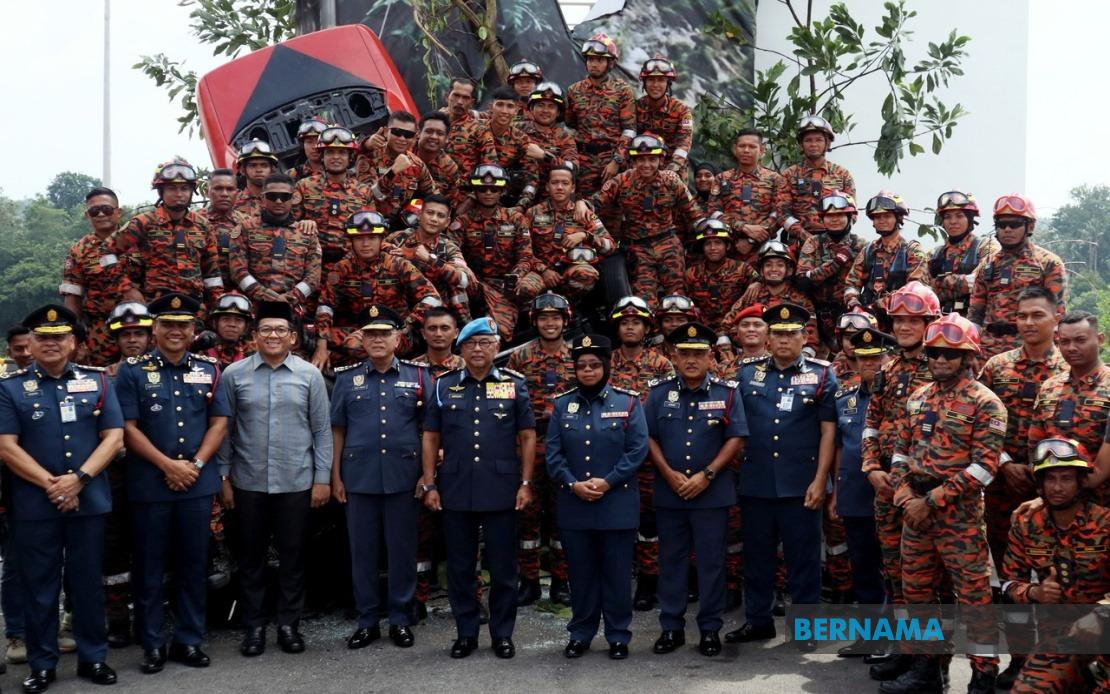
The Federal Government has greenlit an annual expenditure ceiling of RM278.9 million designated for the Malaysian Fire and Rescue Department to roll out 86 projects as part of the First Rolling Plan under the 13th Malaysia Plan. The initiative reflects the administration's commitment to strengthening emergency response infrastructure across the nation, with the allocation supporting both the launch of new fire stations and the continuation of existing facility development schemes. The scope of the funding encompasses 27 newly-sanctioned projects alongside 59 ongoing ventures that span the entire country, addressing critical gaps in fire and rescue service delivery.
Deputy Minister of Housing and Local Government Datuk Aiman Athirah Sabu outlined the allocation's strategic dimensions while presiding over the opening ceremony of Sungai Lembing Fire and Rescue Station in Pahang, a development inaugurated by the Sultan of Pahang Al-Sultan Abdullah Ri'ayatuddin Al-Mustafa Billah Shah. The announcement underscores the government's expanded focus on preventative infrastructure and emergency preparedness, particularly in regions where rapid urbanisation and heritage conservation projects create distinct safety demands. By integrating both capital expansion and operational enhancement, the allocation signals recognition that modern fire and rescue services require sustained investment beyond single infrastructure projects.
Pahang state alone is benefiting from substantial developmental activity in this domain, with seven facility projects currently advancing under both the previous planning cycle and the current rolling plan framework. Among the most significant initiatives are the acquisition and development of Gohtong Jaya Fire and Rescue Station, together with its residential quarters, the full construction of Benta station, and the establishment of facilities in Tioman accompanied by accommodation infrastructure. The state is simultaneously experiencing upgrades to existing stations in Bentong and Kuantan, alongside the comprehensive reconstruction of Triang Fire and Rescue Station. Preparatory ground works are also underway for the forthcoming Tanjung Lumpur Fire and Rescue Station, indicating that the government's investment strategy combines immediate service improvements with long-term infrastructure consolidation.
The newly-commissioned Sungai Lembing Fire and Rescue Station represents a tangible outcome of this broader investment framework, constructed at a cost of RM6 million on a seven-acre parcel of land. Operationalised on February 15, the facility serves as Pahang's 29th fire and rescue station and directly provides coverage to approximately 15,000 residents within Sungai Lembing and adjacent communities. The station's establishment addresses a significant service gap in an area experiencing heritage-led development initiatives, where the convergence of conservation activities and tourism expansion creates unique emergency management requirements. The timing of the station's launch aligns with broader revitalisation efforts targeting the town, suggesting coordinated government planning across multiple portfolios.
Beyond its core function as an emergency response facility, the Sungai Lembing Fire and Rescue Station has been envisioned as a multi-purpose community asset designed to generate broader social impact. According to Aiman Athirah, the station aspires to transcend conventional operational boundaries and evolve into a comprehensive knowledge and skills dissemination platform. The facility is intended to serve as a hub for public education on fire safety, rescue techniques, and disaster preparedness, with particular emphasis on cultivating community-based lifesaving competencies. This expanded mandate reflects contemporary understanding that fire and rescue departments can function as catalysts for community resilience and grassroots emergency response capability, reducing reliance solely on professional personnel.
The integration of the fire and rescue station within Sungai Lembing's broader development narrative was emphasised by Deputy Economy Minister and Paya Besar Member of Parliament Datuk Mohd Shahar Abdullah, who positioned the facility within an interconnected ecosystem of heritage preservation and economic revitalisation. The town's transformation encompasses multiple concurrent initiatives including the restoration of the defunct PCCL Cinema, the development of ecotourism attractions, the construction of a digital museum, the upgrading of the Sungai Lembing Tunnel, and strategic positioning of the locality as a potential UNESCO World Heritage Site candidate. These multifaceted development efforts collectively aim to reposition Sungai Lembing from its post-mining decline into a contemporary destination balancing historical authenticity with modern amenities.
Mohd Shahar's remarks underscored an often-overlooked dimension of town revitalisation: the necessity of embedding safety infrastructure within heritage development frameworks. He articulated that conservation and tourism initiatives become meaningless without corresponding investments in emergency preparedness and disaster management capacity. The Sungai Lembing Fire and Rescue Station therefore functions not merely as a response mechanism to potential incidents but as a foundational element enabling the town's broader transformation into a secure, modern heritage destination. This conceptual linkage between safety infrastructure and economic development represents sophisticated urban planning that recognises how visitor confidence and resident wellbeing depend fundamentally on robust emergency services.
The governmental decision to advance the Sungai Lembing project followed advocacy from Pahang's state leadership, with the Sultan of Pahang having issued a directive prioritising the station's construction. The presence at the opening ceremony of Pahang Menteri Besar Datuk Seri Wan Rosdy Wan Ismail and State Legislative Assembly Speaker Datuk Seri Mohd Sharkar Shamsuddin reflected the project's significance within provincial governance structures. This ceremonial dimension indicates that fire and rescue infrastructure development carries considerable political weight at both federal and state levels, reflecting constituent demands for improved emergency services and the symbolic value of visible infrastructure investment.
The RM278.9 million annual allocation must be contextualised within Malaysia's broader infrastructure and public service modernisation agenda. Fire and rescue services have historically received fragmented funding relative to their critical role in national safety frameworks, with previous budgetary constraints limiting facility expansion and equipment acquisition. The consolidated allocation through the 13th Malaysia Plan's rolling phase suggests systematic effort to rectify this underinvestment, particularly benefiting states like Pahang where geographic dispersal and the proximity of heritage and ecotourism sites demand geographically dispersed coverage. For Malaysian readers, this represents tangible evidence of enhanced government commitment to emergency preparedness across diverse regional contexts.
Looking forward, the success of initiatives like the Sungai Lembing Fire and Rescue Station will depend substantially on operational resourcing beyond capital investment. The establishment of 86 projects across the nation requires corresponding allocation for trained personnel, maintenance budgets, and equipment procurement, considerations that extend beyond the capital development ceiling. The integration of community education functions additionally necessitates specialised training for station personnel, potentially requiring partnerships with educational institutions and non-governmental organisations specialising in public safety instruction. These operational dimensions will prove equally consequential as infrastructure creation in determining whether the government's developmental vision translates into sustained service enhancement.
For Southeast Asian observers, Malaysia's fire and rescue infrastructure expansion reflects broader regional trends toward enhanced disaster preparedness amid climate change, urbanisation, and tourism growth. The model of embedding emergency services within heritage preservation and economic development frameworks offers insights applicable to comparable initiatives across ASEAN nations. As regional economies increasingly embrace heritage tourism and sustainable development paradigms, the integration of modern safety infrastructure with conservation objectives becomes increasingly relevant. Malaysia's approach to the Sungai Lembing project may thus serve as a reference point for neighbouring countries pursuing analogous development strategies that harmonise economic revitalisation with public safety imperatives.

