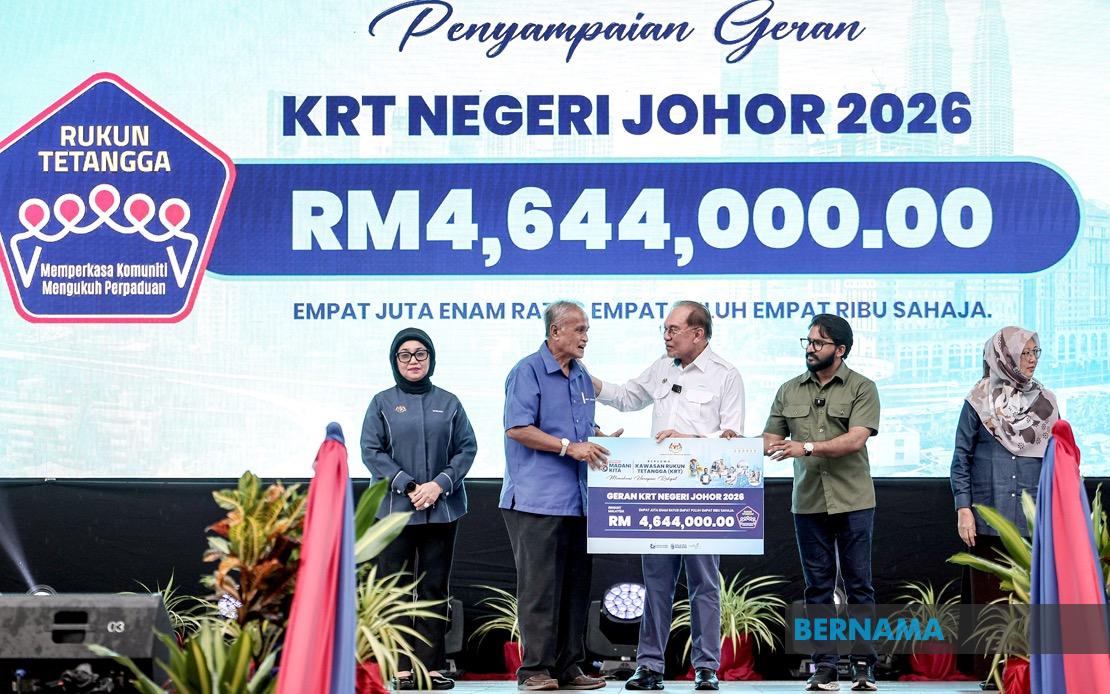
Prime Minister Datuk Seri Anwar Ibrahim has sanctioned a significant increase in funding for Neighbourhood Watch Areas (KRT) across Malaysia, raising the annual grant from RM6,000 to RM10,000, with implementation set for January 1, 2027. The announcement came during the MADANI KITA Programme at Dataran Segamat on June 24, signalling the government's renewed commitment to strengthening community-level institutions that have long served as bridges between citizens and state machinery. The move represents a watershed moment for grassroots organizations that have operated under the same funding ceiling for an entire decade, despite their expanding responsibilities in addressing social challenges at the community level.
The Prime Minister's decision reflects a recognition that KRT organizations have been stretched financially while taking on increasingly complex roles in maintaining social harmony and assisting government agencies with security and welfare matters. Anwar Ibrahim framed the grant increase as overdue recognition of institutional value, noting that the previous allocation had become obsolete relative to operational needs and inflationary pressures affecting community programmes. His statement underscored a broader philosophical position: that investing in grassroots institutions strengthens the democratic fabric and reinforces the collaborative relationship between government and civil society in addressing localized concerns before they escalate into systemic problems.
The significance of this funding boost extends beyond mere financial arithmetic. KRT organizations represent Malaysia's traditional model of community self-governance, mobilizing neighbourhood residents to contribute to collective welfare, security awareness, and social cohesion. By elevating their resource base, the government signals that this model remains central to national strategy even as urbanization and digital connectivity reshape how communities organize themselves. The RM10,000 annual allocation, while modest in absolute terms, provides breathing room for KRTs to expand activities—whether educational workshops, community safety initiatives, or social support programmes—without relying entirely on volunteer capacity.
For Malaysian readers, particularly those in suburban and semi-rural areas where KRT presence is strongest, the increase holds practical implications. Many KRTs have historically struggled to maintain meeting spaces, purchase basic equipment, or organize meaningful activities due to budget constraints. The enhanced grant enables these organizations to invest in infrastructure, conduct training programmes for members, and undertake small-scale community projects that address local needs. In an era when social fragmentation and polarization concern policymakers, better-resourced neighbourhood watch groups can serve as forums for inter-community dialogue and collaborative problem-solving, particularly in diverse neighbourhoods where different ethnic and religious groups coexist.
Anwar Ibrahim's emphasis on Malaysia's multicultural strength, delivered in the same address, contextualizes the KRT funding increase within broader nation-building strategy. He articulated a vision where cultural, racial, and religious diversity strengthen rather than divide society, and framed KRT as institutional mechanisms for operationalizing that vision at street level. This framing positions community organizations as custodians of social peace, requiring adequate resources to fulfill that mandate. The rhetorical connection between funding and national unity suggests the government views investment in grassroots institutions as essential infrastructure for democratic resilience and intercommunal stability.
Beyond the headline grant increase, the Prime Minister announced complementary investments addressing institutional needs of other stakeholder groups. An immediate allocation of RM3.205 million targets infrastructure repairs at Islamic educational institutions throughout Johor, encompassing religious schools, madrasahs, study centres, and tahfiz institutions across districts including Batu Pahat, Muar, and Segamat. This parallel investment reflects a holistic approach to strengthening community institutions, recognizing that grassroots stability depends on functioning schools, security infrastructure, and public facilities. The government's simultaneous funding for religious education facilities alongside secular neighbourhood watch groups suggests an integrated vision of community development that addresses spiritual, educational, and social dimensions.
The commitment of RM1.0 million for urgent repairs to Royal Malaysian Police quarters in Johor represents a third strand in this institutional investment strategy. Anwar Ibrahim linked this allocation explicitly to national security imperatives and personnel welfare, noting that adequate living conditions for security forces enable them to discharge their responsibilities effectively. This triangulated funding approach—neighbourhood watch grants, religious education infrastructure, and police facilities—suggests a deliberate strategy to strengthen three pillars of grassroots stability: community self-organization, spiritual and educational formation, and law enforcement presence.
The January 1, 2027 implementation date for the enhanced KRT grant merits attention, as it allows time for budgetary planning and establishes a clear transition point. This forward-looking timeline, rather than immediate implementation, reflects fiscal discipline and proper administrative procedure, while ensuring KRT organizations can plan their 2027 activities with certainty. The specificity of the date also underscores government commitment, as it transforms a policy announcement into a fixed obligation with accountability mechanisms built in.
For Southeast Asian observers, Malaysia's KRT model presents a case study in how governments can leverage traditional community structures to address contemporary governance challenges. Many regional governments struggle with balancing centralized authority against grassroots participation, and Malaysia's approach—channelling resources to neighbourhood watch organizations while maintaining government oversight—offers a potential template. The KRT system's longevity and continued relevance suggest that institutions embedding community participation in governance can endure even as broader social conditions transform.
The fiscal impact of raising KRT grants from RM6,000 to RM10,000 annually nationwide requires budgetary reallocation, signalling that the government prioritizes grassroots institutional strengthening within its spending priorities. While the aggregate cost across thousands of KRTs may be substantial, the investment targets a decentralized, volunteer-dependent system requiring minimal infrastructure compared to conventional government departments. This efficiency makes grassroots institution-building an attractive governance strategy for resource-conscious administrations seeking maximum social impact from development expenditures.
Moving forward, the success of this funding increase depends not merely on disbursement but on how effectively KRT organizations utilize enhanced resources and how government agencies support their work. Capacity-building, accountability frameworks, and integration with existing government programmes will determine whether the grant increase translates into tangible improvements in community welfare and social cohesion. The investment represents a wager that empowering grassroots organizations ultimately strengthens government legitimacy and institutional effectiveness throughout the country.