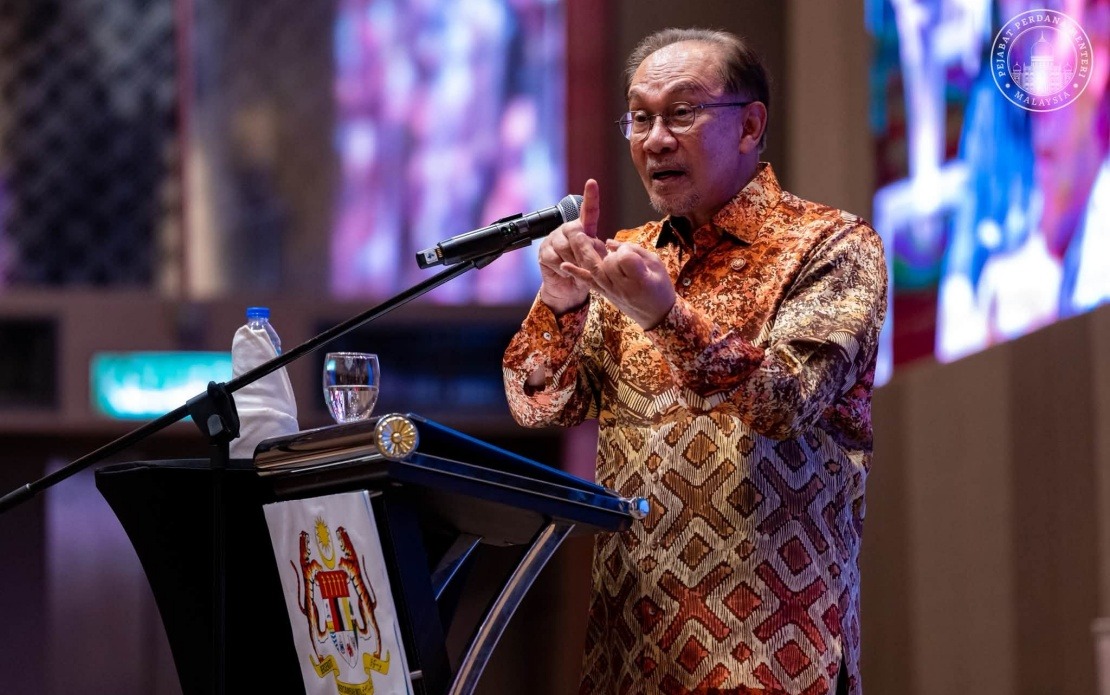
Prime Minister Datuk Seri Anwar Ibrahim has pledged that his administration will dedicate its full resources and capabilities to assist Malaysia's younger generation in addressing the multifaceted challenges they encounter in today's rapidly evolving landscape. The commitment emerged following direct interaction with youth representatives at the "Temu Anwar" session and the Opening Ceremony of the 2026 International Youth Assembly (HAMKA) held in Klang, Selangor, where the Prime Minister engaged extensively with young people to understand their perspectives and gather their counsel on pressing national issues.
Through a Facebook statement released in the evening, Anwar emphasised the government's recognition that young Malaysians operate within an increasingly intricate environment where divergent viewpoints and ideological friction have become commonplace occurrences. Rather than viewing such diversity as problematic, the Prime Minister framed these differences as inevitable aspects of democratic discourse, provided they remain grounded in substantive knowledge, reasoned argumentation, and civility. He cautioned against allowing discussions to devolve into sentiment-driven debates, expressions of animosity, or narrow factional interests, instead advocating for a discourse that privileges evidence and mutual respect.
The Prime Minister's engagement at the HAMKA assembly represents a deliberate effort to maintain direct communication channels with Malaysia's youth constituency, a demographic increasingly vocal in articulating their concerns regarding economic prospects, educational opportunities, and social inclusion. By hosting forums such as "Temu Anwar," the government signals its intention to position youth input as central rather than peripheral to policy formulation and national direction-setting. This approach acknowledges the reality that young people possess distinct experiences and insights that may not align with older generations' assumptions about economic conditions, technological disruption, and social change.
Anwar's reference to the significance of the HAMKA designation carries particular symbolic weight within Malaysian intellectual and political circles. The assembly's nomenclature honours Abdul Malik Karim Amrullah, a towering figure in Southeast Asian Islamic thought and literary tradition who earned renown for his multifaceted contributions as both an intellectual and public intellectual. Amrullah's historical legacy encompasses his reputation as a pioneering thinker whose writings and oratory shaped ideological discourse across the region, earning him characterisation as both a formidable orator and an influential writer whose written works extended his influence beyond the immediate circle of listeners.
By invoking Amrullah's example, the Prime Minister draws a parallel between the historical figure's championing of knowledge-based discourse and contemporary expectations for youth engagement. Amrullah's career exemplified the proposition that informed opinion, articulated persuasively and defended rigorously, constitutes a legitimate and necessary mode of participation in public life. The historical figure's emphasis on intellectual courage—the willingness to challenge prevailing orthodoxies through evidence and reasoning—resonates with aspirations many young Malaysians harbour regarding their capacity to influence national conversations on matters affecting their futures.
The Prime Minister's invocation of Amrullah's teachings regarding the importance of knowledge acquisition carries implications for educational policy and the role government assigns to intellectual development. Young Malaysians seeking to build careers in an increasingly competitive global economy require access to quality education, skills development, and opportunities for practical application of their learning. Government support for youth must therefore extend beyond rhetorical affirmation to encompass concrete policy initiatives addressing educational infrastructure, vocational training pathways, and employment creation.
Anwar's emphasis on "openness in generating ideas" signals an openness, at least in principle, to heterodox thinking and creative problem-solving approaches that younger citizens might propose. This stance carries significance for Malaysia's competitive positioning within Southeast Asia and beyond, as nations increasingly recognise that innovation and economic dynamism depend upon fostering environments where unconventional thinking flourishes rather than faces suppression. Young entrepreneurs, technologists, and social innovators require regulatory frameworks and cultural permission structures that enable experimentation and calculated risk-taking.
The HAMKA assembly in Klang also reflects broader regional dynamics shaping youth engagement across Southeast Asia. Young people throughout the region navigate comparable challenges: labour market transitions driven by automation and artificial intelligence, climate change impacts on livelihoods and settlement patterns, educational systems requiring adaptation to emerging skill requirements, and digital ecosystems creating unprecedented information access alongside novel forms of misinformation. International forums such as HAMKA provide platforms for youth from multiple nations to exchange experiences and perspectives, potentially strengthening cross-border understanding among generations that will inherit regional stewardship responsibilities.
The Prime Minister's formulation—that government will assist "within its available capacity"—warrants careful consideration regarding realistic expectations and resource constraints. This phrasing acknowledges that governmental capabilities, while substantial, operate within definable boundaries. Economic limitations, competing budgetary priorities, and institutional capacity constraints all condition what governments can deliver, particularly when young people's aspirations encompass systemic transformations in economic structures, governance arrangements, or environmental remediation. Honest communication about such limitations, rather than unconstrained promises subsequently unmet, establishes foundations for sustained credibility and productive engagement.
Moving forward, the extent to which Anwar's commitments translate into substantive policy outcomes will likely determine whether youth perceive governmental engagement as genuine partnership or symbolic gesture. Young Malaysians expect tangible results: expanded opportunities in higher education and skills development, entrepreneurship support mechanisms, meaningful participation in policy processes affecting their interests, and government action addressing environmental degradation and climate adaptation. The gap between political rhetoric endorsing youth empowerment and administrative follow-through on specific initiatives remains a chronic challenge for governments throughout the region.

