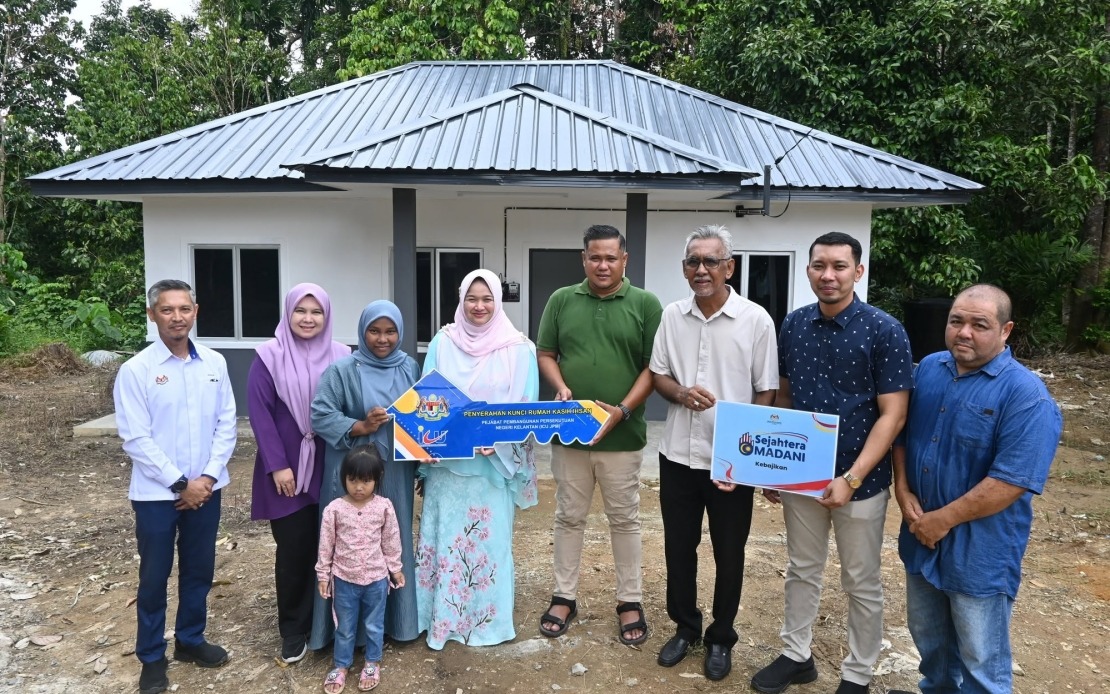
Prime Minister Datuk Seri Anwar Ibrahim's administration continues its push to expand access to safe and dignified housing across Malaysia, with two families in Jeli, Kelantan recently receiving homes through the Rumah Kasih Ihsan programme. The initiative, coordinated through the Kelantan Implementation Coordination Unit (ICU) under the Prime Minister's Department, represents a tangible expression of the government's pledge to strengthen social welfare delivery at the grassroots level.
The handover ceremony saw Yusof Mohamed Nawawi receive formal acceptance papers for a newly constructed dwelling in Kampung Renyut, marking a replacement of his previous accommodation with a structure designed to meet modern safety and comfort standards. Simultaneously, Shamsul Bahri Che Musa received the keys to his completed home, signalling the completion of another phase in this targeted assistance programme. These transactions were formalised by Dr Wan Nur Ibtisam Wan Ismail, the Kelantan ICU JPM director, working under the broader PMX Coordination Team framework that orchestrates such welfare initiatives across districts.
Beyond the physical transfer of property deeds, both recipients were presented with food baskets—a symbolic accompaniment that underscores the government's broader concern for immediate household welfare alongside longer-term housing security. This layered approach to assistance reflects an understanding that vulnerable populations often face compounding challenges, and that addressing shelter alone without attending to nutritional security represents an incomplete intervention.
The Rumah Kasih Ihsan initiative embodies a philosophical reorientation in how Malaysian policymakers conceive of development impact. Rather than measuring success primarily through infrastructure metrics or aggregate economic figures, the programme's architects emphasise the lived experience of beneficiaries. According to statements from the Kelantan ICU JPM, a secure residence functions as more than architectural shelter; it constitutes the foundational precondition for dignity, aspiration, and family stability that enable individuals to participate meaningfully in economic and social life.
For Malaysian observers, the Jeli handovers carry particular significance within the broader context of rural development disparities. Kelantan, historically one of Malaysia's economically challenged states, continues to experience pockets of housing inadequacy where families live in structures vulnerable to weathering, flooding, and safety hazards. The Rumah Kasih Ihsan programme directly targets these vulnerability gaps, recognising that housing security represents a prerequisite rather than a luxury good for populations at the economic margins.
The coordination structure underpinning these deliveries—the ICU model operating under the Prime Minister's Department—suggests an attempt to streamline welfare administration and reduce bureaucratic fragmentation. By centralising coordination at the federal level while maintaining district-level implementation teams, the government seeks to accelerate programme delivery and ensure consistent quality standards across different state administrations. This architectural approach addresses a long-standing challenge in Malaysian social policy: the tendency for well-intentioned programmes to languish in implementation due to unclear accountability lines or resource constraints at lower administrative tiers.
The philosophy articulated by programme administrators—that meaningful development must be measured by its direct impact on people's lives rather than abstract progress metrics—resonates with growing international discourse on human-centred development. This framing positions housing security not as charity or welfare dependency, but as an investment in human capability and social stability. When families no longer expend psychological energy worrying about structural integrity or exposure to the elements, they can redirect effort toward education, skill-building, and income-generating activities.
For Southeast Asian readers observing Malaysia's approach, the Rumah Kasih Ihsan model offers lessons on targeting housing intervention within resource-constrained environments. Rather than attempting universalised programmes that dilute impact across broad populations, this initiative concentrates resources on documented cases of severe housing inadequacy. This precision targeting approach, when combined with institutional coordination mechanisms, can maximise the welfare impact of limited public resources—an consideration of acute relevance across the region where housing deficits persist despite general economic growth.
The symbolic importance of Prime Minister Anwar Ibrahim's public endorsement of these transfers through social media demonstrates administrative priority-setting. By personally highlighting individual cases of housing delivery, the leadership signals that grassroots welfare achievements merit celebration equivalent to large infrastructure projects. This recalibration of political messaging around development success may gradually shift how Malaysians understand and evaluate government performance—away from exclusive focus on mega-projects toward recognition of incremental improvements in household security and living standards.
Moving forward, the scalability question remains central. Jeli represents one district within one state; Malaysia's housing adequacy challenges extend across rural and urban areas nationwide. The success of the Rumah Kasih Ihsan programme in Kelantan will likely determine whether similar models expand to other states and districts. If the coordination mechanisms prove robust and delivery remains consistent, the template could become a template for addressing housing insecurity more comprehensively, though success would ultimately depend on sustained budgetary allocation and political commitment across changing administrations.

