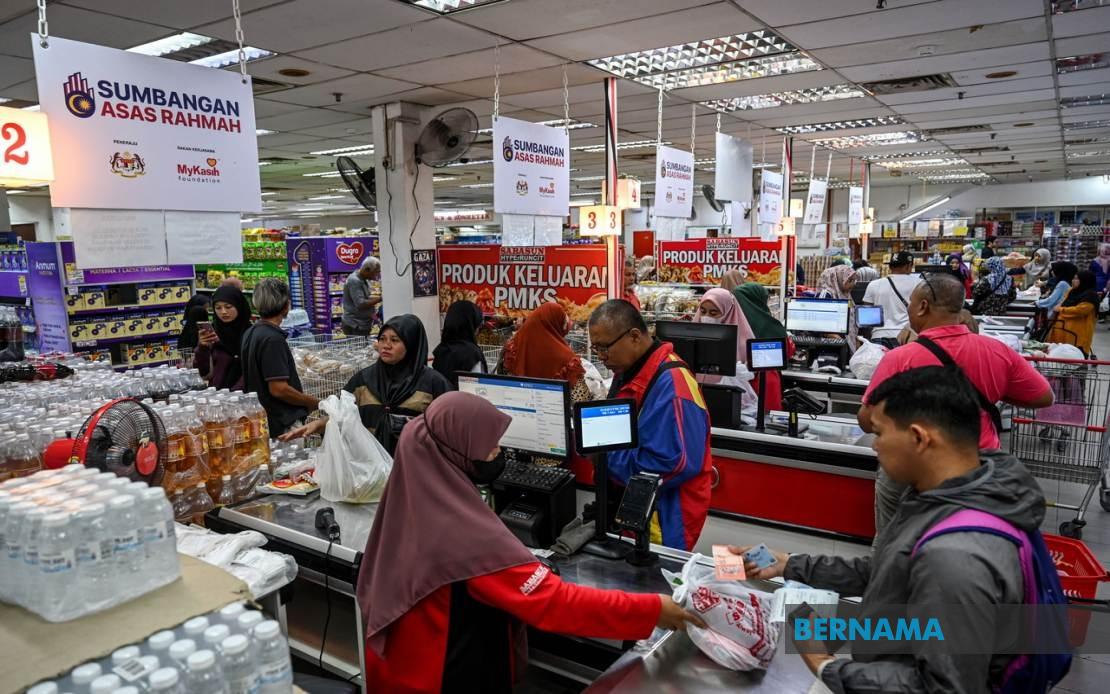
Malaysia's government is exploring the possibility of raising payments under its two principal cash assistance schemes—the Sumbangan Tunai Rahmah (STR) and Sumbangan Asas Rahmah (SARA)—provided that the nation's economic circumstances strengthen sufficiently. Prime Minister Datuk Seri Anwar Ibrahim disclosed this during remarks made at a community gathering in Ipoh on July 19, signalling that both the fiscal framework and household support remain active policy concerns for the MADANI administration as it navigates competing priorities.
During his address at the MADANI KITA Together with the Tambun Community Programme, hosted by the Malaysian Volunteer Corps Department (RELA), Anwar indicated that deliberations between his office and the Treasury's top civil servant, Tan Sri Johan Mahmood Merican, have already begun on the feasibility of expanding these programmes. The Prime Minister, who simultaneously holds the Finance Ministry portfolio, suggested that any elevation in assistance levels would form part of the deliberations shaping the next national Budget, underscoring how social spending decisions are integrated with broader macroeconomic planning.
The STR and SARA schemes represent the government's primary mechanism for delivering direct income support to lower and middle-income households. These programmes have become central to the MADANI administration's welfare narrative since taking office, functioning as tangible expressions of its commitment to protecting purchasing power amid inflationary pressures and cost-of-living challenges. Anwar's comments reflect acknowledgment that current payment levels, while meaningful, may require recalibration if economic growth permits. The conditional language—"if the economy allows"—reveals the administration's constraint: social spending expansion remains tethered to fiscal sustainability and revenue availability.
Malaysia's economic performance has remained uneven through 2024, with growth moderating from earlier pandemic-recovery momentum. Inflation has gradually declined from its 2022 peaks but remains a concern for household budgets, particularly affecting lower-income Malaysians who spend proportionally more on essentials like food and utilities. The government faces a delicate balancing act: increasing social transfers could provide relief to vulnerable populations yet simultaneously create inflationary pressures if demand stimulus outpaces productive capacity. This tension helps explain why Anwar framed assistance expansion as contingent rather than guaranteed.
Beyond the immediate support schemes, Anwar used the Ipoh appearance to reinforce the government's broader positioning on security-focused welfare and public service recognition. He announced that RELA, the volunteer corps department that provides both security and disaster-response functions, would receive RM3 million in allocation this year for member welfare—a figure maintained from the previous year. While this demonstrates sustained commitment to volunteer organisations, the unchanged quantum suggests budget constraints may limit upward movement across multiple social programmes simultaneously.
The involvement of senior Home Ministry officials at the event, including Deputy Secretary-General (Security) Datuk Abdul Halim Abdul Rahman and RELA Director-General Datuk Rosli Yaakub, underscores how the government frames security personnel welfare within its broader social compact narrative. RELA volunteers, who operate without formal employment status and receive modest compensation, have historically occupied an ambiguous position in Malaysia's welfare architecture—neither fully civilian nor formally militarised. By securing dedicated allocation, the government attempts to acknowledge their contributions to disaster response, which became increasingly salient following recent flood events affecting multiple states.
For Malaysian households currently receiving STR and SARA payments, Anwar's remarks offer modest encouragement without firm commitments. The schemes currently distribute cash to eligible recipients on monthly bases, with amounts varying according to household composition and income thresholds. Any increase would require recalibration of payment schedules and potentially expansion of eligibility criteria, both processes that demand administrative preparation and fiscal forecasting. The insertion of these matters into Budget deliberations—typically spanning several months of interagency coordination—suggests formal announcements remain distant.
Regionally, Malaysia's cautious approach to expanding social transfers reflects broader Southeast Asian challenges. Neighbouring governments face similar pressures: inflation, wage stagnation, and rising living costs drive demands for government assistance, yet all operate within constrained fiscal space shaped by pandemic-era spending and emerging debt concerns. How Malaysia calibrates its response may offer insights to Thailand, Indonesia, and the Philippines, each navigating comparable policy trade-offs between social protection and macroeconomic stability.
For opposition figures and critics of the MADANI government, Anwar's statements on conditional assistance expansion likely invite scrutiny. Some will argue the language of economic conditionality masks insufficient commitment to vulnerable populations, while others may counter that fiscal prudence protects long-term social sustainability. The framing of Budget review processes suggests decisions will emerge through conventional parliamentary channels rather than through special announcements, potentially limiting opposition political leverage on the issue.
The timing of these remarks—mid-year and well ahead of typical Budget season announcements—suggests the government is gauging public and fiscal officer sentiment before crystallising policy positions. By floating the possibility now, the administration creates space to either accelerate or modify announcements based on subsequent economic data, without appearing reactive to external pressures. This calculated approach reflects mature budget management, though it may frustrate advocates seeking immediate policy clarity.
Implementation challenges would accompany any decision to raise STR and SARA payments. The government relies on sophisticated targeting mechanisms to identify eligible recipients, systems that required significant investment to establish and maintain. Expanding payment values might necessitate threshold adjustments to preserve programme efficiency and prevent budgetary drift. Additionally, any announcement of increased assistance would generate immediate media attention and community expectations, potentially triggering demands for broader welfare programme expansion across education, healthcare, and housing sectors.
Moving forward, the Budget process will provide the concrete vehicle for translating these exploratory discussions into policy. Economists, social welfare advocates, and fiscal watchdogs will scrutinise whether enhanced allocation to STR and SARA reflects genuine economic improvement or represents a political choice to prioritise immediate household relief over other government investments. The eventual outcome will signal much about the MADANI administration's ordering of policy priorities and its assessment of Malaysia's fiscal trajectory.

