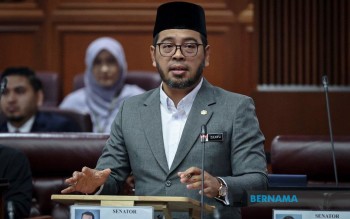
The Malaysian government has intervened in the financial crisis affecting Lembaga Tabung Haji (TH) through a substantial bailout package exceeding RM10 billion, designed specifically to restore the fund's solvency rather than to acquire its assets, Parliament heard during a special sitting addressing the institution's troubled affairs. Minister in the Prime Minister's Department (Religious Affairs) Dr Zulkifli Hasan detailed the rescue operation, which was triggered by a critical shortfall between the pilgrimage fund's liabilities and remaining assets.
The decision to provide the emergency funding came after an extensive review of TH's operational history, with investigators uncovering significant financial mismanagement alongside acts of embezzlement that had severely depleted resources meant to safeguard the savings of over a million Malaysian Muslims. By the fourth quarter of 2018, the gap between what TH owed and what it actually held had ballooned to more than RM10 billion, creating an urgent insolvency crisis that threatened the retirement security of countless pilgrims who had entrusted their hajj savings to the institution over decades.
Dr Zulkifli used the parliamentary platform to categorically refute circulating claims that had been amplified by what he termed irresponsible political actors seeking to exploit religious sensitivities for their own gain. According to the minister, allegations that TH had transferred assets to non-Muslim or Chinese ownership were entirely false and appeared designed to incite communal tension and undermine public confidence in the government's stewardship of Muslim institutions. Such misinformation, the minister suggested, represented a deliberate attempt to weaponize the legitimate concerns of TH members for narrow political advantage.
The minister clarified the structural arrangements governing TH's asset base, explaining that ownership ultimately rests with Urusharta Jamaah, a wholly-owned subsidiary of the Minister of Finance Incorporated, thereby maintaining government control under the framework of Malaysia's public financial institutions. This arrangement ensures that assets remain within the state apparatus rather than passing into private hands or external parties, preserving them within a structure accountable to Parliament and the Malaysian public. The configuration reflects standard practice for managing critical national financial assets held in trust for beneficiary populations.
The critical juncture came in late 2018, when TH faced what amounted to an existential threat to its continued operation. The pilgrimage fund's financial position had deteriorated so severely that without immediate intervention, the institution would have been unable to meet its obligations to members seeking to withdraw savings or undertake the hajj pilgrimage. The window for action was extremely narrow, with only a three-month timeframe in which to identify and implement a rescue strategy before the situation became irretrievable and potentially triggered a complete institutional collapse.
The government's bailout strategy represented a deliberate choice to preserve TH as a functioning institution serving its original purpose rather than allowing it to enter liquidation, which would have been far more damaging to the hundreds of thousands of Muslim Malaysians with funds invested in the scheme. By injecting capital and implementing a comprehensive financial restructuring, policymakers aimed to return TH to a position where it could once again operate sustainably and fulfill its mandate as a dedicated savings mechanism for hajj pilgrimage costs. This approach contrasts sharply with allowing the institution to collapse entirely, which would have resulted in massive losses for depositors.
Dr Zulkifli emphasized that the restructuring package pursued by the Pakatan Harapan administration at the time represented a carefully considered response designed to stabilize TH's operations and restore long-term viability. The bailout was not framed as a temporary measure but rather as part of a comprehensive rehabilitation strategy aimed at returning the institution to health through sound financial management and institutional reform. The government's intervention was therefore fundamentally about protecting the interests of TH members and restoring confidence in Malaysia's primary Islamic financial institution dedicated to facilitating the religious obligation of hajj.
The Royal Commission of Inquiry report that preceded the bailout decision had documented the full extent of the mismanagement and dishonesty that had undermined TH's financial position, providing Parliament and the public with a detailed account of how the institution had been compromised. These findings justified the scale of government intervention required and underscored the necessity of decisive action to prevent further deterioration. The detailed investigation had traced how operational failures combined with dishonest practices to create the massive deficit that threatened institutional survival.
For Malaysian Muslims and their families dependent on TH for hajj savings support, the government intervention represented a critical protection of their financial interests at a moment when the institution faced terminal decline. The bailout demonstrated state commitment to safeguarding access to one of Malaysia's most important Islamic financial services, ensuring that the saving mechanisms and pilgrimage support systems would remain available for future generations. Without the government's decisive action and substantial financial commitment, the consequences for millions of Malaysian Muslims planning their religious journey would have been catastrophic and irreversible.

