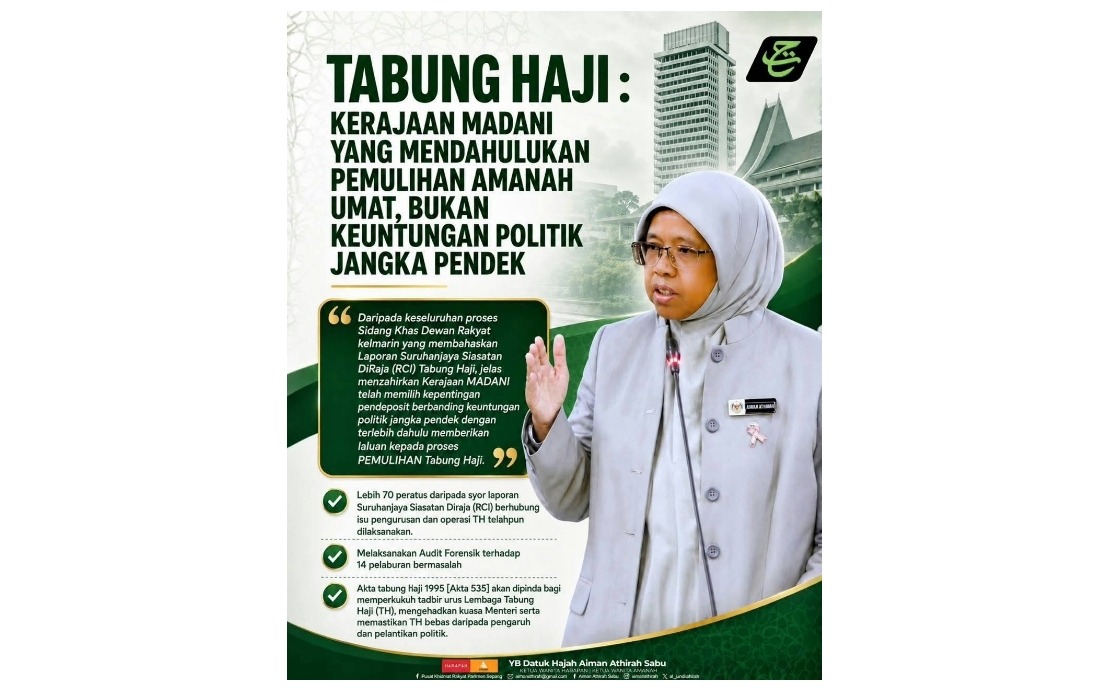
The Malaysian government is deliberately adopting a conservative stance toward revealing the Tabung Haji Royal Commission of Inquiry findings, prioritising the welfare of over 10 million depositors rather than pursuing quick political advantage. Datuk Aiman Athirah Sabu, the Deputy Minister of Housing and Local Government, articulated this position in recent comments, underscoring the institutional sensitivity surrounding Malaysia's premier Islamic pilgrimage savings body.
Tabung Haji occupies a unique position within the Malaysian financial landscape, serving as custodian of savings accumulated by millions of Muslim Malaysians earmarked for fulfilling the hajj pilgrimage. The institution's stability carries profound religious and cultural significance that extends beyond conventional banking operations. Any precipitous action regarding disclosure of governance failures risks undermining public confidence in an institution intrinsically linked to religious obligations and personal aspirations of the nation's Muslim majority.
The cautious approach reflects lessons learned from the 2018 crisis, when governance weaknesses triggered withdrawal cascades exceeding RM6 billion and threatened the institution's viability. That episode demonstrated how swiftly depositor confidence can evaporate when institutional integrity appears compromised. The government's measured strategy represents an attempt to prevent recurrence of such destabilising mass withdrawals that could damage TH's financial position and shake the religious trust undergirding the institution.
Aiman Athirah specifically addressed criticism from opposition quarters, particularly Parti Islam Se-Malaysia and Parti Wawasan Negara, who questioned the timing of the report's release. Rather than dismissing concerns outright, she reframed the government's approach as exercising fiscal prudence and institutional stewardship. The Deputy Minister argued that managing public perception must yield to ensuring the long-term stability of an organisation serving millions of Malaysian Muslims seeking to discharge a fundamental Islamic obligation.
The government has demonstrated substantive progress in implementing reforms recommended by the Royal Commission of Inquiry. More than 70 per cent of governance-related recommendations have been operationalised, according to Religious Affairs Minister Dr Zulkifli Hasan. Notably, forensic audits of 14 problematic investments have commenced, representing tangible efforts to illuminate the scale and nature of past failures while establishing accountability mechanisms. These remedial measures collectively suggest the government is addressing underlying institutional weaknesses rather than merely concealing inconvenient findings.
TH's financial trajectory offers encouraging indicators that recovery mechanisms are functioning effectively. The institution realised investment income of RM4.64 billion during 2025, a record performance, while profit distribution to depositors expanded substantially from 1.25 per cent in 2018 to 3.5 per cent in 2025. These metrics suggest operational improvements and renewed investment discipline are generating tangible returns. Simultaneously, the government has maintained hajj pilgrimage costs at RM33,000 across three consecutive seasons despite mounting operational expenses, demonstrating commitment to accessibility for Malaysian pilgrims.
The scale of historical losses from failed investments underscores why institutional recovery requires time and methodical governance reconstruction. Nearly RM13 billion in losses stemmed from 14 troubled investments, with seven recording complete capital loss. The government absorbed RM10.2 billion through a rescue mechanism involving Urusharta Jamaah Sdn Bhd in 2018, while TH sustained RM2.6 billion in impairment losses between 2018 and 2025. Revealing these figures without simultaneously demonstrating reformed governance structures and concrete recovery progress could trigger renewed anxiety among depositors already traumatised by the 2018 episode.
Regulatory reform constitutes another critical element of the government's stabilisation strategy. Proposed amendments to the Tabung Haji Act 1995 aim to strengthen governance architecture, circumscribe ministerial discretionary power, and insulate the institution from political interference and patronage appointments. These legislative changes address systemic vulnerabilities that permitted earlier governance failures. Implementing such structural reforms before releasing the full inquiry report allows the government to demonstrate that identified weaknesses have been addressed through durable institutional mechanisms rather than temporary measures.
Aiman Athirah's comments reflect recognition that TH's stability transcends ordinary institutional considerations. Malaysian Muslims view Tabung Haji not merely as a financial intermediary but as a custodian of religious aspirations and personal savings dedicated to fulfilling the hajj pilgrimage, one of Islam's five fundamental pillars. The institution's perceived integrity directly affects whether millions of Malaysian Muslims maintain confidence in depositing additional savings earmarked for this sacred obligation. This religious and cultural dimension distinguishes TH from conventional banking institutions and necessitates especially careful management of public communications.
Critics contending that the government is suppressing inconvenient truths have overlooked the distinction between concealing information and timing disclosure strategically. The government has publicly acknowledged substantial losses and governance failures, as evidenced by statements during the special Dewan Rakyat sitting. The question centres not on whether the public learns about these problems but on whether disclosure occurs within a context demonstrating reformed governance, active recovery, and restored institutional stability. Premature revelation without evidence of successful remediation could prove counterproductive.
The political dimension nevertheless merits acknowledgment. Opposition lawmakers walked out during the special sitting, characterising the disclosure timeline as politically motivated. Their criticism reflects legitimate concerns about transparency, even if their procedural response invited criticism as obstructionist. The government's communication strategy must navigate between protecting institutional stability and maintaining sufficient transparency to satisfy democratic accountability expectations. This tension remains unresolved and will likely resurface as the government determines the appropriate moment for comprehensive public disclosure.
For Malaysian depositors and the broader Muslim community reliant on TH for hajj aspirations, the immediate priority centres on evidence that governance has genuinely improved and the institution's financial foundation strengthened. Recovery indicators—rising investment returns, expanded profit distributions, controlled pilgrimage costs, and advancing regulatory reform—suggest this process is underway. Whether the government ultimately releases the complete Royal Commission report alongside these positive metrics or continues restricting disclosure will significantly shape public perception of governmental commitment to both institutional stability and democratic transparency.

