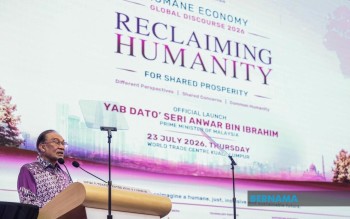
Prime Minister Datuk Seri Anwar Ibrahim has signalled that the government will commence work on Budget 2027 during August, with formal tabling anticipated in the opening weeks of October. Speaking in his capacity as Finance Minister, Anwar outlined a budgetary framework that moves beyond conventional economic metrics, instead emphasising how growth should manifest as concrete benefits for ordinary Malaysians across income levels and regions.
The overarching philosophy guiding Budget 2027 represents a deliberate departure from purely quantitative assessments of economic success. Rather than treating national accounts and gross domestic product expansion as endpoints, Anwar articulated a vision wherein fiscal policy functions as an instrument for human flourishing. This approach signals a recalibration in how the administration measures policy effectiveness, placing dignity, security, purposeful employment and hope at the centre of budgetary considerations. For Malaysian households still contending with cost-of-living pressures and employment uncertainty, this framing carries immediate resonance, particularly in a climate where wage stagnation and housing affordability remain persistent frustrations.
Elaborating on this philosophy at the Humane Economy Global Discourse 2026 forum in Kuala Lumpur, Anwar stressed that every consequential governmental decision must be evaluated through a series of critical questions. Before pursuing growth initiatives, policymakers should interrogate whether such measures expand or contract economic participation for ordinary citizens, whether they fortify family structures and neighbourhoods or leave them more exposed to volatility, and whether development treats people as stakeholders or merely as production inputs. This framework suggests Budget 2027 may prioritise inclusive growth strategies over aggregate expansion alone, potentially reshaping how resources are allocated across sectors and geographical areas.
The Prime Minister's framing also carries implications for Malaysia's semiconductor and technology sectors, which have become central to the nation's competitive positioning in East Asia. Rather than pursuing high-tech investments purely for export competitiveness, the budgetary lens would require that such industries create quality employment pathways, skills development opportunities and wealth distribution mechanisms that reach beyond metropolitan centres. This could influence how incentive structures are designed for multinational corporations and domestic enterprises operating in these strategic sectors.
Energy transition and digital transformation initiatives, traditionally pursued as competitive necessities and environmental obligations, are recontextualised through this humane economy framework. Budget 2027 allocations for renewable energy infrastructure and broadband expansion would need to demonstrate how such investments translate into reduced utility costs for middle and lower-income households, improved digital access for rural communities, and job creation in green sectors. The implicit challenge here is ensuring that Malaysia's energy and digital transitions do not inadvertently widen inequalities between urban and rural populations or between sectors.
Wages and employment quality emerge as particular focal points within this budgetary philosophy. Anwar's emphasis on meaningful work and better remuneration signals potential budget measures targeting wage competitiveness, skills training programmes and labour market protections. Given Malaysia's persistent wage gap relative to developed Asian economies and widespread underemployment of tertiary-educated workers, this rhetorical commitment raises expectations that Budget 2027 will include concrete interventions addressing these structural challenges rather than relying on market forces alone.
Housing affordability, identified explicitly by Anwar as a priority, represents one of Malaysia's most pressing policy challenges. Young professionals, young families and first-time homebuyers across income brackets have faced deteriorating affordability ratios, particularly in Klang Valley and George Town regions. Budget 2027 allocations for affordable housing development, down-payment assistance schemes or housing loan guarantees would test whether the humane economy framework translates into redistributive fiscal action or remains primarily rhetorical.
Healthcare accessibility and education quality similarly feature prominently in the articulated vision. These sectors have faced resource constraints and quality concerns in recent years, with Malaysians increasingly reliant on private provision for specialised care and quality early education. Budgetary commitments to expand public health infrastructure, improve provider remuneration and enhance school resources would signal genuine alignment with the stated philosophy. Without such allocations, the framing risks being perceived as aspirational rather than substantive.
The sustainability dimension of Anwar's statement carries forward Malaysia's commitments to environmental stewardship whilst framing them as intergenerational justice issues rather than merely regulatory compliance. Budget 2027 might therefore incorporate mechanisms ensuring that current economic activities do not transfer environmental remediation costs to future generations, potentially influencing tax structures, subsidy patterns and infrastructure investment priorities. This framing also encompasses financial sustainability, requiring that public debt trajectories remain manageable and fiscal buffers adequate for emerging shocks.
Innovation, frequently championed as a panacea for development challenges, is repositioned within this framework as requiring accountability to inclusion and capability expansion metrics. Rather than pursuing innovation investment indiscriminately, Budget 2027 might emphasise research and development trajectories that address local problems, enhance human capabilities broadly rather than benefiting narrow elite segments, and create accessible technology solutions. This could reshape Malaysia's approach to funding startups, academic research and technology incubation programmes.
Community resilience, mentioned specifically within Anwar's discourse, suggests Budget 2027 may allocate resources toward local economic development, community institutions and civic participation mechanisms. This could manifest as enhanced funding for local governments, community development programmes, cooperative enterprises and grassroots organisations, representing a shift toward recognising community-level actors as development partners rather than implementing agencies for centrally-designed programmes.
The timing of this budgetary formulation, commencing in August with October tabling, provides approximately six weeks for interdepartmental consultation and cabinet deliberation. This compressed timeline suggests the government has substantial policy parameters already defined, though the early announcement of this timetable allows stakeholders—businesses, civil society, labour organisations and professional bodies—time to lodge input and advocacy before finalisation. How receptive the government proves to such inputs will indicate whether the humane economy framework functions as genuine participatory policymaking or represents predetermined philosophical commitments awaiting technical execution.
For Malaysia's Southeast Asian standing, Anwar's articulation of growth philosophy potentially influences regional development discourse, particularly as Vietnam, Thailand and Indonesia confront similar tensions between rapid industrialisation and household welfare. Should Budget 2027 meaningfully operationalise these principles through concrete allocations and measurable outcomes, Malaysia could establish models for humane economic policy that regional peers might examine and adapt.

