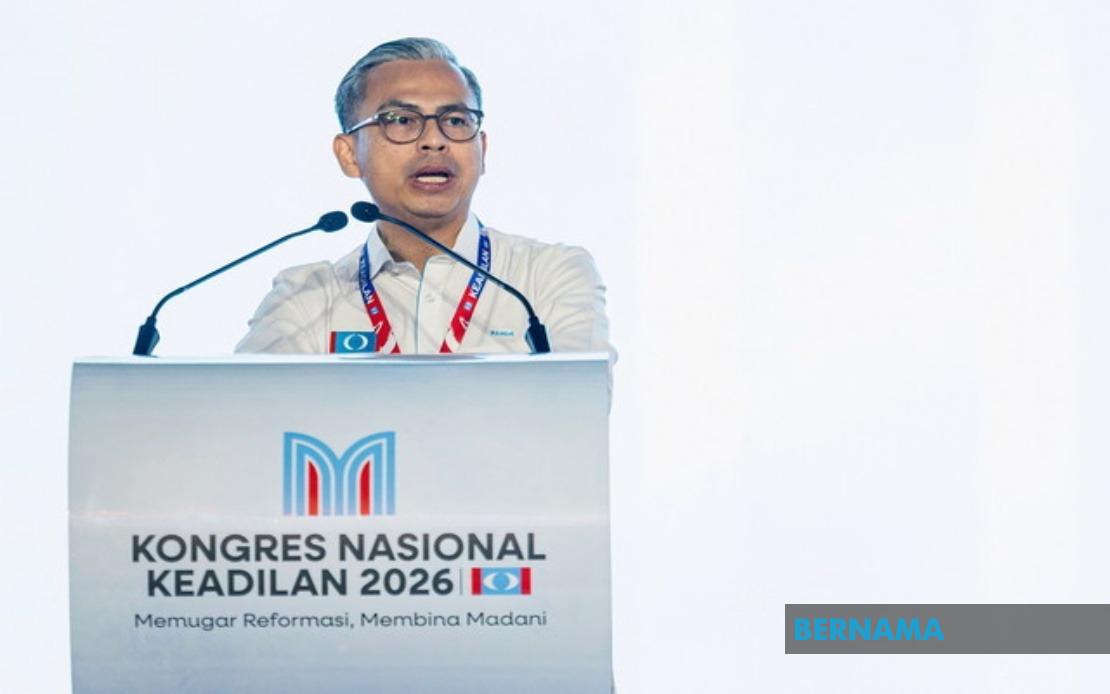
The Malaysian government has committed to overhauling how it communicates its economic policies and achievements to the public, recognising that strong macroeconomic performance alone is insufficient if citizens do not grasp or experience its real-world benefits. Datuk Seri Fahmi Fadzil, PKR's information chief and Communications Minister, made these remarks at the 2026 PKR National Congress in Melaka, signalling that the ruling coalition intends to recalibrate its messaging strategy to bridge what appears to be a significant perception gap between government actions and public awareness.
The core issue facing the administration, according to Fahmi, is that many of the policy initiatives championed by Prime Minister Datuk Seri Anwar Ibrahim and his cabinet have achieved macroeconomic success but remain poorly understood or felt by ordinary Malaysians. He characterised this challenge as translating the "pot economy"—the headline figures of growth and stability—into tangible improvements in people's daily lives. This acknowledgement reflects frustration within the ruling coalition that its achievements are not translating into political or social capital among voters, despite objective economic indicators showing progress.
Central to the revised approach is recognition that effective government communication must engage people's emotions and lived experiences, not merely inform them of facts and figures. Fahmi stressed that policies must "find a place in the hearts of the people," suggesting that the government has relied too heavily on technical explanations and statistical evidence while neglecting the psychological and emotional dimensions that drive public perception. This shift in thinking represents a more sophisticated understanding of how citizens engage with government messaging in an era of fragmented media consumption and competing narratives.
To execute this revised strategy, the government plans to mobilise grassroots party structures more effectively. PKR will deepen cooperation with division chiefs and grassroots leaders to ensure information flows more efficiently from the capital to communities. This decentralised approach acknowledges that top-down messaging from federal authorities often fails to resonate as powerfully as explanations delivered by trusted local figures within constituencies. By channelling government achievements through established party networks, the administration hopes to increase credibility and relevance at the ground level.
Small-scale community dialogue sessions will be expanded significantly as part of this effort. Fahmi indicated that intimate, informal settings allow policy discussions to unfold in relaxed environments where citizens can ask questions and engage directly with government representatives. These sessions avoid the formal, bureaucratic tone of large-scale announcements and create space for two-way conversation rather than one-directional broadcasting. The implicit recognition here is that Malaysian voters increasingly demand engagement and responsiveness, not merely information delivery.
Parallel to enhancing positive messaging, the government is intensifying efforts to counter misinformation and manipulation. Fahmi revealed that since the recent Johor state election, the Malaysian Communications and Multimedia Commission (MCMC) has identified and flagged more than 8,410 fake accounts exploiting sensitive issues related to religion, race, and the royal institution—collectively referred to as "3R issues." This coordination reflects concern that false narratives weaponising these culturally charged topics undermine public understanding of legitimate government efforts. By targeting coordinated disinformation campaigns, authorities aim to create cleaner informational space in which factual government messaging can gain traction.
The government's approach to media criticism signals a deliberate softening of tone compared to past tensions with journalists and news organisations. Fahmi explicitly rejected any suggestion that the administration seeks to control media coverage, instead framing corrective engagement as respectful dialogue aimed at addressing factual inaccuracies. This positioning is significant in a Malaysian context where press freedom concerns periodically arise; by emphasising courtesy and proper channels, the government attempts to distinguish between legitimate media accountability and authoritarian censorship. Whether this rhetorical commitment translates into practice remains to be seen, but it represents an articulation of principles around how the state should interact with fourth-estate institutions.
Internal party reforms are also planned, with the Wanita PKR wing—the women's section of the party—being repositioned as a key channel for disseminating information about government achievements to female voters and their families. This reflects recognition that women often serve as primary information gatekeepers within households and communities, and that effectively reaching them multiplies the ripple effect of government messaging. Strengthening coordination with party wings ensures that communication strategies permeate different demographic segments rather than relying solely on blanket national campaigns.
For Malaysian and broader Southeast Asian observers, this communication overhaul carries implications beyond mere messaging tactics. It suggests the Anwar-led government feels pressure to demonstrate tangible benefits from its macroeconomic policies before the next general election, expected in 2027 or 2028. Economic indicators may be solid, but political vulnerability exists if voters do not perceive improvement in their own circumstances. The emphasis on emotional resonance and grassroots engagement reflects understanding that electoral support in Malaysia's pluralistic, competitive political landscape depends not just on objective performance but on successful narrative-building around that performance.
The initiative also acknowledges lessons from regional peers. Governments across Southeast Asia have grappled with similar challenges of communication disconnect, and some have experimented with decentralised messaging and grassroots engagement strategies. Malaysia's approach borrows elements of these regional experiments while adapting them to the country's specific political and media landscape. The emphasis on countering coordinated disinformation around sensitive communal issues reflects patterns seen across the region, where such manipulation has periodically destabilised electoral environments and social cohesion.
Looking forward, the success of these communication adjustments will depend on execution and consistency. Committing to enhanced engagement at PKR congresses is straightforward; translating those commitments into sustained, credible grassroots activity across the country's varied constituencies presents substantially greater challenges. Fahmi's statements indicate awareness of this gap, but awareness alone does not guarantee effective implementation. The coming months will reveal whether the government's communication machinery can genuinely bridge the perception gap or whether structural and political constraints limit the impact of improved messaging tactics.

