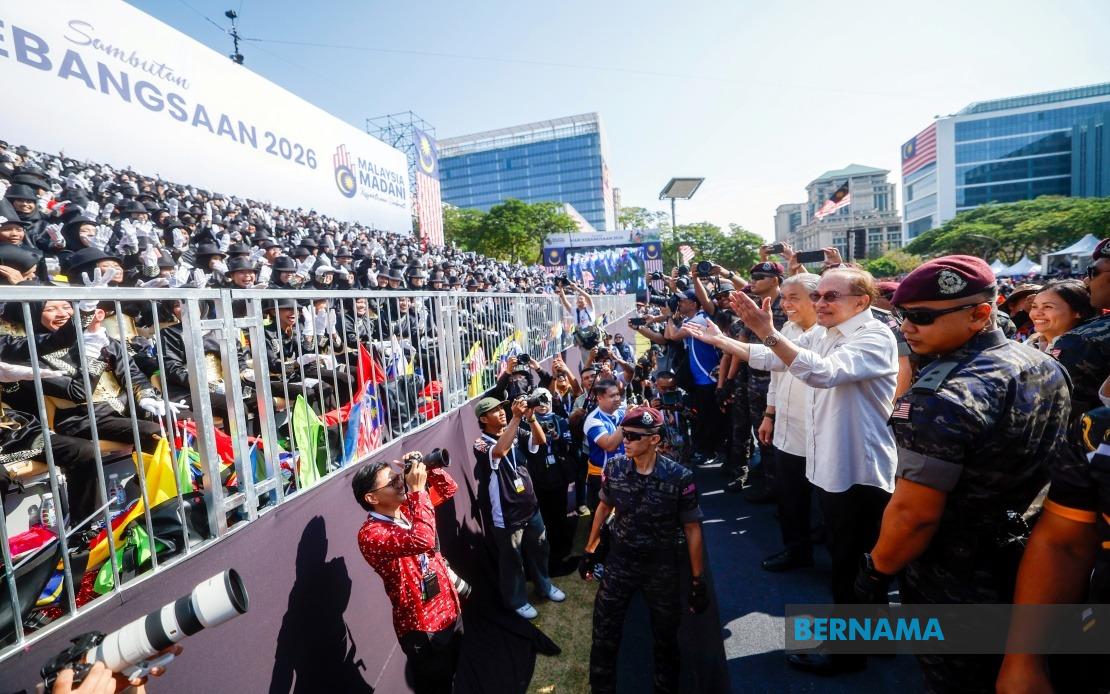
Prime Minister Datuk Seri Anwar Ibrahim delivered effusive praise for the 2026 National Day celebration held at Dataran Putrajaya, acknowledging the collective effort of organisers and the enthusiastic participation of Malaysian citizens who gathered to mark the nation's 69th independence anniversary. Speaking to media representatives after witnessing the main parade and procession, the Prime Minister expressed his satisfaction with the scale and energy of the event, describing it as a "great show" and thanking all involved in bringing the vision to life.
The celebration, which commenced at 8 am, gained added prestige with the attendance of His Majesty Sultan Ibrahim and Her Majesty Raja Zarith Sofiah, the reigning King and Queen of Malaysia. Anwar and his spouse, Datuk Seri Dr Wan Azizah Wan Ismail, welcomed Their Majesties upon arrival, alongside Communications Minister Datuk Seri Fahmi Fadzil, who chairs the main committee overseeing the 2026 National Day and Malaysia Day observances. This high-level royal participation underscored the significance accorded to the nation's independence commemoration and the MADANI vision it represents.
The event operated under the theme "Malaysia MADANI: Kesejahteraan Dinikmati," a concept that has become central to the government's messaging around inclusive development and citizen welfare. The carefully choreographed programme began with traditional military ceremonial elements before transitioning into stage performances and an elaborate parade that visually depicted the MADANI principles of national prosperity shared equitably and respect for Malaysia's multicultural fabric. This thematic coherence between the nation's founding ideals and contemporary governance aspirations offers a narrative framework through which leaders signal continuity with independence principles while projecting forward-looking economic and social ambitions.
The parade itself represented an impressive mobilisation of national resources and personnel. Nearly 11,000 participants marched across 76 different contingents, supported by 22 marching bands that provided musical accompaniment. The spectacle was enhanced by 11 decorated vehicles, a combination of 328 military and civilian assets drawn from land, sea, and air domains, 112 service animals integrated into various contingents, and notably, 22 electric vehicles that visibly communicated the government's commitment to environmental sustainability and clean energy transition. A human graphics performance executed on the terraces added an innovative contemporary dimension to traditional parade elements.
The scale of public participation eclipsed expectations, with organisers reporting that more than 100,000 Malaysians gathered at Dataran Putrajaya to witness the proceedings. The level of engagement was evident in the fact that some attendees had camped overnight at the venue the previous evening, while others arrived early in the morning, demonstrating substantial grassroots enthusiasm for the national celebration. This civilian turnout reflects not merely dutiful observance of a national ritual but genuine public engagement with national identity and patriotic sentiment.
After the formal proceedings concluded, Anwar demonstrated accessible political engagement by spending considerable time interacting with the assembled crowds. He walked for more than half a kilometre around Dataran Putrajaya, stopping to speak with citizens and accommodating numerous requests for photographs. This walkabout style of engagement serves multiple political purposes: it projects an image of a leader connected to ordinary Malaysians rather than insulated within official hierarchies, generates positive grassroots sentiment, and creates informal feedback channels where citizens can express concerns or gratitude directly. One attendee seized this opportunity to thank the Prime Minister personally for recent policy adjustments affecting fuel subsidies.
That spontaneous expression of appreciation related directly to subsidy announcements Anwar had made during his National Day Address the preceding day. In that speech, the Prime Minister unveiled six principal government initiatives aimed at enhancing citizen welfare. Foremost among these was the restoration of the monthly RON95 fuel quota under the BUDI MADANI RON95 (BUDI95) programme from 200 litres to 300 litres per eligible recipient. This adjustment benefits more than 16 million Malaysian users of subsidised RON95 fuel, representing a substantial portion of the driving population and therefore a politically significant constituency.
Beyond petrol subsidies, the government announced expanded support for commercial vehicle operators. The announcement stipulated that more than half a million Malaysians who own diesel-powered pickup trucks and jeeps—vehicles commonly used for small business operations, agricultural work, and rural transport—would become eligible to receive up to 400 litres of BUDI Diesel monthly beginning September 1. This extension of the subsidy programme to diesel users acknowledges the distinct transportation needs of commercial operators and agricultural workers, segments often economically vulnerable and politically important to the government's electoral coalition.
These fuel subsidy enhancements represent a significant fiscal commitment at a time when global oil markets remain volatile and government budgets face competing pressures. The decision to expand rather than contract subsidies, despite prevailing international trends toward subsidy rationalisation, signals that the government prioritises near-term purchasing power support for ordinary Malaysians over structural fiscal consolidation. For Southeast Asian observers, this approach reflects calculations about social stability and electoral politics that differ from prescriptions offered by international financial institutions, which typically advocate for subsidy reduction as part of broader economic reform.
The National Day celebration also carried implications for Malaysia's broader political trajectory. The 2026 observance occurred during the initial phase of implementing the Malaysia MADANI framework, an agenda that the Anwar administration has positioned as its defining contribution to national governance. By situating the independence celebration within this narrative, the government sought to establish intellectual and emotional connection between the nation's founding principles and its contemporary policy direction. For Southeast Asian policymakers and analysts, Malaysia's approach demonstrates how national anniversaries function as opportunities to reframe national purpose and rebuild social consensus around government-defined development priorities.
The visible enthusiasm displayed at the 2026 National Day celebration provides the government with evidence of public receptivity to both its messaging and its subsidy policies. The spontaneous expressions of gratitude from ordinary citizens, captured in media reports, serve as informal validation that the fiscal measures announced resonate with target beneficiaries. However, the sustainability of such public goodwill depends on continued policy delivery and broader economic performance. For Malaysia's regional position, the success in mobilising national sentiment around the MADANI vision affects the nation's stability and its capacity to project influence within ASEAN and beyond.

