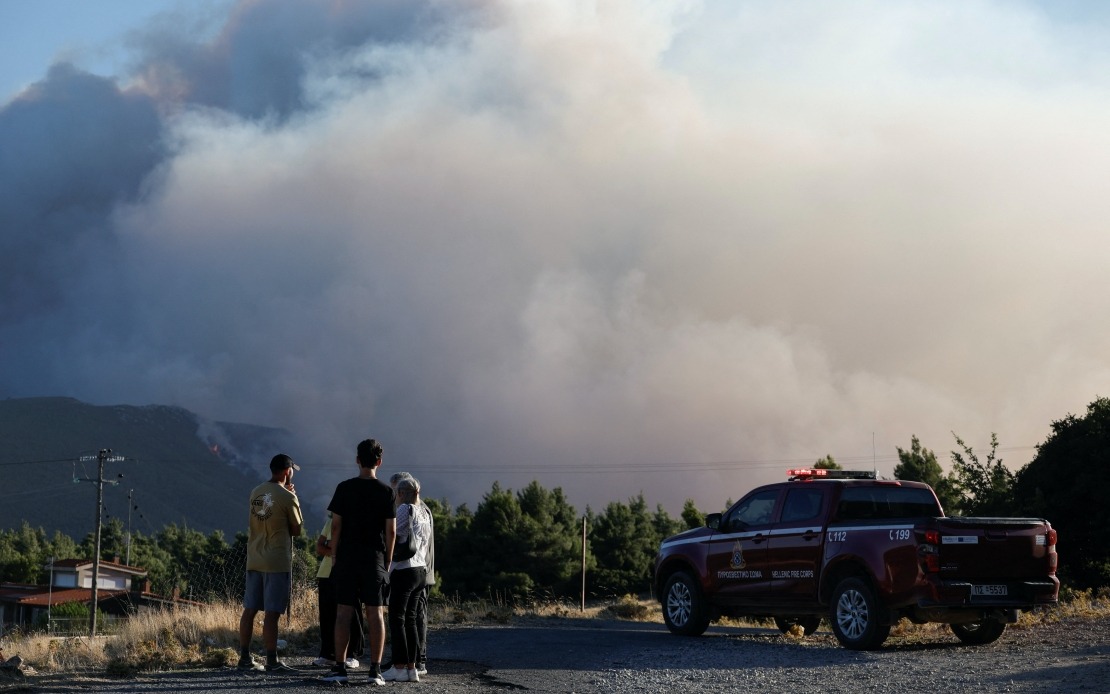
Greece's firefighting forces faced an intensifying battle on Sunday against a massive wildfire that had engulfed the Kithairon Mountains region west of Athens, with evacuation zones expanding as flames crept closer toward populated areas. The scale of the emergency response underscored the severity of the crisis, as emergency crews worked through the night to contain a fire that had proven increasingly difficult to manage in challenging terrain and volatile weather conditions.
The operational response mobilized an unprecedented coalescence of resources across national and international boundaries. At least 500 firefighters were deployed on the ground, a figure that encompassed not only Greek personnel but also specialist teams dispatched from Romania and France, reflecting the magnitude of the disaster and the willingness of European neighbours to provide mutual assistance during environmental emergencies. Supporting this ground contingent were military vehicles, volunteer organizations, and heavy equipment, yet the inferno's intensity continued to test the limits of conventional firefighting capabilities.
Weather patterns significantly amplified the danger confronting responders. Strong winds functioned as an accelerant, enabling flames to spread with unpredictable velocity across the landscape, making predictions about the fire's trajectory unreliable. The communities of Veniza and Psatha bore the brunt of the initial onslaught, with residents witnessing dramatic property losses and infrastructural damage. Meteorologists tracking the fire's progression estimated that approximately 10,000 hectares of land across the northwestern and western districts surrounding Athens had already been consumed, a figure highlighting the fire's expansive footprint across the region.
By daybreak, the strategic focus shifted to aerial intervention as firefighting planes and helicopters resumed operations once light and visibility permitted their deployment. These aircraft represented a critical element in the containment strategy, allowing water and fire-retardant drops across areas inaccessible to ground crews and enabling reconnaissance of the fire's advancing perimeter. However, the most alarming development was the fire's eastward trajectory, which positioned it just kilometres from Megara, a city approximately 50 kilometres west of Athens. This proximity to a significant population centre transformed the wildfire from a regional environmental disaster into a potential humanitarian crisis.
The investigation into the fire's origins revealed a troubling pattern of suspected criminal behaviour. Authorities across Greece had arrested 13 individuals on charges of negligent arson in connection with various fires burning throughout the country, suggesting that human carelessness or malice had triggered multiple simultaneous blazes. This element injected a criminal justice dimension into what was already a pressing environmental emergency, prompting authorities to pursue dual tracks of suppression and investigation simultaneously.
While the Athens-region fire dominated headlines and emergency resources, Greece simultaneously contended with additional fire fronts across its island territories. The island of Cephalonia was experiencing a major wildfire, though officials indicated that populated areas faced lower immediate risk. The situation on Crete appeared less critical, with local media reporting that the majority of fires there had been brought under control, yet the human toll remained significant—several towns had been evacuated, and media outlets reported that up to 200 homes had been destroyed, though official confirmation of this figure remained pending as damage assessment teams continued their work.
From a Southeast Asian perspective, Greece's wildfire crisis offers sobering lessons for a region increasingly vulnerable to similar environmental disasters. Malaysia and other nations across Southeast Asia have experienced their own recurring wildfire seasons, particularly affecting Indonesia and neighbouring areas, with transboundary smoke affecting millions of residents across the region. The Greek response—emphasizing international cooperation, rapid mobilization of diverse resources, and integration of aerial and ground assets—provides a strategic template that regional governments might study as they refine their own disaster management protocols.
The economic and environmental ramifications of such fires extend well beyond immediate firefighting costs. The destruction of 10,000 hectares represents not merely land consumed by flames but ecosystem services lost, agricultural productivity diminished, and long-term environmental rehabilitation requirements. Greece's experience demonstrates how rapidly fire can overwhelm even well-resourced nations, underscoring the importance of preventive investments in early detection systems, fuel reduction programmes, and community preparedness initiatives.
The evolution of the crisis over the coming hours remained uncertain, with weather conditions and firefighter performance determining whether Megara would be spared or whether the flames would reach its boundaries and threaten thousands of additional residents. The international dimension of the response—with Romanian and French teams operating alongside Greek colleagues—illustrated how contemporary disasters increasingly transcend national boundaries and demand coordinated multinational solutions, a reality that Malaysian policymakers should recognize as environmental challenges become more transnational in character.

