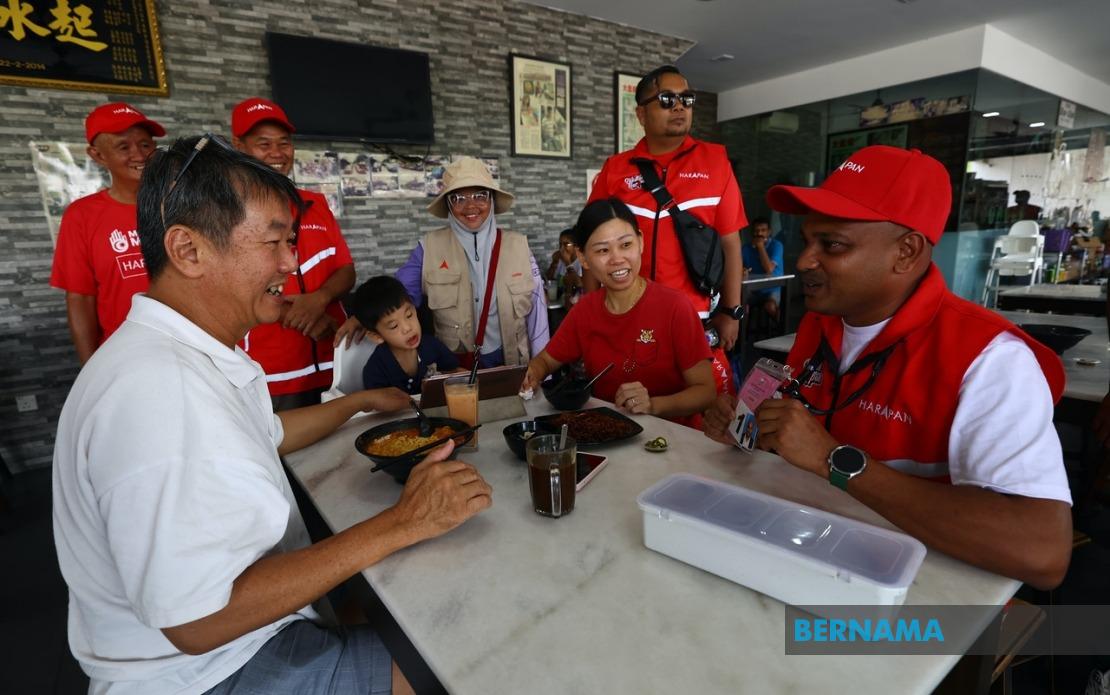
Guna Balakrishnan, the Pakatan Harapan candidate contesting the Layang-Layang state seat, has ramped up his campaign intensity with the Johor state election just five days away, aiming to connect with the final fifth of the constituency's voters that his campaign machinery has yet to reach. Speaking at the PH operations centre in Kluang, he expressed determination to surge his efforts beyond current levels to ensure comprehensive voter engagement across the 25,181-strong electorate in the constituency.
The campaign team has managed to cover roughly four-fifths of Layang-Layang through door-to-door visits and grassroots engagement, but Balakrishnan acknowledged that the remaining 20 per cent of voters represent a critical component of his path to victory. In a striking statement about his commitment, he suggested that the campaign would need to elevate its energy and resources significantly in the closing stretch, employing maximalist tactics to reach those still beyond the campaign's footprint.
Balakrishnan's core campaign message centres on positioning Pakatan Harapan as a force for substantive governance reform at the state level. He has framed the election as a choice between the ruling coalition's demonstrated record of delivering development outcomes versus alternatives, urging voters to consider which political force has earned credibility through tangible improvements to citizens' lives and institutional performance.
The candidate's manifesto reveals a granular understanding of Layang-Layang's infrastructure challenges and quality-of-life concerns. Flood mitigation emerges as a priority, reflecting the constituency's vulnerability to seasonal inundation—a persistent headache for residents in lower-lying areas. Complementing this, Balakrishnan has pledged systematic upgrades to road networks and street lighting infrastructure, basic services that remain inconsistent across many Malaysian constituencies despite urbanisation elsewhere.
Connectivity and digital access form another pillar of his platform, addressing a genuine infrastructure gap in rural and semi-rural areas of Johor where internet quality remains unreliable. This resonates with modern economic participation, education, and social inclusion imperatives. For traders, remote workers, and students relying on online platforms, stable broadband access has shifted from luxury to necessity, making this a substantively important policy commitment beyond rhetorical appeal.
Human capital development initiatives distinguish Balakrishnan's offer from generic campaign promises. His emphasis on vocational training expansion targets youth employment prospects in a state where manufacturing and services sectors demand skilled workers. Similarly, women's entrepreneurship support addresses both gender equity and economic participation, while proposals to establish senior citizen activity centres (PAWE) acknowledge the welfare needs of Johor's ageing population—a demographic reality gaining political salience across Malaysia.
Local business owners have responded positively to this agenda. Trader Tan Ah Kiat, representing the merchant community, highlighted Balakrishnan's practical focus on the specific drainage and infrastructure deficiencies that affect commercial activity and residential safety. His recognition that connectivity improvements have direct bearing on rural business viability—enabling e-commerce, digital marketing, and online transactions—points to how infrastructure policy intersects with economic opportunity in contemporary Southeast Asia.
Residents like R. Kalaiselvan have similarly endorsed the human-centred dimensions of Balakrishnan's platform, particularly the emphasis on youth skills development and inclusive welfare provision. The approval for a long-term vision spanning different age cohorts and economic strata suggests that PH's candidate has calibrated his messaging to address multiple constituencies' distinct needs rather than pursuing one-dimensional populism.
The Layang-Layang contest itself represents a genuinely competitive three-way race, distinguishing it from many Malaysian constituencies where one force dominates. Barisan Nasional has fielded Chua Jian Boon, while Perikatan Nasional's incumbent Abd Mutalip Abd Rahim seeks retention. This configuration means that vote-splitting dynamics, turnout variation, and persuadable swing voters will likely determine the outcome—making Balakrishnan's final week campaign intensity strategically logical.
The timing of Johor's state election assumes particular significance within Malaysia's broader political cycle. Unlike federal general elections, state contests allow regional voters to express preferences more granularly, often serving as referendums on state government performance. For Pakatan Harapan, establishing or consolidating strength in Johor—historically a Barisan Nasional stronghold—carries implications for the party's trajectory at national level and its capacity to challenge incumbent federal structures in Southeast Asia's most prosperous state economy.
Early voting commences on July 7, with polling day scheduled for July 11, compressing the final campaign window considerably. For candidates like Balakrishnan, this timeline creates urgency around voter mobilisation, particularly among demographics with lower natural propensity to vote early. The intensity he is describing reflects recognition that elections are ultimately decided by who shows up and votes, not merely by who has been contacted or convinced in principle.
For Malaysian voters and observers tracking Johor's political trajectory, the Layang-Layang contest encapsulates broader questions about governance priorities, development delivery, and which coalition can most credibly address infrastructure deficiencies and inclusive economic participation. Balakrishnan's manifesto suggests that Pakatan Harapan is fighting the election on substantive policy grounds rather than merely inherited partisan advantage, a strategy that may or may not resonate once ballots are cast across the state.

