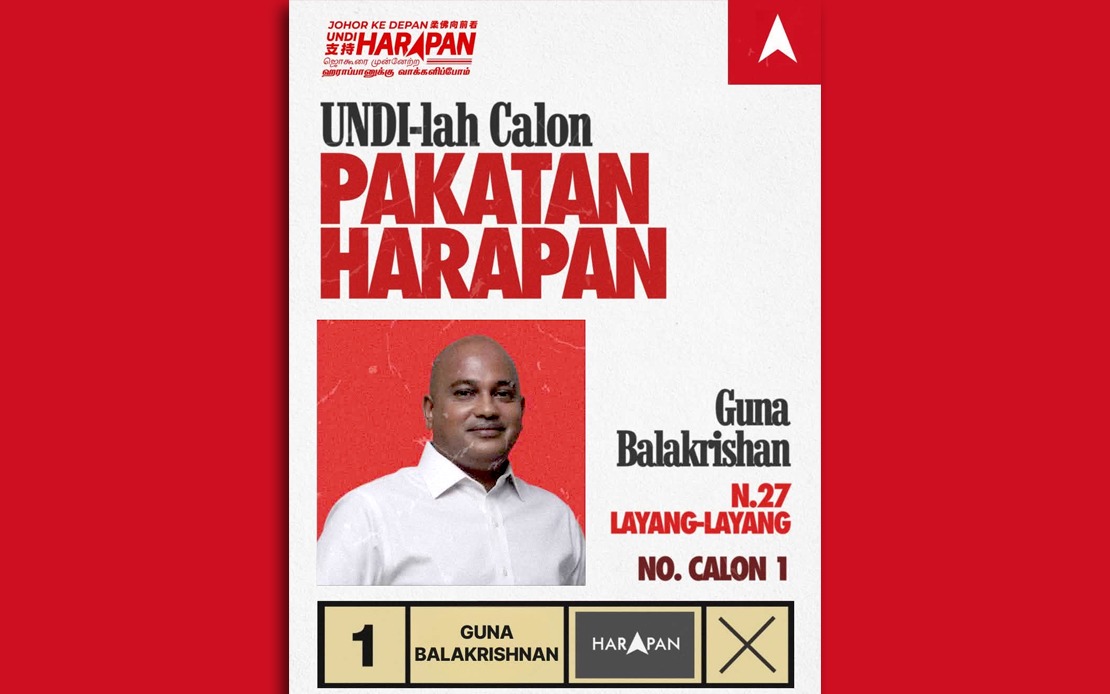
Pakatan Harapan candidate Guna Balakrishnan has presented an ambitious six-point manifesto for the Layang-Layang state seat, positioning himself as a representative committed to narrowing the gap between constituents and government machinery. Speaking in Kluang ahead of the Johor state election scheduled for July 11, Guna framed his candidacy around the principle of inclusive development that would tangibly improve residents' quality of life across the diverse community.
Flood management stands central to Guna's platform, reflecting the persistent vulnerability of multiple settlements within the constituency. Villages including Kampung Senda, Sungai Sayong, Kampung Tengah Renggam, Ulu Benut, Simpang Renggam and Kampung Chokro have endured repeated inundation that disrupts livelihoods and threatens safety. Beyond merely acknowledging the problem, Guna's approach encompasses expedited implementation of mitigation infrastructure, systematic upgrades to drainage networks, and regular maintenance protocols for road and public facility networks. This three-layered strategy suggests recognition that flooding requires integrated solutions spanning engineering, maintenance systems, and responsive governance rather than ad-hoc interventions.
The candidate's infrastructure agenda extends beyond flood prevention to embrace digital connectivity and public safety. Rural areas within Layang-Layang currently face limited internet access, a constraint that undermines educational opportunity and entrepreneurial activity for residents geographically distant from urban centres. Enhanced street lighting simultaneously addresses safety concerns while improving the evening functionality of public spaces. These investments in connectivity and safety infrastructure carry particular resonance for rural constituencies across Southeast Asia, where such deficits often translate into competitive disadvantage for residents compared to their urban counterparts.
Economic empowerment through local entrepreneurship represents another pillar of Guna's manifesto. His proposals to strengthen small traders and commercialise Renggam's tourism potential suggest a diversification strategy that would broaden income sources beyond traditional sectors. This approach acknowledges that rural constituencies require tailored economic strategies distinct from urban-centric development models, with tourism and localised commerce offering realistic pathways toward sustainable livelihoods. By directly targeting traders and tourism operators, the candidate signals engagement with constituencies' actual economic actors rather than abstract policy frameworks.
Youth development initiatives feature prominently, with Guna proposing expanded access to Technical and Vocational Education and Training programmes and establishment of a motorsports facility. The motorsports component warrants particular scrutiny as it reflects recognition that youth in rural areas require organised platforms channelling energy and talent rather than informal outlets that often generate safety concerns. TVET expansion addresses the persistent skills gap that limits youth employment prospects in regions with limited tertiary education infrastructure, a challenge resonating across Malaysia's peripheral districts.
Gender and age demographics receive specific attention within the manifesto framework. Proposals to strengthen women's entrepreneurship acknowledge female participation in informal economies while providing structured support mechanisms. Establishment of a Senior Citizens Activity Centre responds to demographic ageing and social isolation affecting retired residents in constituencies where extended family structures have weakened. These demographic-specific commitments suggest Guna recognises that inclusive development requires targeted interventions addressing particular population segments rather than universalised approaches.
Guna's rhetorical framing emphasises transformation of the assemblyman role from distant administrator to accessible intermediary between constituent concerns and governmental apparatus. This messaging implicitly critiques existing representation structures while positioning the candidate as offering qualitative improvement in responsiveness and accessibility. By explicitly characterising his pledges as realistic commitments rather than rhetorical flourishes, Guna attempts to distinguish himself from conventional campaign discourse that residents may regard sceptically after previous unimplemented promises.
The Layang-Layang contest presents a three-way competition among Guna representing Pakatan Harapan, Barisan Nasional's Chua Jian Boon, and incumbent Abd Mutalip Abd Rahim of Perikatan Nasional. The constituency encompasses 25,181 registered voters, a sufficient base where campaign platforms and candidate visibility carry genuine electoral weight. Early voting occurs on July 7, with the main election conducted four days later, providing the coalition a compressed timeframe for ground operations and persuasion messaging.
For Malaysian observers and regional analysts, Guna's platform exemplifies the strategic positioning emerging among opposition candidates in peripheral constituencies where bread-and-butter service delivery and responsive governance represent primary electoral concerns. Unlike urban constituencies where ideological debates and national political narratives dominate discourse, rural and semi-rural seats reward candidates demonstrating specific solutions to documented problems—flooding, connectivity deficits, economic stagnation, and demographic challenges. Guna's approach reflects apparent recognition that Layang-Layang voters prioritise concrete improvements in tangible service delivery over abstract policy debates.
The manifesto's structure also signals attempt to address governance gaps that have presumably persisted under existing representation. The emphasis on interagency coordination and systematic project implementation suggests prior frustration with fragmented administrative responses where residents encounter difficulty determining which government entity bears responsibility for particular problems. By committing to orchestrate cooperation across the state government, local authorities, and relevant agencies, Guna implicitly acknowledges that inclusive development requires administrative integration that transcends traditional hierarchical boundaries.
Within broader Johor electoral dynamics, Layang-Layang represents territory where Pakatan Harapan seeks to expand its presence and demonstrate capacity to deliver alternative governance models to established ruling coalitions. Success in peripheral constituencies requires particular attention to locally salient issues rather than national messaging, an approach reflected in Guna's granular focus on flood mitigation, rural connectivity, and community-specific welfare initiatives. The candidate's emphasis on being permanently accessible and responsive to constituent concerns attempts to address a fundamental legitimacy challenge facing opposition candidates in territories with limited prior experience of non-traditional governance.
For Southeast Asian readers observing Malaysian political development, Layang-Layang and comparable constituencies illustrate enduring divides between urban and rural political economies. Rural voters frequently demand different governance qualities than metropolitan electorates, prioritising responsiveness, practical problem-solving, and accessible representation over ideological consistency or policy sophistication. Guna's platform demonstrates recognition of these differentiated voter expectations and tailors his candidacy accordingly, presenting inclusive development not as rhetorical flourish but as specific, achievable commitments addressing documented constituent needs across multiple dimensions.

