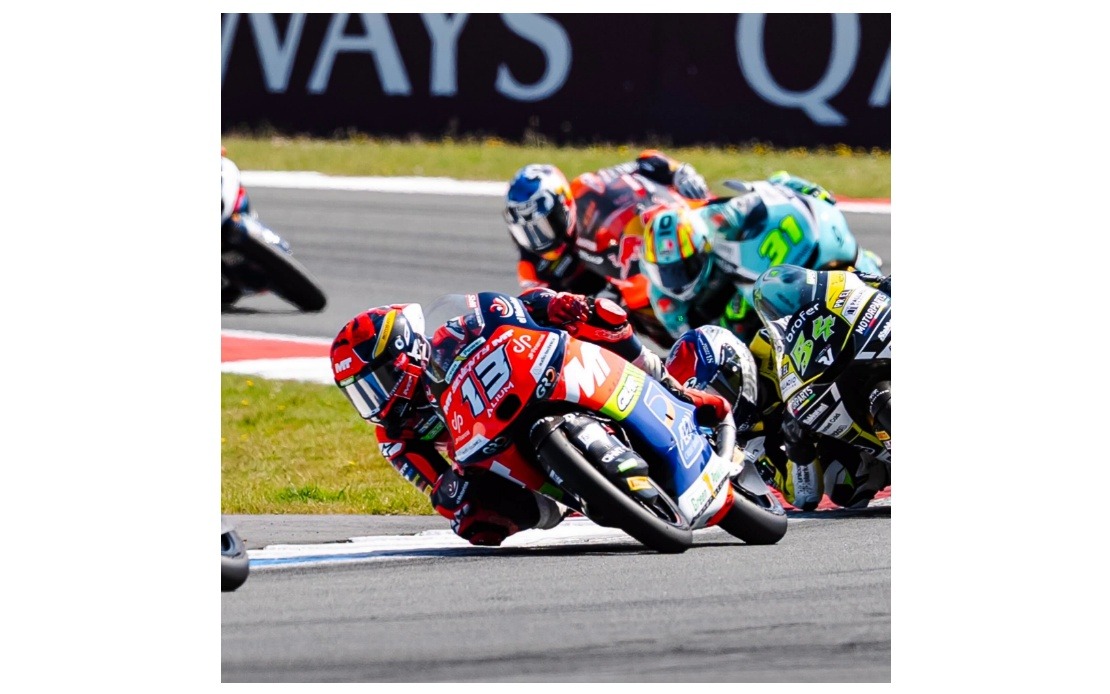
Muhammad Hakim Danish Ramli demonstrated the tenacity required of competitive motorcycle racers yesterday at the TT Circuit Assen, where the 18-year-old Malaysian talent navigated a challenging Dutch Grand Prix to secure a seventh-place finish in the Moto3 category. The result extends Hakim Danish's championship campaign with nine additional points, repositioning him at sixth place overall in the standings with an accumulated tally of 82 points as the season progresses through its European rounds.
Starting from a disadvantageous 16th position on the grid, Hakim Danish's performance highlighted the technical skill required to overturn such a deficit within the Moto3 class, where the competitive field remains tightly bunched and overtaking opportunities depend on precise throttle management and line selection. His ability to make progress through the field during the opening stages demonstrated the aggressive yet calculated approach necessary to compete at this level of international motorcycle racing.
For much of the 25-lap encounter, Hakim Danish operated within the leading pack and even contested for positions inside the top three, suggesting a competitive pace that belied his qualifying position. This period of the race represented the Malaysian's most assured moment, where his machine handling appeared consistent and his tactical positioning reflected an understanding of the racing dynamics unfolding around him.
However, the latter stages of the Grand Prix presented significant challenges to the young Malaysian rider's ambitions. As the race entered its final five laps, Hakim Danish began experiencing difficulties with tyre grip—a common problem in motorcycle racing where tyre degradation and track temperature fluctuations can dramatically alter handling characteristics. The loss of confidence in tyre performance forced him into a more conservative approach when maintaining competitiveness would have demanded aggression.
This final-lap struggle proved decisive. Several competitors capitalized on Hakim Danish's reduced momentum during the closing stages, overtaking him and consolidating their positions ahead. The Malaysian rider crossed the line in 33 minutes 56.275 seconds, ultimately seven positions behind where he had threatened to finish earlier in the encounter. While seventh place represents a respectable result by most standards, the manner in which it came—slipping back when advancement appeared possible—will likely fuel motivation for future rounds.
The championship mathematics now place Hakim Danish in contention but not commanding. His sixth-place standing with 82 points represents mid-field consistency, the type of scoring pattern that keeps a rider within striking distance of the leaders without commanding the narrative. For Malaysian motorsport followers, the presence of a young rider competing at this level carries significance beyond individual race results, as the Moto3 category serves as the traditional pathway to the premier MotoGP class.
Hakim Danish's own assessment, offered through social media, reflected a measured perspective on both achievement and frustration. He acknowledged managing the race well from the challenging opening position and breaking into the leading group—accomplishments that deserve recognition. Simultaneously, he registered his dissatisfaction with tyre performance, indicating an honest appraisal of where his efforts fell short of his own expectations. This balance between acknowledging progress and identifying shortcomings suggests a mature approach to professional racing.
The Moto3 class remains one of the most competitive junior categories in international motorsport, with numerous manufacturers represented and national federations investing substantially in rider development. Within this environment, Malaysian representation has grown more sporadic in recent seasons, making Hakim Danish's participation and point-scoring performances noteworthy within the broader context of Southeast Asian motorsport participation at elite levels.
For the upcoming rounds, Hakim Danish will likely focus on qualifying improvements that could alleviate the pressure of recovering from grid positions outside the top ten. The speed to compete at the front clearly exists, as his mid-race performance demonstrated. The challenge now becomes translating that race-day competitiveness into consistent qualification results that provide better launching positions for the Grand Prix encounters ahead. The Dutch Grand Prix outcome, while satisfactory in isolation, represents a platform from which incremental progress becomes essential for championship aspirations.

