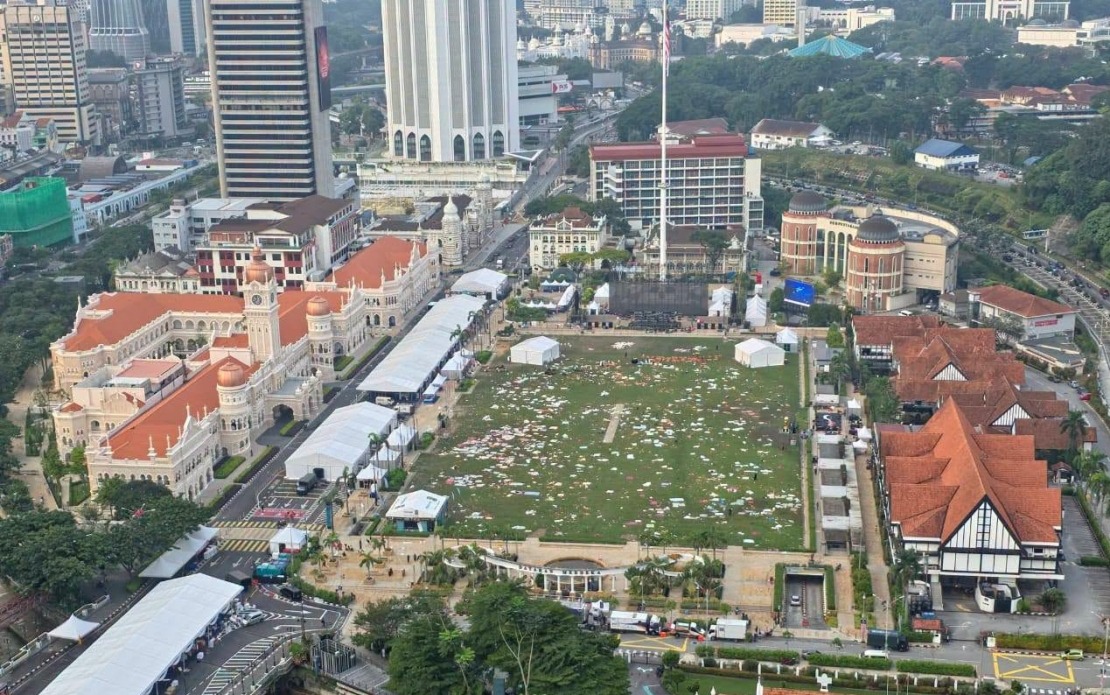
Federal Territories Minister Hannah Yeoh has used the littering incident at Dataran Merdeka following a public screening of the 2026 FIFA World Cup final as a teachable moment about civic responsibility, striking a balance between acknowledging government service obligations and emphasizing the role of citizens in maintaining shared public spaces.
The minister took to Facebook to commend the efforts of Kuala Lumpur City Hall (DBKL) staff who worked extensively to restore the iconic venue after the event. However, her praise came alongside a pointed reminder that disposing of rubbish in designated bins represents a fundamental civic duty that should not rest solely on the shoulders of public workers. Her intervention reflects growing concerns among government officials about the gap between expectations of state services and individual accountability in maintaining urban environments.
Hannah's statement directly challenged what she framed as a misunderstanding of citizens' rights and responsibilities. She acknowledged that taxpayers legitimately expect efficient public services and that DBKL must fulfil its operational mandates. Yet she emphasized that the ability to use public facilities does not translate into a blanket permission to shift all cleaning obligations to municipal workers. The minister's position suggests an understanding that sustainable public space management requires partnership rather than one-directional service delivery.
The incident at Dataran Merdeka carries symbolic weight beyond simple littering. The venue holds profound national significance as a landmark central to Malaysia's independence narrative and the dignity of the capital city itself. Hannah framed the preservation of this space as a collective obligation, positioning cleanliness not merely as a practical concern but as an expression of respect for shared national heritage. This connection between environmental responsibility and national pride represents an attempt to elevate the conversation beyond procedural rules about waste disposal.
The minister's messaging also aligned with the Malaysia MADANI development framework championed by Prime Minister Datuk Seri Anwar Ibrahim. Rather than viewing MADANI solely as a government-driven agenda, Hannah reframed it as a mutual undertaking requiring both state institutions and individual citizens to meet their respective obligations. This interpretation suggests that progress in Malaysia requires cultural shifts in how people regard public property and collective spaces, moving beyond passive consumerism of government services toward active stewardship.
Hannah referenced the Prime Minister's perspective that national advancement cannot be measured by physical infrastructure alone. Instead, she emphasized that how citizens treat and respect public spaces constitutes an equally important indicator of societal development. This philosophical stance challenges a common tendency in discussions of urban development to focus exclusively on construction, facilities, and government efficiency while overlooking the behavioral and cultural dimensions that sustain functioning cities.
The appeal carries particular relevance for Malaysia's rapidly urbanizing context. As cities expand and public venues become more heavily utilized, the tension between service provision and user responsibility becomes more acute. Events attracting large crowds, such as major sporting spectacles, often leave significant cleanup tasks for municipal authorities. Hannah's intervention suggests recognition that repeated incidents of this nature reflect not merely isolated lapses but potentially systemic patterns requiring changed attitudes rather than simply increased budgetary allocation for sanitation services.
The statement employed a direct appeal to Malaysians' sense of ownership and pride in their capital, using the phrase "Kuala Lumpur is our home." This framing attempts to shift responsibility from an external entity—government workers—to the individuals who create the mess. By using domestic metaphors, Hannah sought to activate an intuitive understanding that people maintain their own homes and should extend this logic to shared public spaces. This approach acknowledges that moral suasion and appeals to collective identity sometimes prove more effective than enforcement mechanisms.
The minister's public intervention also served a broader governance function by establishing expectations and norms. Official statements from senior government figures regarding citizen conduct help shape societal standards and create space for public discourse about behavioral expectations. By elevating this issue to ministerial attention, Hannah signaled that maintaining public spaces constitutes a matter of legitimate government concern and public policy discussion, not merely a technical service delivery challenge.
The cleanup incident at Dataran Merdeka underscores broader Southeast Asian urban management challenges. As the region's cities host increasingly large public gatherings and international events, municipalities face mounting pressure to maintain facilities. Malaysia's experience reflects patterns seen across the region, where rapid urbanization and growing public events create tensions between citizen expectations of pristine public spaces and willingness to take personal responsibility for maintaining them.
Hannah's emphasis on personal responsibility also implicitly acknowledges resource constraints in municipal governance. While DBKL possesses organizational capacity and funding, unlimited littering creates unsustainable cleaning burdens. By appealing to civic consciousness, the minister promoted a sustainable approach grounded in prevention rather than endless remediation. This strategy recognizes that structural solutions alone—more workers, better equipment, larger budgets—cannot address behavioral patterns.
The minister's statement represents a nuanced approach to public management that neither absolves government of service responsibilities nor permits citizens unlimited freedom to treat public spaces as disposable. This balanced perspective contrasts with more polarized positions that either blame individuals entirely for environmental degradation or attribute all responsibility to inadequate state services. Hannah's framework suggests that genuine urban improvement requires simultaneous progress on both institutional effectiveness and cultural attitudes toward communal stewardship.

