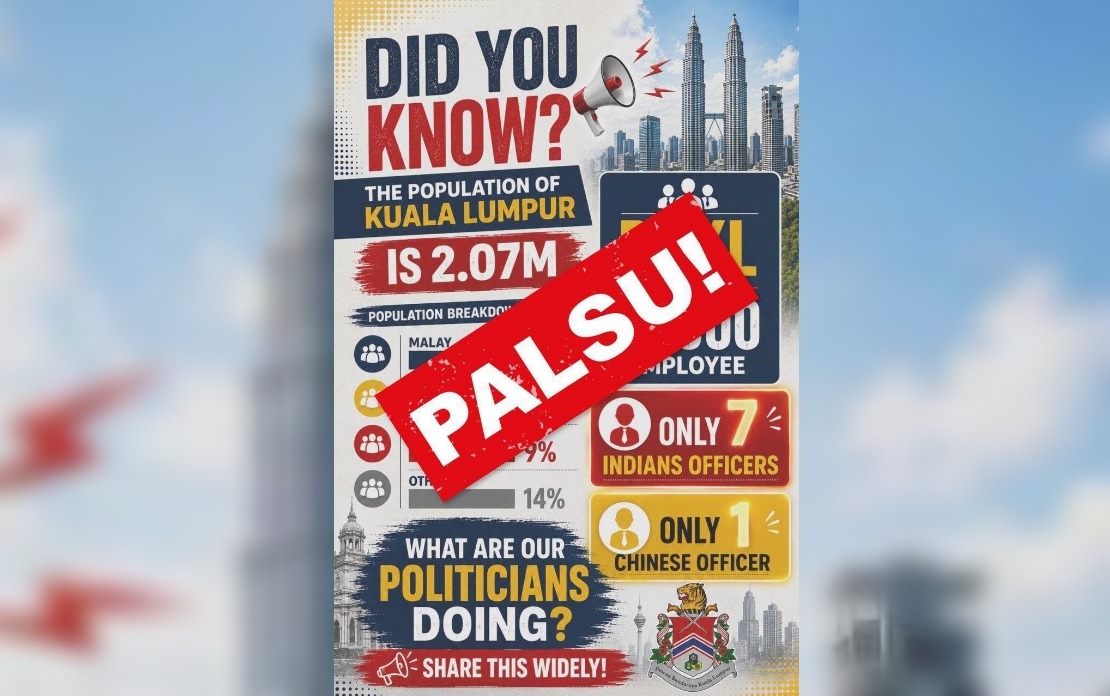
Minister in the Prime Minister's Department (Federal Territories) Hannah Yeoh has moved to counter misinformation spreading through social media regarding Kuala Lumpur City Hall's (DBKL) employment composition, directly addressing inflammatory claims that emerged during campaign season. The false narrative, which gained traction via WhatsApp messaging, alleged that DBKL maintained an ethnically skewed workforce with representation limited to just seven Indian employees and a single Chinese staff member—a characterisation that fundamentally misrepresents the actual diversity within Malaysia's capital city administration.
In response, Hannah provided comprehensive data documenting DBKL's genuine workforce makeup as of July 1, 2026. The local authority operates with a total staff complement of 9,131 personnel, of which 490 identify as Indian and 22 as Chinese, fundamentally contradicting the circulated poster's inflammatory claims. Beyond raw headcount figures, the minister also disclosed disaggregated information about representation within higher-ranking positions, noting that the Management and Professional Group includes ten Indian officers and two Chinese officers on the payroll, further debunking assertions of systematic exclusion at senior levels.
The circulation of such claims during Malaysia's electoral cycle carries particular significance given the nation's historically sensitive intercommunal dynamics. Hannah explicitly cautioned against weaponising workforce diversity issues to manufacture communal grievances or polarise the electorate along ethnic lines. Rather than exploiting genuine governance questions for electoral advantage, the minister called upon all stakeholders to focus attention on correcting demonstrable falsehoods and addressing any legitimate concerns about representation and merit-based advancement within public institutions.
While rejecting the specific allegations as false, Hannah acknowledged that room for improvement exists within DBKL's employment framework. Rather than dismissing concerns about diversity outright, she took the constructive step of directing the authority to undertake a comprehensive audit of its human resource practices. This review encompasses multiple dimensions of employment management: recruitment methodologies, hiring decision-making processes, promotion pathways, and the channels through which job vacancies are advertised to potential candidates. The objective is identifying procedural gaps that may inadvertently create barriers to equal opportunity.
The directive emphasises principles of transparency, fairness, and merit-based selection as foundational to reformed hiring and advancement practices. Hannah's approach suggests recognition that procedural reforms can strengthen public sector credibility while simultaneously demonstrating commitment to inclusive governance. By committing DBKL to systematic examination of its own practices rather than defensively dismissing concerns, the minister positioned the issue within a framework of continuous institutional improvement rather than one of defensive denial.
The timing of these false claims during an election campaign raises broader questions about the deliberate dissemination of misinformation as an electoral tactic in Malaysia. The ease with which unverified claims can circulate through encrypted messaging platforms, where verification mechanisms are absent and source attribution becomes impossible to trace, creates vulnerability to coordinated disinformation efforts. Public officials face heightened pressure during campaign periods to respond to false narratives that nonetheless gain credibility through repetition and sharing within tight social networks.
For Malaysian readers, particularly those concerned with governance standards and institutional integrity, the incident underscores the importance of critical media literacy and source verification. Claims about government agencies circulating through informal channels warrant scrutiny before acceptance and further dissemination. Official data releases and direct government statements, while not inherently infallible, provide more reliable foundations for forming opinions about public sector practices than unattributed social media posts.
The broader context of public service diversity in Malaysia remains complex. While DBKL's figures demonstrate meaningful representation across ethnic communities, questions about equitable advancement, departmental distribution, and whether recruitment practices genuinely reach all demographic groups fairly continue to merit attention. Hannah's acknowledgment that improvement remains possible signals willingness to address systemic factors that might create unequal outcomes even absent discriminatory intent.
The minister's response also reflects evolving standards for political communication in Malaysian public administration. Rather than simply dismissing critics or attacking those spreading false information, Hannah sought to provide comprehensive accurate data while simultaneously calling for elevated discourse standards. This approach attempts to counter misinformation while avoiding escalatory rhetoric that could intensify communal tensions during sensitive electoral periods.
Moving forward, DBKL's prospective human resources audit will likely become subject to public scrutiny, particularly regarding whether concrete reforms emerge and how genuinely the authority implements transparency measures. The credibility of Hannah's commitment to institutional improvement will ultimately depend on tangible changes in hiring practices, promotion criteria visibility, and demonstrable progress in workforce representation across occupational categories.
For Southeast Asian observers, Malaysia's experience with election-period misinformation offers instructive lessons about vulnerabilities within digital communication ecosystems and the particular effectiveness of ethnically divisive messaging in plural societies. Countering such narratives requires simultaneous deployment of accurate information, institutional credibility-building, and deliberate efforts to prevent exploitation of legitimate diversity discussions for electoral advantage—a balancing act Hannah's response attempted to strike.

