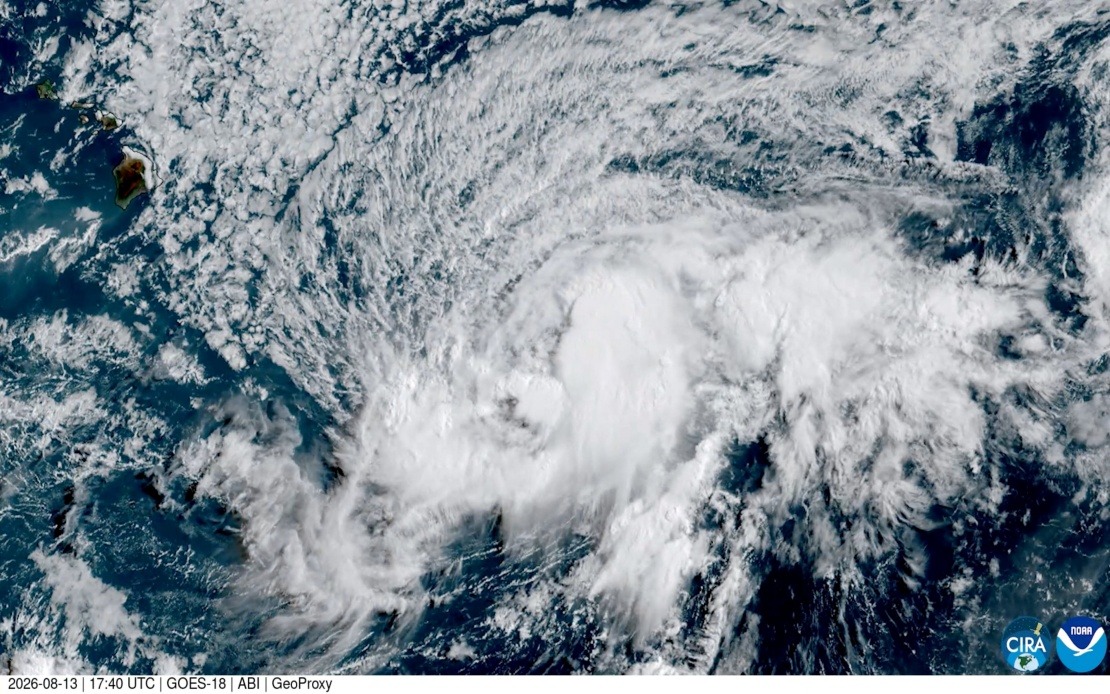
Tropical Storm Lala is intensifying in the Pacific and poses an increasingly serious threat to Hawaii's Big Island, with meteorological authorities predicting it will achieve hurricane status before making landfall this coming weekend. The National Hurricane Centre has indicated that Lala should cross into hurricane-strength conditions during its approach to the island, creating a rare and historically significant weather event for the Hawaiian archipelago.
The potential arrival would mark a watershed moment in the islands' recorded meteorological history. According to research conducted by atmospheric scientists at the University of Hawaii who examined historical newspaper accounts, the Big Island has not experienced a direct hurricane strike for over 150 years. The last recorded impact occurred in 1871, when a Category 3 hurricane struck the northeast section of the island, leaving a gap in the island's exposure to such severe tropical systems that has now spanned more than a century and a half.
Meteorologers with the National Weather Service in Honolulu have emphasized the distinctive nature of this threat within the modern meteorological record. Vanessa Almanza, a meteorologist stationed in Honolulu, noted that whilst satellite observation has transformed weather forecasting capabilities since the 19th century, such a direct strike represents a first in the satellite era. She further observed that current modeling suggests Lala's trajectory will bring it remarkably close to the southern tip of the Big Island, positioning it for a potentially significant impact on that vulnerable region.
The anticipated storm surge and precipitation present multiple hazards to island communities and infrastructure. Heavy rainfall accompanying the hurricane is forecast to generate destructive flooding across vulnerable areas, whilst the concurrent strong winds pose additional risks by potentially igniting or accelerating wildfires across the islands' dry regions. These compounding weather phenomena create layered threats that emergency management officials must prepare for simultaneously.
Hawaiian authorities have responded by implementing a tiered warning system reflecting the differential threat levels across the archipelago. The Big Island, facing the most direct threat, has been placed under a hurricane warning, indicating that hurricane conditions are expected imminently. Neighbouring Maui County, which encompasses the islands of Maui, Molokai, Lanai and Kahoolawe, has been assigned a tropical storm warning, reflecting the expectation of sustained tropical storm-force conditions though with a lower probability of hurricane-force winds.
For Malaysian readers and regional observers, this event illustrates the continuing vulnerabilities of island communities to tropical cyclones, a phenomenon well understood in Southeast Asia and the broader Asia-Pacific region. Hawaii's geographic isolation in the central Pacific and the century-long hiatus since the last direct hurricane strike may have created complacency or reduced institutional memory about hurricane preparedness, challenges that island nations across the region likewise confront as they balance development pressures with disaster resilience.
The rarity of direct hurricane strikes on the Big Island underscores how even well-developed jurisdictions with advanced forecasting capabilities face unique challenges when extreme weather events fall outside recent historical norms. Emergency response systems may not have been tested against the specific conditions that a major hurricane would produce, and infrastructure designed or maintained based on historical patterns of lower cyclonic activity may prove inadequate.
The approaching storm also carries implications for Hawaii's tourism-dependent economy and agricultural sectors. The Big Island hosts significant portions of Hawaii's macadamia nut production, coffee cultivation, and other agricultural operations that are vulnerable to both wind damage and flooding. Furthermore, the tourism industry on the Big Island may face disruptions not only during the storm event itself but potentially in the aftermath as infrastructure is assessed and repaired.
Meteorological tracking will intensify over the coming days as Lala continues its trajectory toward Hawaii. The precise timing of maximum intensity relative to the moment of landfall, the exact point of contact with the island, and the storm's forward speed will all substantially influence the ultimate damage assessment. Scientists and emergency managers will be closely monitoring model predictions and satellite imagery to provide increasingly refined guidance to residents and businesses preparing for the potential impact.
The Hawaiian Islands' geographic position in the central Pacific has historically spared them from the frequency of direct hurricane strikes experienced by other tropical regions. However, this storm emphasises that whilst such events remain statistically uncommon, they remain possible and warrant sustained preparedness efforts even during prolonged periods without direct impacts. As climate patterns continue to evolve, understanding both historical cyclone behaviour and emerging meteorological trends will remain essential for island communities throughout the Pacific region seeking to balance development with resilience.

