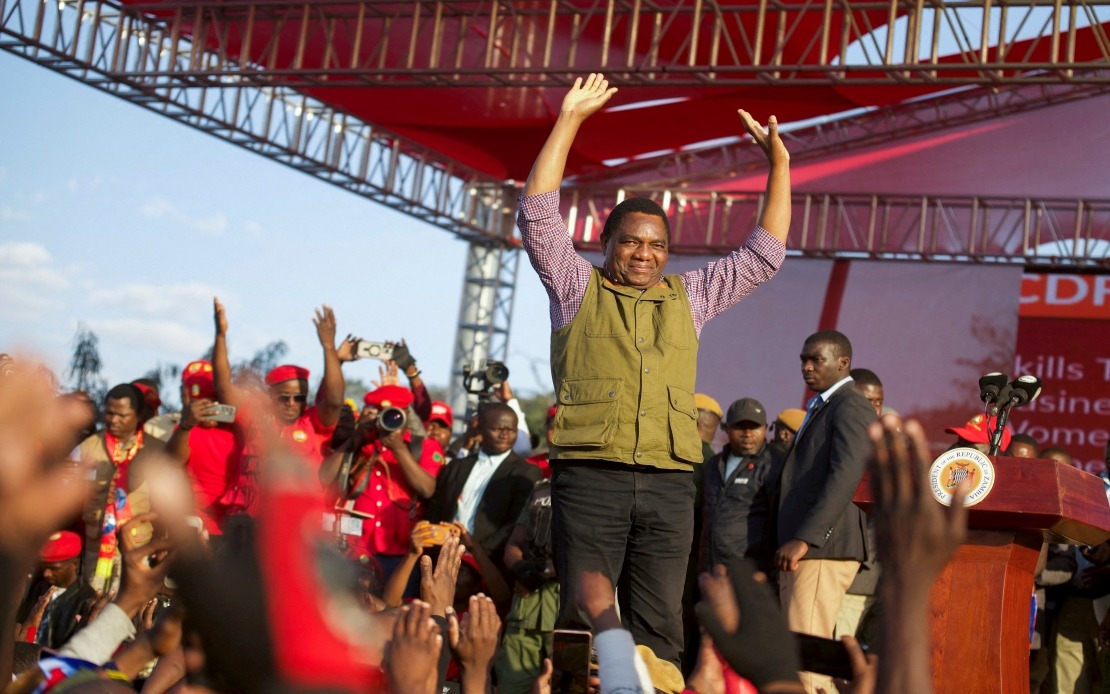
Zambian President Hakainde Hichilema is heading toward a convincing second-term victory after commanding a substantial lead in Sunday's presidential election, with preliminary tallies showing the 64-year-old economist and rancher has accumulated more than 1.5 million votes from results counted in 135 of the country's 226 constituencies. The Electoral Commission of Zambia announced the consolidated figures at the National Election Results Centre in Lusaka, with Hichilema's United Party for National Development (UPND) significantly outpacing its competitors at this stage of the count.
With 1,544,140 votes registered so far, Hichilema maintains a commanding advantage over his nearest rival, Brian Mundubile of the National Reconciliation Party for Unity and Prosperity (NRPUP), who has garnered 1,030,662 votes. The gap of roughly half a million votes at the preliminary stage suggests a difficult path for opposition candidates to overcome the deficit before all ballots are tallied, though the electoral process remains ongoing as counting continues across the remaining constituencies.
The electoral landscape in Zambia reflects broader regional patterns seen across Southern Africa, where incumbent leaders often leverage the machinery of state and existing institutional advantages. Hichilema's first term, which began in 2021 after he defeated then-President Edgar Lungu by more than one million votes, established him as a transformative figure in Zambian politics. His administration has pursued an agenda centred on economic restructuring and debt reduction, addressing the fiscal pressures that had accumulated under his predecessor's tenure.
Economic management has formed the cornerstone of Hichilema's political messaging and policy platform. His government has undertaken significant efforts to restructure Zambia's substantial external debt burden, a legacy of previous administrations. These efforts have included negotiations with international creditors and the International Monetary Fund, reflecting Zambia's position within the broader global financial system. The success or failure of these restructuring efforts will significantly shape the country's economic trajectory in the coming years.
Beyond fiscal matters, Hichilema's administration has prioritised revitalisation of Zambia's mining sector, which remains the engine of the national economy. Zambia ranks among Africa's largest copper producers, and the health of this industry directly impacts government revenues, foreign exchange earnings, and employment. His government's approach to attracting investment while ensuring local benefit from resource extraction represents a delicate balance that shapes perceptions of economic stewardship among voters.
Social policy initiatives have also featured prominently in the government's platform. The introduction of free education for students in public primary and secondary schools represents a significant expansion of state provision, targeting what many Zambians identify as critical barriers to upward mobility. Such programmes carry substantial budgetary implications and reflect political choices about resource allocation and the state's role in providing essential services to citizens.
Mundubile, aged 55 and trained as a lawyer, has assembled an opposition alliance that has gained traction in certain geographic pockets, particularly in urbanised regions stretching through Lusaka and the Copperbelt provinces. The concentration of opposition support in these areas suggests that urban voters and mining-dependent communities may harbour distinct concerns or grievances compared to rural constituencies. This geographic pattern of electoral support is instructive for understanding the social bases and regional foundations of Zambian politics.
Under Zambia's constitutional framework, securing the presidency requires clearing a significant threshold—a candidate must capture more than 50 per cent of all valid votes cast to be declared president-elect outright. Should no candidate surpass this hurdle in the initial count, the contest proceeds to a second ballot between the leading contenders. Given Hichilema's current commanding position and the distribution of opposition votes among multiple candidates, the likelihood of a runoff scenario appears diminished, though the final outcome depends on results from the remaining 91 constituencies yet to be fully processed.
The electoral dynamics in Zambia carry implications for the broader Southern African region, where political competition and democratic processes are increasingly scrutinised. The conduct of these elections, the acceptance of results by losing candidates, and the subsequent political behaviour of all parties shape both domestic stability and regional perceptions of democratic health. The region has experienced instances of election-related tensions and disputes, making peaceful transfers of power or successful incumbency renewals significant events worthy of observation.
Hichilema's potential second term would provide the opportunity to advance the reform agenda initiated during his first five years, consolidating institutional and policy changes that require continuity to take full effect. Debt restructuring agreements, mining sector reforms, and educational initiatives all benefit from sustained implementation and evolving policy refinement. Conversely, a second term also carries expectations for demonstrable improvements in living standards, employment opportunities, and service delivery that extend beyond broad macroeconomic metrics.
For Malaysian observers and regional analysts, the Zambian election illustrates the intersection of economic policy, institutional development, and electoral competition in African democracies. Malaysia's own experience with managing commodity-dependent revenues, debt levels, and social programmes offers potential points of comparative analysis. The success or struggles that incumbent leaders face when seeking renewal mandates often reflects the quality of governance, the credibility of development claims, and the distribution of benefits across different segments of society.

