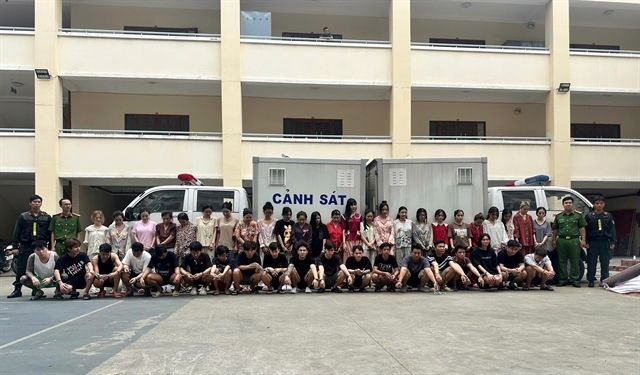
Vietnamese law enforcement in Ho Chi Minh City has dismantled a sophisticated drug trafficking network centred on the illicit distribution of etomidate-laced electronic cigarettes, culminating in the arrest of 49 suspects including four foreign nationals. The operation, which investigators revealed on Wednesday, represents a significant enforcement action against an emerging drugs trend that exploits the widespread popularity of vaping among young people across the region.
During the crackdown, authorities seized approximately 1,670 contaminated vape pods along with substantial quantities of ketamine and methamphetamine. The etomidate itself—a potent short-acting anaesthetic normally restricted to surgical environments where trained medical specialists provide close supervision—had been illegally incorporated into vape liquid cartridges. Vietnamese health authorities added etomidate to the nation's controlled substances list in January, transforming its unauthorised sale and consumption into a serious criminal matter.
The ingenious marketing approach employed by traffickers involved dissolving the anaesthetic into sweetened vape solutions and promoting them under deceptively innocuous brand names designed to appeal to recreational users. Retailers marketed these contaminated pods as "chill pod", "relaxation pod", "sleep-well pod" and "fly pod", disguising their true pharmacological properties. The products circulated through venues frequented predominantly by younger demographics, including entertainment establishments such as bars and karaoke lounges, as well as through residential rental properties where social gatherings occurred.
Investigators initially focused their attention on a street-level dealer operating under the alias Ba Giá, subsequently identified as 28-year-old Nguyen Huu Huan from Dong Thap province. Following his arrest on June 25 alongside his wife Ngo Thi Kim Chi, aged 30, authorities uncovered a multi-tiered distribution infrastructure. The investigation revealed that Huan had acquired his inventory from at least two distinct supply networks, each contributing to the city's emerging etomidate problem.
One supplier group operated under the direction of Huynh Ngoc Thuy Nhu, 26, supported by Hua Tuong Vy, 20, both based in Ho Chi Minh City. This network maintained its own production and distribution channels within the metropolis. A second, more geographically ambitious operation involved Le Quoc Duy, 40, from An Giang province, who had established a cross-border smuggling pipeline through Cambodia. Duy exploited porous frontier crossing points in his home province to transport contraband vape products into Vietnam before consolidating shipments for delivery to Ho Chi Minh City distributors. Police recovered 37 pods from Duy's location alongside 200 grammes each of ketamine and methamphetamine.
A third criminal faction, allegedly coordinated by Han Kiat—a Cambodian citizen—along with three additional foreign nationals, specifically targeted expatriate communities residing in Ho Chi Minh City. This network's strategy of focusing marketing efforts on non-Vietnamese speakers reflects how trafficking operations have adapted to demographic patterns and consumer segmentation within major Southeast Asian urban centres. The presence of South Korean, Chinese and Cambodian nationals among the arrested individuals underscores the regional dimensions of this illicit trade.
The public health dangers posed by inhaled etomidate distinguish this substance from traditional recreational drugs encountered in enforcement operations. When inhaled through vaping mechanisms, etomidate circumvents the usual digestive absorption route and instead passes directly from the lungs into the bloodstream, reaching the brain within seconds. Initial effects reported by users include sensations of lightheadedness accompanied by mild hallucinations. However, this benign onset masks serious acute risks including neurotoxicity, severe drowsiness, involuntary muscle contractions and complete loss of consciousness.
Particularly alarming to health authorities is etomidate's lethality potential when combined with alcohol or other central nervous system depressants commonly consumed in entertainment venues where these vapes circulate. Police medical advisors have warned that high-dose exposure or concurrent polysubstance use can trigger sudden respiratory arrest and fatality. The substance's chemistry also creates detection challenges that criminals deliberately exploit in their marketing claims.
Unlike conventional narcotics such as heroin, cannabis or methamphetamine, which consumer-grade rapid testing kits can readily identify, etomidate's distinct molecular structure renders standard field-level detection impossible. Traffickers have capitalised on this analytical gap, advertising their products as "undetectable" or claiming they will produce "100 per cent negative" results on commercially available test kits. Specialist forensic analysis equipment operated by police and dedicated laboratory facilities can identify etomidate with accuracy, but the infrastructure limitations mean detection primarily occurs through targeted enforcement rather than routine screening.
The visual appeal and contemporary cultural associations of electronic cigarettes substantially amplify the recruitment challenge facing law enforcement. Young consumers may perceive vaping as a sophisticated, trend-aligned consumption method, rendering them vulnerable to criminal marketing that emphasises the devices' fashionable appearance and social credibility. The combination of visual legitimacy, sophisticated marketing narratives, detection evasion capabilities and genuine pharmacological potency creates conditions for rapid market expansion if left unchecked.
This operation assumes particular significance for Southeast Asian policymakers because it demonstrates how drug trafficking networks continuously innovate their delivery mechanisms and product formulations to circumvent established detection and enforcement frameworks. Vietnam's addition of etomidate to controlled substance lists only months before this operation was discovered suggests officials were already monitoring emerging trends. The involvement of cross-border smuggling through Cambodia highlights how regional cooperation on pharmaceutical contraband becomes increasingly critical as traffickers exploit jurisdictional complexities across Southeast Asia.
Vietnam's drug control authorities have issued explicit warnings to citizens, particularly young adults, to exercise extreme caution regarding e-cigarette products from unverified sources. Officials have urged the public to reject marketing claims regardless of their assurances, and to refrain from involvement in any stage of the supply chain from manufacturing through possession and distribution. The warnings reflect broader recognition that emerging drug trends in major Southeast Asian cities often prototype in Ho Chi Minh City before potentially spreading across the region, making these enforcement successes internationally significant for the region's public health response strategies.

