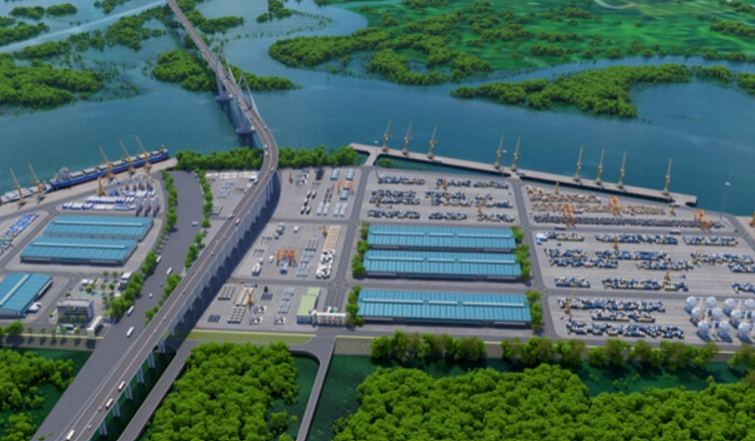
Ho Chi Minh City officially inaugurated construction of the QTM International Port on Sunday, a US$261 million (VNĐ6.9 trillion) venture that represents a significant commitment to fortifying the region's position as Southeast Asia's premier logistics gateway. The project, situated within the sprawling Cai Mep-Thi Vai deep-water port complex in Phu My Ward, addresses mounting pressure on existing infrastructure as Vietnam's southern economic engine accelerates operations following administrative consolidations that have substantially enlarged the city's footprint and commercial hinterland.
The port facility will eventually operate eight deep-water berths capable of accommodating cargo vessels up to 60,000 deadweight tonnes, with infrastructure designed to accommodate future expansion to vessels exceeding 100,000 DWT. Upon full completion, the complex is projected to process 16 million tonnes of cargo annually across its 80-hectare footprint, representing a substantial addition to Vietnam's maritime transport capacity. The development schedule spans two construction phases extending from 2026 through 2034, allowing for phased commissioning and operational refinement as demand patterns evolve across the region's logistics networks.
Integral to the port's design is an expansive integrated warehousing and logistics hub exceeding 190,000 square metres, positioning the facility to serve as more than simply a vessel berth. This component addresses a critical gap in Southeast Asia's supply chain infrastructure, where modern, climate-controlled storage and distribution capabilities remain constrained. The warehousing facility will enable consolidation of shipments, value-added processing, and distribution management functions that increasingly define competitiveness in global trade corridors, particularly for regional exporters serving markets across the Indo-Pacific and Europe.
The timing of this investment reflects demonstrable commercial pressures. During the initial six months of 2024, maritime and inland waterway cargo volumes moving through Ho Chi Minh City expanded by 7.3 percent, a trajectory that accelerated following the city's consolidation of surrounding districts. This expansion has created logistical bottlenecks within existing port infrastructure, constraining the velocity of goods movement and imposing economic costs on businesses dependent on rapid turnaround of inventory and materials. Port planners recognize that without augmenting capacity, congestion pricing and extended transit times will increasingly disadvantage Vietnamese producers competing in time-sensitive global markets.
During the groundbreaking ceremony, Hoang Nguyen Dinh, vice chairman of Ho Chi Minh City's People's Committee, articulated the strategic imperative driving the project. His remarks emphasized that the city's recent administrative expansion has fundamentally altered cargo handling requirements, necessitating a comprehensive modernization of transport corridors linking suppliers to regional and international markets. The QTM project addresses this challenge by creating what planners envision as a networked logistics ecosystem, incorporating maritime transport, warehouse operations, and inland distribution under coordinated management rather than fragmented competing entities.
National leadership underscored the macro-economic dimensions of port infrastructure investment. Deputy Prime Minister Pham Gia Tuc highlighted that logistics expenditures currently consume between 14 and 16 percent of Vietnam's gross domestic product, a burden that impairs the competitiveness of domestically produced goods relative to regional competitors operating from more efficient port and distribution environments. By reducing the friction costs embedded within supply chains, modernized port infrastructure effectively subsidizes export producers and enhances Vietnam's positioning within global value chains demanding rapid, economical movements of raw materials and finished goods.
The deputy prime minister's statement also signaled political urgency, directing project developers to prioritize completion of the initial operational phase within eleven months—an ambitious timeline that underscores government prioritization of the project. This acceleration aligns with Ho Chi Minh City's announced economic growth targets, which project double-digit percentage increases dependent upon removing logistical constraints that currently throttle commercial expansion. Should developers meet this compressed schedule, the port could operationally commence contributing to export volume growth and regional trade consolidation well before the full facility achieves completion.
Ho Chi Minh City's geographic endowments position port expansion as strategically rational. The municipality commands approximately 110 kilometres of coastline along the Southeast Asian maritime thoroughfare, hosting one of Vietnam's most substantial maritime transport ecosystems. The Cai Mep-Thi Vai complex operates as a globally recognized container hub, maintaining direct shipping services to both trans-Pacific and European trade corridors that connect regional producers to the world's largest consumer markets. Incremental capacity additions amplify the port's capability to capture additional cargo volumes transiting across Asia's most economically dynamic region.
For Malaysia and other Southeast Asian economies, the QTM project carries implications extending beyond Vietnamese borders. Regional supply chains increasingly depend upon Vietnamese port capacity, particularly for manufacturing sectors spanning textiles, electronics, and resource-dependent industries. Enhanced port efficiency benefits the entire regional trading network by reducing the time and expense required to move intermediate inputs and finished products across production networks distributed across multiple countries. Malaysian manufacturers shipping components through Vietnamese ports or relying upon Vietnamese suppliers benefit directly from infrastructure improvements that accelerate throughput and diminish transit costs.
The project also reflects intensifying competitive dynamics among Southeast Asian port hubs. Singapore, as the region's traditional logistics epicentre, faces mounting competition from expanding facilities in Vietnam and other emerging alternatives. The QTM investment signals determination to capture market share in the rapidly growing intra-regional and trans-Pacific trade flows that are reshaping Southeast Asia's economic geography. For Malaysian policymakers and business leaders, this development underscores the necessity of parallel infrastructure modernization within Malaysian port facilities to maintain competitive positioning and prevent cargo diversion to alternative regional logistics hubs.
The investment pattern evident in Ho Chi Minh City's infrastructure ambitions also reflects Vietnam's broader strategic pivot toward positioning itself as indispensable to global supply chains seeking alternatives to concentrating critical logistics functions within single jurisdictions. Port capacity expansions complement complementary investments in inland transport networks, special economic zones, and regulatory frameworks designed to attract multinational manufacturers seeking geographic diversification of production and distribution activities. This coherent national strategy, steadily executed across multiple infrastructure categories, has proven increasingly effective at attracting both foreign direct investment and international trade flows previously flowing through established regional rivals.

