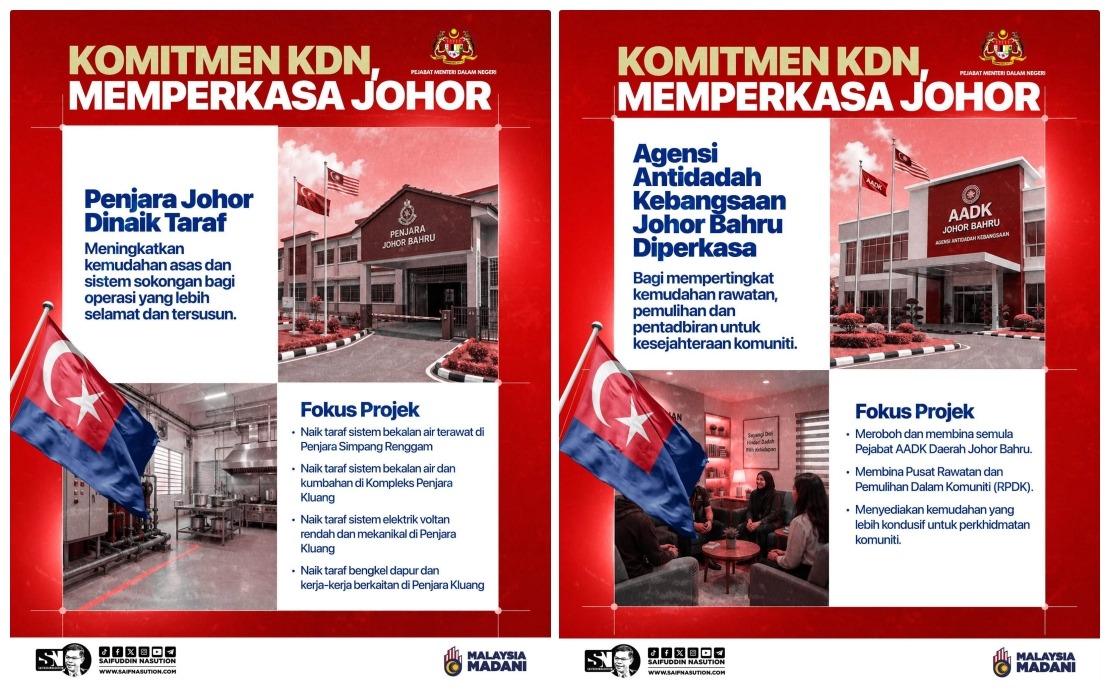
Home Minister Datuk Seri Saifuddin Nasution Ismail has announced a comprehensive strategy to strengthen Johor's security apparatus and administrative capacity through a series of targeted infrastructure and facility upgrades. The initiative underscores the government's recognition of Johor's pivotal role in the nation's southern region, where the state serves as a critical juncture for internal security operations, border management, and international transit. The coordinated effort spans multiple agencies operating under the Home Ministry's purview, signalling an integrated approach to addressing systemic deficiencies across the state's governance infrastructure.
The scale of these development undertakings reflects Johor's geopolitical and economic significance within Malaysia's broader security framework. As a state that bridges the capital region and the eastern coast, Johor functions as a crucial buffer zone and operational headquarters for numerous federal agencies. The ministry's decision to concentrate resources here suggests recognition that modernised facilities and improved operational efficiency at the state level directly contribute to national security outcomes and the quality of public services that citizens depend upon daily.
Police operations will benefit substantially from the planned investments, with the Royal Malaysia Police securing funds for the construction of a new district police headquarters in Segamat. Simultaneously, land acquisition efforts are proceeding for establishing a corresponding facility in Pengerang, expanding the force's geographic footprint across the state. Beyond these flagship projects, the ministry is allocating resources for essential maintenance work, including repairs to residential quarters and lift systems at existing police premises—maintenance often deferred in resource-constrained environments but critical for officer morale and facility safety.
Border and immigration services represent another focal point of the ministry's strategy. The Sultan Iskandar Building and the Sultan Abu Bakar Complex, both handling substantial volumes of cross-border traffic daily, will undergo facility upgrades aimed at modernising their operational systems. These improvements are designed not merely to increase processing efficiency but to enhance the professional presentation of Malaysia's border services and strengthen integrity protocols—considerations increasingly important as Johor's role as an international gateway expands with regional connectivity projects.
The National Registration Department's operational capacity in Johor will be augmented through the construction of a new district office in Batu Pahat, addressing administrative bottlenecks in a growing district. This expansion acknowledges the correlation between efficient public administration and economic development; communities with responsive government services attract business investment and citizen participation in formal systems. The investment thus carries implications extending beyond administrative convenience to economic development strategy.
Correctional facilities will receive systematic upgrades, with both Kluang Prison and Simpang Renggam Prison scheduled for improvements to their fundamental infrastructure systems. These upgrades touch upon essential aspects of facility safety, sanitation, and operational reliability—areas that directly affect prisoner welfare, staff safety, and the legitimacy of Malaysia's correctional system. Enhanced facilities support rehabilitation objectives and reduce the operational pressures that can compromise institutional integrity.
The National Anti-Drugs Agency's presence in Johor will be reconfigured through redevelopment of both its administrative offices and treatment facilities. This dual investment acknowledges that effective drug control requires both investigative capacity and rehabilitation infrastructure. The state faces persistent drug trafficking pressures given its geography and connectivity to major smuggling routes, making enhanced agency capacity a necessity rather than an amenity. Treatment facility improvements signal commitment to addressing substance abuse as a public health matter alongside law enforcement.
Maritime enforcement capability receives attention through upgrades to the Abu Bakar Maritime Base, including jetty and building renovations. Given Johor's extensive coastline and the strategic importance of the Johor Strait, enhancing maritime agency infrastructure directly contributes to regional security and the protection of critical sea lanes. The investment reflects understanding that littoral security requires modern facilities and proper personnel welfare arrangements.
The Home Ministry's framing of these initiatives emphasises that resource allocation produces tangible benefits for both serving personnel and the public they protect. The statement reflects a broader shift in how government agencies justify infrastructure spending—moving beyond technical descriptions toward outcome-oriented messaging that connects physical improvements to quality of life and security outcomes. For Johor residents, the visible manifestation of federal investment in local infrastructure provides reassurance that the state's strategic importance translates into concrete improvements in daily governance.
The timing of this announcement coincides with electoral activity in Johor, though the projects themselves represent multi-year commitments extending beyond electoral cycles. The ministry's emphasis on continuous improvement and sustained commitment suggests these are not election-driven initiatives but rather components of longer-term strategic planning. However, the public visibility of such announcements inevitably influences political perceptions, particularly in a state where the federal government has invested substantially in development initiatives.
For Malaysian policymakers and regional analysts, Johor's infrastructure development carries implications beyond the state itself. As ASEAN connectivity projects advance and cross-border economic integration deepens, the efficiency of Malaysia's border management and administrative systems directly affects the country's capacity to participate in regional value chains. Johor's infrastructure modernisation thus represents an investment in national competitiveness and ASEAN integration capacity.
The coordination of multiple agencies within a single strategic framework demonstrates institutional capacity for comprehensive planning and suggests that siloed departmental operations are gradually giving way to integrated service delivery models. This systemic improvement, if sustained, could establish templates for similar initiatives in other Malaysian states facing comparable administrative and security challenges.

