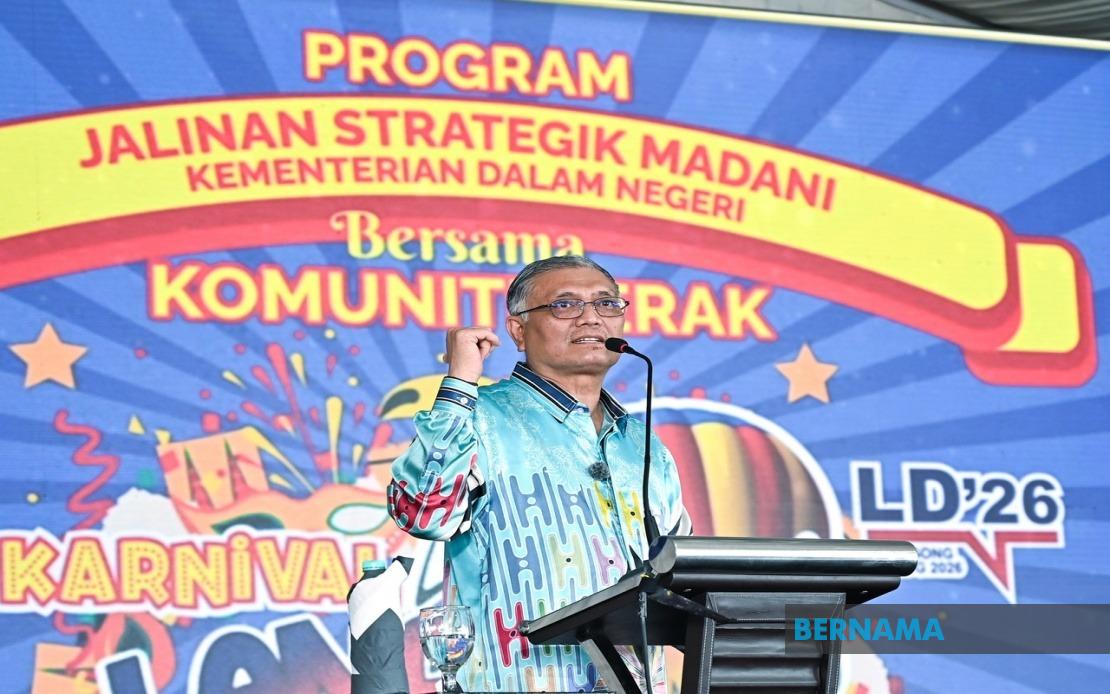
The Home Ministry has launched an ambitious initiative to bridge the gap between government agencies and local communities, deploying essential services and security personnel directly to grassroots level through its newly activated MADANI Strategic Partnership Programme. The two-day activation in Lenggong, a UNESCO World Heritage Site in Perak, demonstrates the ministry's commitment to decentralizing access to public services while strengthening collaborative ties with residents. By bringing Royal Malaysia Police personnel, Immigration Department officials, and National Anti-Drugs Agency representatives into close proximity with ordinary citizens at Dataran Lenggong, the programme offers a practical model for how centralized government machinery can be repositioned to serve citizens more effectively at the community level.
Deputy Home Minister Datuk Seri Dr Shamsul Anuar Nasarah, who serves as the Member of Parliament for Lenggong, emphasized that the initiative transcends the conventional top-down approach to governance. Rather than requiring residents to navigate bureaucratic channels or travel to distant government offices, the MADANI programme reverses this dynamic by stationing service counters directly within communities. Visitors could update personal records, request advice on procedural matters, or submit complaints to relevant authorities without the typical administrative friction. This accessibility-first approach reflects a broader philosophy within the Home Ministry to remove barriers that have traditionally prevented ordinary Malaysians from engaging directly with the security and administrative apparatus.
The programme extended beyond service delivery into community building and public engagement. A series of religious talks, children's competitions, and creative performances created an environment where security agencies were not perceived as distant institutions but as neighbors invested in community wellbeing. The wide variety of activities deliberately appealed to different demographic groups, ensuring that participation was inclusive across age ranges and interests. This multi-faceted approach acknowledges that effective community engagement requires creating welcoming environments and demonstrating tangible value beyond formal bureaucratic interactions.
The security agencies involved in the activation each showcased their respective mandates and capabilities through dedicated exhibitions. The Royal Malaysia Police displayed crime prevention resources and community policing initiatives, the Immigration Department highlighted services related to citizenship and travel documentation, while the National Anti-Drugs Agency presented drug awareness materials and rehabilitation support options. These exhibitions served a dual purpose: they educated the public about available services while simultaneously allowing ordinary residents to understand the operational scope and organizational culture of institutions that directly impact their security and daily lives. Such transparency can contribute to stronger community-police relations and greater public cooperation in addressing localized security concerns.
Recreational programming formed a significant component of the two-day activation, with approximately 1,190 participants engaging in organized Fun Ride and Fun Run activities coordinated jointly by the People's Volunteer Corps and the National Anti-Drugs Agency. Rather than treating physical activity as incidental, the programme strategically routed participants through surrounding villages, allowing them to experience Lenggong's distinctive natural environment while fostering informal interactions with agency representatives. This integration of recreation with community engagement proves more effective than purely transactional service delivery, as it creates positive associations between government institutions and leisure, health, and community pride. The scenic Lenggong Valley, recognized as a UNESCO World Heritage Site, provided a powerful backdrop that connected government service delivery with the region's cultural and natural heritage.
The timing and location of this initiative carry particular significance for Malaysian governance and regional development. Lenggong represents a category of Malaysian community—situated outside major urban centers yet possessing considerable cultural and environmental assets. By prioritizing such locations for intensive government engagement programs, the Home Ministry signals its commitment to ensuring that governance quality and service accessibility are not concentrated in metropolitan areas. This geographical approach has implications for how Malaysia addresses regional inequality and ensures that citizens in smaller towns experience tangible benefits from federal government initiatives.
From a security governance perspective, the MADANI programme embodies an approach that emphasizes preventive engagement over reactive enforcement. By creating platforms where communities can directly communicate concerns related to crime, drug abuse, and local security issues to relevant authorities, the programme facilitates information flow that can inform policy decisions and resource allocation. When residents feel heard and see their concerns reflected in agency priorities, they become more likely to cooperate with security efforts and report suspicious activities. This transformation of communities from passive subjects of security measures into active participants in security governance represents a significant conceptual shift within Malaysian law enforcement culture.
The programme's emphasis on two-way communication deserves particular attention. Rather than positioning the Home Ministry and its agencies as entities dispensing services unidirectionally, the MADANI model explicitly frames community members as sources of intelligence and insight regarding local security challenges. This reciprocal engagement acknowledges that citizens possess detailed knowledge of their neighborhoods and can identify patterns or threats that might elude distant bureaucratic analysis. By institutionalizing mechanisms for communities to communicate these insights to authorities, the programme creates potential for more responsive and contextually appropriate security policies.
The involvement of the People's Volunteer Corps alongside professional government agencies reflects Malaysia's historical reliance on community volunteers to extend the reach of state institutions. By integrating RELA into recreational and health promotion activities, the programme strengthens the volunteer infrastructure while demonstrating practical applications of citizen engagement in governance. This public-private partnership model between formal government agencies and volunteer organizations offers a scalable template that could be replicated across other communities and other policy domains beyond security.
Looking forward, the success of the Lenggong activation will likely influence how the Home Ministry approaches community engagement in other regions. The programme's comprehensive structure—combining service delivery, recreational activities, educational exhibitions, and informal interaction opportunities—addresses multiple dimensions of citizen experience and satisfaction with government. As Malaysia continues to navigate challenges related to drug trafficking, organized crime, and transnational security threats, models that strengthen community-agency relationships become increasingly valuable. The MADANI programme demonstrates that such relationship-building need not compromise efficiency or professionalism; rather, accessibility and transparency can enhance the legitimacy and effectiveness of security institutions.
The Lenggong initiative also carries implications for how Malaysia positions itself regionally. As Southeast Asian nations grapple with transnational security challenges and develop new approaches to community policing, Malaysia's investment in grassroots government engagement offers a model that other regional governments may study and adapt. The programme's integration of heritage tourism, health promotion, and service delivery suggests that comprehensive community development benefits when security agencies actively participate in broader social and economic initiatives rather than operating in isolation from civic institutions.

