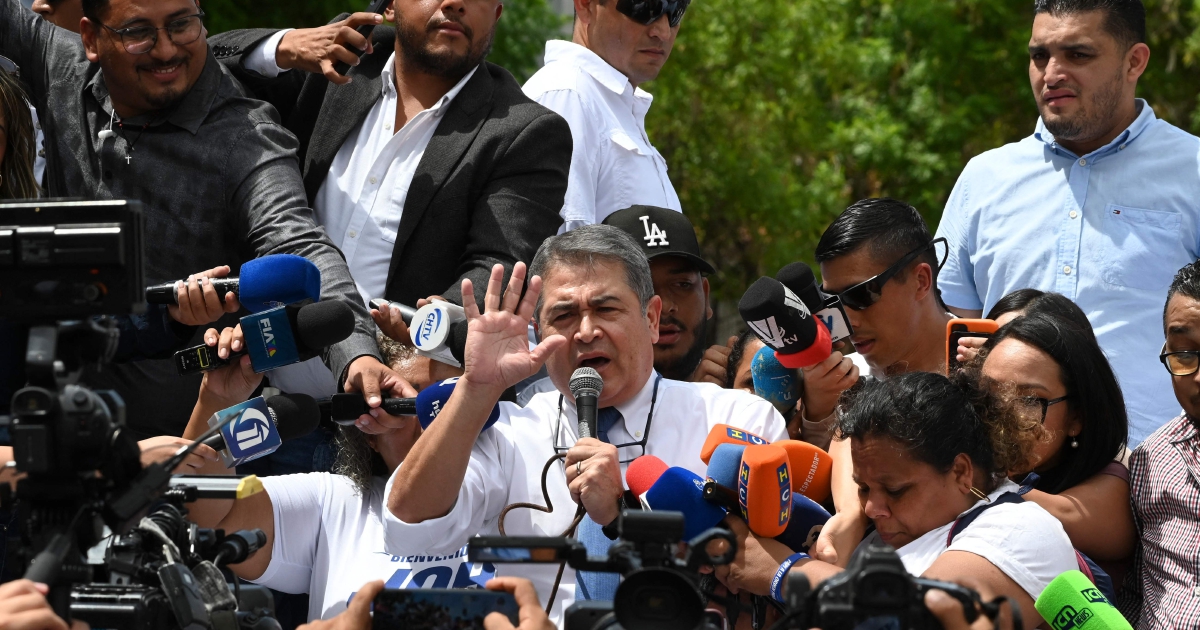
A Honduran court has permitted former president Juan Orlando Hernandez to remain at liberty whilst navigating a corruption trial in his home country, marking another chapter in the complex legal saga surrounding the controversial ex-leader. The decision, handed down by a judge in Tegucigalpa on Monday, comes roughly a year after Hernandez received a contentious pardon from US President Donald Trump that effectively erased his conviction on American drug trafficking charges.
The timing of the court's ruling underscores the parallel legal battles Hernandez has been forced to navigate across two jurisdictions. The pardon Trump granted represented an extraordinary intervention in the affairs of a neighbouring nation and generated significant diplomatic reverberations throughout the region. The move was widely criticised by civil society groups, anti-corruption advocates, and regional observers who viewed it as a reversal of American commitment to combating narcotics trafficking and organised crime in Central America.
Hernandez's tenure as president of Honduras from 2014 to 2022 was marked by escalating allegations of involvement with drug smuggling networks and the misappropriation of public funds. American prosecutors had documented extensive evidence linking him to cocaine trafficking operations, ultimately resulting in his extradition to the United States in 2023 after the Honduran government finally surrendered him for trial. The conviction that followed appeared to represent a significant victory for international justice efforts in a region plagued by corruption and cartel influence.
The pardon, however, upended these expectations and exposed the vulnerabilities inherent in pursuing accountability for high-level corruption in Central America. Trump's decision to absolve Hernandez of his US conviction created profound complications for Honduras' domestic legal system, which had initiated its own corruption investigations independent of American proceedings. The presidential pardon did not invalidate Honduran charges, meaning Hernandez still faces potential imprisonment in his country despite his exoneration in US courts.
For Malaysia and other Southeast Asian nations monitoring governance and rule-of-law developments, the Honduran situation illustrates broader patterns of how political transitions and shifting international relationships can destabilise legal accountability mechanisms. The unpredictability of US foreign policy decisions—particularly regarding extradition, prosecution, and clemency—carries implications for regional stability and the enforceability of international agreements on organised crime. Southeast Asian countries with significant drug trafficking problems and endemic corruption have observed how a single presidential decision can fundamentally alter the calculus of transnational law enforcement cooperation.
The Honduran judge's decision to allow Hernandez's continued liberty during the domestic trial suggests that the court system is proceeding independently of the American pardon, treating the corruption allegations as distinct matters requiring separate adjudication. This separation of jurisdictions, whilst legally sound, reflects the challenge of maintaining institutional independence when powerful external actors have demonstrated their capacity to intervene at critical junctures. The decision also indicates that Honduran judicial institutions retained sufficient autonomy to continue prosecuting their former leader despite pressure from his supporters and international complications.
Hernandez's freedom pending trial carries significant symbolic weight within Honduras, where corruption has historically enjoyed remarkable impunity. The country has struggled for decades with pervasive criminal networks, drug trafficking operations, and political leaders who have enriched themselves through embezzlement and organised crime connections. Public opinion regarding Hernandez remains deeply polarised, with supporters viewing him as a victim of American overreach and international conspiracy, whilst critics regard his pardon as a betrayal of the justice process and an affront to Honduras' reputation.
The corruption allegations specifically target Hernandez's alleged illicit enrichment during his presidency, involving accusations that he orchestrated schemes to funnel drug proceeds into political campaigns and personal accounts. Honduran investigators have reportedly compiled substantial documentation supporting these charges, drawing on years of financial investigations and witness testimony. The pending trial will test whether the domestic legal system possesses the institutional capacity to prosecute a former head of state, a challenge that has historically defeated Central American countries lacking robust judicial protections against political interference.
Regional implications extend beyond Honduras' borders, as the case affects how other Central American nations perceive the durability of international commitments to anti-corruption efforts. Guatemala, El Salvador, and Nicaragua have each grappled with high-profile prosecutions of former officials, often confronting similar challenges of political pressure and institutional vulnerability. The willingness of Honduras to proceed with its corruption trial despite the American pardon suggests that some judicial systems may be developing greater resilience, though scepticism about long-term sustainability remains warranted.
The path forward for Hernandez's domestic prosecution remains uncertain, contingent on judicial impartiality, witness protection, and the absence of political pressure that could derail proceedings. His continued freedom suggests that at minimum, the Honduran court did not view him as an immediate flight risk—a determination that may reflect confidence in his commitment to remain in Honduras or perhaps recognition that his international profile and the diplomatic complications surrounding him make disappearance impractical.
The broader significance of this case for international governance stems from how it illuminates tensions between national sovereignty, transnational justice mechanisms, and the exercise of presidential clemency power. Honduras' decision to prosecute despite Trump's pardon affirms that national legal systems retain independent authority to hold leaders accountable, even when powerful allies intervene. Whether this independence translates into a successful conviction remains to be seen, but the court's initial ruling suggests that momentum toward accountability, though fragile, has not entirely dissipated.

