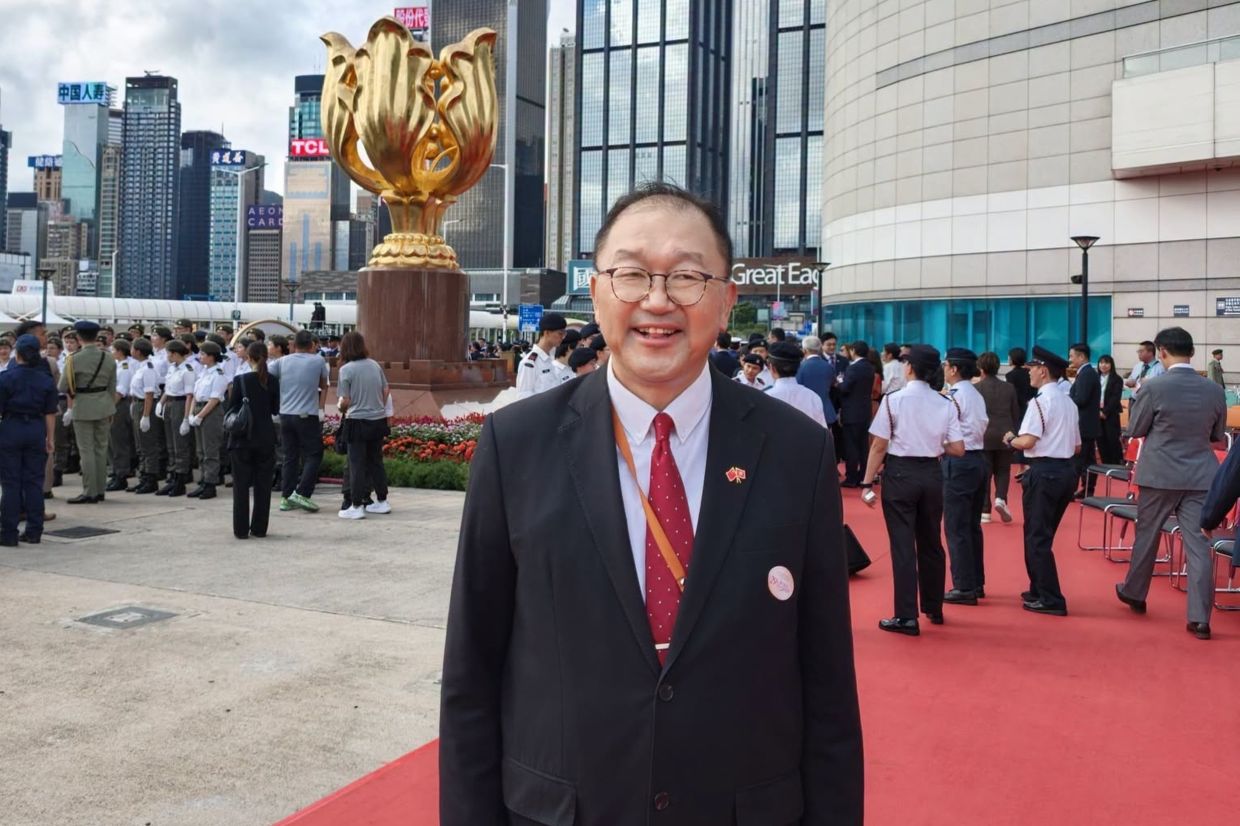
William Wong Kam-fai, a 66-year-old member of Hong Kong's Legislative Council, has stepped down from his position following his arrest on suspicion of drink-driving and involvement in a hit-and-run incident. The announcement on Friday makes Wong the first legislator to resign over a scandal in more than two decades, underscoring the gravity of the situation and the political conventions governing conduct among Hong Kong's lawmakers. His departure comes just days after he was arrested on Monday night when his vehicle struck two parked cars on a university campus near 10.46pm, causing significant damage and raising serious questions about his fitness to serve.
Wong's resignation letter, submitted to Legislative Council President Starry Lee Wai-king, expressed remorse for the distress caused to both the legislature and the broader public. In his statement, Wong acknowledged that stepping down was necessary to prevent further disruption to the council's operations, a move that reflects the political calculus facing senior figures when personal conduct becomes a liability. He appealed for public understanding regarding his inability to discuss details while police investigations continue, signalling his recognition that the judicial process must take precedence over public commentary. Lee responded by accepting his resignation and thanking Wong for his service, maintaining the institutional dignity expected of a legislative leader during such circumstances.
The resignation marks the first legislative departure due to scandal since Gary Cheng Kai-nam quit in 2000, just months after winning his seat. Cheng's resignation followed revelations of undisclosed business conflicts of interest, improper handling of confidential government documents, and personal misconduct. He was subsequently convicted of bribery, misconduct in public office, false accounting and theft, receiving an 18-month prison sentence in 2001. The quarter-century gap between these two resignations illustrates both the rarity of such incidents and the heightened scrutiny placed on lawmakers' personal conduct in contemporary Hong Kong governance.
Political analysts viewed Wong's swift decision as strategically prudent. Lau Siu-kai, a consultant at the semi-official Chinese Association of Hong Kong and Macau Studies, characterised the resignation as the optimal approach to minimise reputational damage to both Wong personally and the legislature institutionally. Lau noted that remaining in office could have invited criticism of the principle of "patriots administering Hong Kong," the governance framework emphasising loyalty and integrity among public officials. By resigning immediately, Wong achieved what analysts described as a protective manoeuvre that benefits multiple stakeholders, from his own future prospects to the broader credibility of Hong Kong's political institutions.
Tam Yiu-chung, Hong Kong's former sole representative to the National People's Congress Standing Committee, concurred that resignation was the appropriate course given the severity of the incident and the elevated standards expected of legislators. Tam observed that the decision would likely prove consequential for Wong's other positions, particularly his membership in the Chinese People's Political Consultative Conference, the country's top political advisory body. While acknowledging that expulsion from such bodies remains rare, Tam anticipated that central authorities would accept any resignation from the CPPCC given the circumstances, reflecting the broader political sensitivity surrounding such matters.
Wong simultaneously holds academic credentials and maintains positions across various organisations. The Chinese University of Hong Kong announced on Friday that it had suspended the staff member from administrative duties pending the outcome of the police investigation, citing the institution's commitment to maintaining rigorous standards of professional ethics and conduct. The university's measured response underscores the cascading consequences that extend beyond legislative halls into Wong's broader career, affecting his standing across multiple professional domains. Such institutional responses have become standard practice when public figures face serious legal allegations, protecting organisational reputation while the judicial process unfolds.
The question of whether Wong's Legislative Council seat will trigger a by-election remains unresolved, dependent on government discretion rather than legal obligation. Tam clarified that no statutory requirement mandates holding a by-election to fill vacant seats, and the government may consider various factors before deciding to proceed, including the length of time remaining in the current legislative term. The precedent of Stephen Wong Yuen-shan's departure in late 2022 is instructive; that legislator's resignation left his Election Committee constituency seat vacant for approximately three years without a by-election being held, as he accepted an appointment as chief of a government think tank.
Wong's seat represents the Election Committee constituency, a distinction Tam emphasised carries implications for the legislature's functioning. Unlike functional constituencies designed to represent specific sectors' interests, Election Committee seats follow different operational logic, making their temporary vacancy less disruptive to the chamber's capacity to reflect sectoral perspectives. In 2024, then-Constitutional Affairs Minister Erick Tsang Kwok-wai advised legislators that financial considerations would inform government decisions about whether to conduct by-elections, introducing budgetary factors into what might otherwise appear purely political questions.
The incident illuminates broader themes within Hong Kong's political landscape regarding institutional integrity and the personal conduct expected of those occupying positions of public trust. Wong's rapid resignation, while politically astute, nonetheless signals that even senior figures with long service records face irreversible consequences when their actions breach the threshold of acceptable conduct. For Malaysia and other Southeast Asian jurisdictions observing Hong Kong's governance evolution, the episode demonstrates how strict institutional norms around legislative propriety operate within the Hong Kong system, and how such mechanisms function to preserve institutional credibility during moments of personal failure by individual office-holders.

