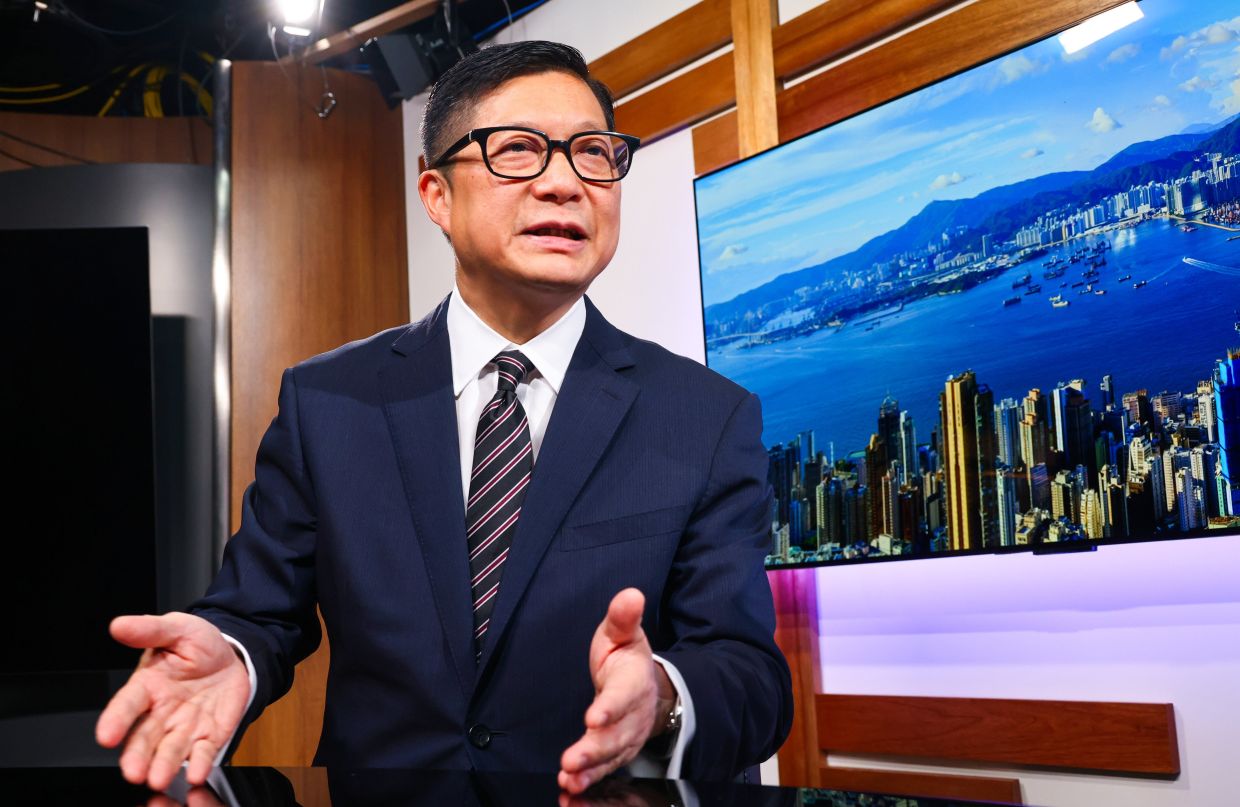
Hong Kong's top security official has pledged that there will be "no limits" to holding people accountable for the catastrophic Wang Fuk Court fire, signalling the government's determination to pursue prosecutions independently of the ongoing independent inquiry into the disaster. Secretary for Security Chris Tang Ping-keung told the South China Morning Post that law enforcement authorities would arrest and prosecute anyone found to have engaged in wrongdoing, with or without their cooperation with the investigating committee. The assurance comes as survivors and observers have expressed anxiety about potential gaps in accountability, particularly following the committee's decision not to seek statutory powers to compel witnesses to testify.
The massive blaze, which erupted in November across the residential estate in Hong Kong's Tai Po district, ranks among the city's worst fire disasters in recent decades. The inferno consumed seven of the eight residential buildings at Wang Fuk Court over a 43-hour period, claiming 168 lives including one firefighter, and rendered approximately 5,000 residents homeless. The scale of the tragedy has made questions of responsibility and accountability central to public discourse, with investigators uncovering a troubling pattern of systemic failures across multiple government departments that preceded and contributed to the disaster.
The independent inquiry has laid bare negligent oversights that facilitated the rapid spread of the fire. Investigators found that renovation work at the estate had involved unauthorised materials including polyfoam boards used to cover windows and non-flame-retardant scaffolding mesh. Perhaps more alarmingly, fireproof windows protecting emergency escape routes had been removed, substantially compromising evacuation pathways. These compounding failures—some involving contractors, others implicating government oversight bodies—created conditions where the fire spread with devastating speed through the densely populated complex. The committee's ongoing hearings have systematically documented how multiple agencies failed to detect and remedy these hazards before the catastrophe occurred.
Tang's insistence on prosecutorial action independent of the committee's conclusions carries particular weight given Monday's announcement that the inquiry would not pursue statutory powers to compel witness testimony. This decision has alarmed some survivors and their advocates, who fear that prominent figures connected to the estate—particularly those involved in the renovation project—might evade accountability by refusing to cooperate with the investigation. By emphasising that evidence, rather than committee testimony, drives prosecutorial decisions, Tang appears to be signalling that the government possesses or will pursue investigative pathways beyond the inquiry's scope.
Two individuals have already faced legal consequences for their refusal to testify before the committee. Hau Wa-kin and Gordon Ho Kin-yip, both directors of Prestige Construction and Engineering, the primary contractor responsible for renovations at Wang Fuk Court, declined to appear for live testimony despite submitting written statements. Their non-cooperation resulted in charges being brought jointly by police and the Independent Commission Against Corruption. In total, authorities have prosecuted seven individuals and two companies on 25 charges spanning manslaughter, conspiracy to defraud, money laundering, obstruction of justice, and tax evasion. The scale of the charging action underscores the government's commitment to pursue the matter through the criminal justice system.
Beyond the contractors, other figures connected to the estate's management have come under scrutiny. Peggy Wong Pik-kiu, a district councillor and former consultant to the Wang Fuk Court owners' committee, similarly submitted a written statement but refused to appear for live testimony. Multiple residents have alleged that Wong engaged in inappropriate conduct, including interfering with owners' meetings, intimidating those with dissenting views, and irregularly collecting proxy votes. Wong has denied impropriety, stating in her submission that she provided no inducements for proxy votes collected in advance of owners' meetings in 2021 and 2024. When asked how the Security Bureau would handle cases like Wong's, Tang emphasised that prosecutorial action would depend fundamentally on available evidence, a measured but pointed response suggesting that investigations remain active.
Tang's approach to the question of accountability within the disciplined services themselves—particularly the Fire Services Department—proved more cautious. Asked whether firefighters and other emergency personnel should be held responsible for any shortcomings in their response, he acknowledged room for improvement but stressed that such criticism must be balanced against recognition of their efforts and sacrifice. One firefighter died in the operation, a fact Tang cited as evidence of the service's commitment. This nuanced position reflects the political sensitivity of criticism directed toward frontline emergency responders, though it does not foreclose possible disciplinary action for supervisors or senior officials whose decisions may have hampered the emergency response.
Parallel to the criminal prosecutions and the independent inquiry, the government is pursuing legislative changes intended to prevent similar disasters. Tang indicated that two significant legislative amendments remain pending before his term concludes next year: one to strengthen penalties for sexual offences and another to tighten fire safety regulations. The latter carries direct relevance to the Wang Fuk Court situation and reflects broader policy recognition that the regulatory framework governing building safety and fire prevention requires reinforcement. These legislative efforts, combined with the criminal investigations and the independent inquiry, comprise a multifaceted government response to the tragedy.
One notable gap in emergency response capacity has emerged as a secondary issue: the inability of mainland Chinese and Macau firefighting services to provide direct assistance during the blaze, despite existing cooperation agreements. Tang explained that fundamental differences in equipment configuration, safety procedures, and operational tactics between Hong Kong and its neighbouring jurisdictions have prevented immediate cross-border firefighting assistance. These differences range from power outlet standards to water source compatibility to fundamentally different tactical doctrines. Hong Kong signed a 2024 agreement with Guangdong and Macau authorities that currently permits mainland emergency vehicles to assist with flooding and landslide response, but not active firefighting. Tang suggested that resolving equipment and procedural compatibility issues could proceed within months, with coordinated water delivery from external sources representing a realistic first phase of cross-border firefighting cooperation.
Tang's defence of the committee's decision to forgo statutory witness-compulsion powers hinged on efficiency arguments. He contended that the judge-led inquiry's current structure would deliver findings promptly, with a final report expected within nine to ten months. This timeline compares favourably to international precedent: Tang cited the 2017 Grenfell Tower fire in London, which took seven years to generate a final investigation report released in September 2024, with no prosecutions materialised to date. Britain initially published a phase-one report in October 2019 examining the fire's origin and spread, followed by a comprehensive 1,700-page final report documenting underlying systemic causes. By highlighting this international comparison, Tang sought to position Hong Kong's inquiry as relatively expeditious and to counter arguments that committee testimony was essential for timely accountability.
The Wang Fuk Court fire has tested Hong Kong's governance systems across multiple dimensions—regulatory oversight, emergency response, criminal investigation, and civic participation in estate management. The tragedy exposed vulnerabilities in fire safety regulation, building inspection procedures, and coordination between government departments tasked with oversight. It also revealed concerning dynamics within the residents' committee structure, where individuals like Wong accumulated disproportionate influence over major decisions affecting the entire community. Tang's public commitment to unrestricted accountability, while carefully calibrated to balance recognition of firefighter sacrifice against criticism of systemic failures, establishes the government's position that no actor—contractor, official, or political operative—should escape consequences if evidence supports prosecution. Whether that promise translates into comprehensive accountability will depend on investigative rigour, prosecutorial courage, and ultimately the judiciary's verdicts in cases that will likely occupy Hong Kong's courts for months or years to come.

