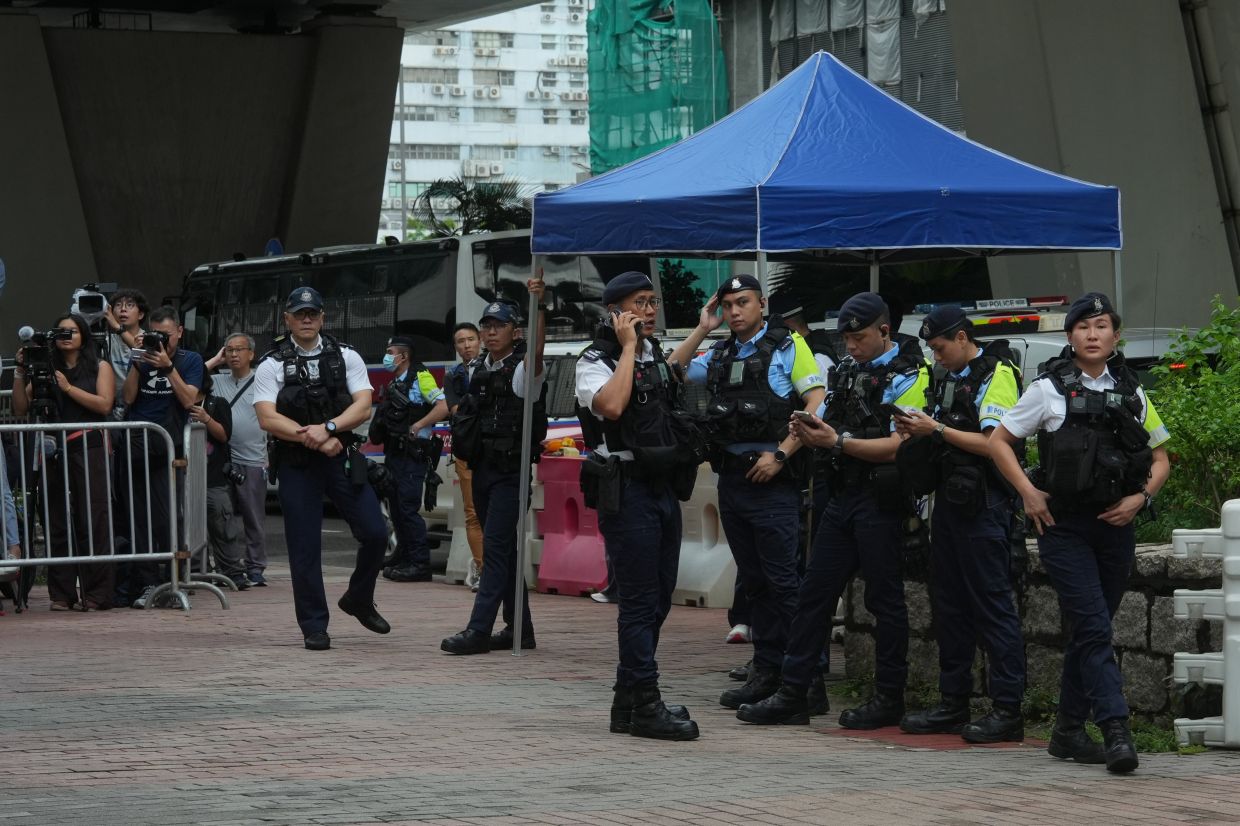
A woman has been arrested in Hong Kong on suspicion of wearing a T-shirt carrying a seditious message outside West Kowloon Court, in an incident that underscores the territory's increasingly stringent enforcement of national security provisions. Police detained the unidentified woman last week, accusing her of disorder in a public place, obstructing officers, and acting with seditious intention. Authorities have offered minimal explanation beyond citing public safety and order concerns, declining to disclose operational details of what appeared to be a targeted security deployment.
The arrest occurred in the hours immediately preceding a High Court verdict against two prominent figures from the now-disbanded Hong Kong Alliance in Support of Patriotic Democratic Movements of China. Former chairman Lee Cheuk‑yan, a veteran lawmaker, and former vice‑chairwoman Chow Hang‑tung, a practising barrister, were convicted of inciting subversion under Hong Kong's national security law. The pair had faced accusations centring on their efforts to mobilise opposition to one‑party rule in mainland China, a campaign that proved legally untenable under the framework established by Beijing's security legislation.
In the early morning hours of Friday, more than fifty individuals had assembled outside the courthouse anticipating the judgment. The gathering reflected significant public interest in a case widely viewed as emblematic of Hong Kong's shrinking space for political dissent. During this wait, a plainclothes officer identified the woman whose garment reportedly contained seditious messaging and removed her from the premises, an action captured by attending journalists. News reports indicate that officers subsequently directed media personnel away from the scene as she was escorted into a police vehicle, an apparent attempt to limit documentary coverage of the detention.
Accounts from witnesses suggested the woman was dressed in a black T-shirt featuring Japanese characters, though authorities have not clarified what those characters signified or how they constituted seditious content under Hong Kong law. The deliberate singling out of this individual amid a larger crowd raises questions about the criteria applied in identifying potential security violations. The incident illustrates how vague language within security legislation can facilitate subjective enforcement and create a chilling effect on public expression.
The timing of the arrest, closely preceding the verdict announcement, appeared coordinated with the court proceedings. Three High Court judges subsequently ruled guilty against Lee and Chow in a comprehensive 216‑page judgment that fundamentally reinterpreted the scope of subversion offences. The court determined that any endeavour to overthrow or undermine the Communist Party of China's governance could constitute subversion, reasoning that Hong Kong's constitutional framework precludes Western‑style democratic systems. This judicial interpretation substantially expands the potential application of national security provisions to encompass political speech and advocacy previously considered protected expression.
Lee and Chow have remained in custody throughout nearly five years of legal proceedings, a duration that itself raises concerns about bail conditions and the pace of justice. Both have maintained their innocence regarding charges they view as politically motivated. The alliance they led had organised Hong Kong's annual candlelit vigil commemorating the 1989 Tiananmen Square incident, a tradition suspended following the enactment of national security legislation. The vigil had functioned as a focal point for Hong Kong's pro‑democracy movement and a symbolic expression of collective memory regarding mainland political repression.
A fourth defendant, former vice‑chairman Albert Ho Chun‑yan, remains detained pending sentencing following his guilty plea in January. Ho's situation compounds concerns about the systemic pressures facing those accused under the national security framework. The sequential processing of cases, combined with extended periods of pre‑trial detention, creates significant psychological and practical burdens on defendants regardless of eventual verdict outcomes.
For regional observers, the Hong Kong developments carry implications extending beyond the territory itself. The case demonstrates how national security legislation, initially framed around concerns regarding terrorism and espionage, progressively encompasses activities constituting legitimate political discourse elsewhere in Asia and globally. The judicial acceptance that democratic advocacy equates to subversion represents a significant departure from established common law traditions and international human rights standards that Hong Kong previously maintained.
The incident involving the T‑shirt wearer exemplifies how security enforcement increasingly operates at the margins of formal law, relying on subjective determinations and administrative discretion rather than transparent application of codified rules. For Malaysian readers, the Hong Kong situation offers instructive lessons regarding the potential trajectory when security frameworks operate without sufficient legislative specificity or judicial constraint. The absence of clear legal guidance regarding what constitutes seditious content creates environments where enforcement becomes unpredictable and potentially discriminatory.
The broader context reveals how Hong Kong's political environment has fundamentally shifted since the national security law's implementation. Public assembly, political organising, and symbolic expression face unprecedented restrictions enforced through both criminal prosecution and administrative measures. The prosecution of the Hong Kong Alliance, coupled with the arrest of the woman outside the courthouse, signals authorities' determination to eliminate institutional and individual manifestations of pro‑democracy sentiment from Hong Kong's political landscape.
For Southeast Asian governments and civil society organisations observing these developments, the Hong Kong experience underscores tensions inherent in balancing security concerns with fundamental freedoms. The trajectory in Hong Kong demonstrates how security legislation, once enacted, tends toward expansion rather than restraint, particularly when judicial review operates within constrained parameters. The fate of Lee, Chow, and others convicted under these provisions will likely influence political behaviour across Hong Kong and potentially inspire similar legislative approaches in other regional jurisdictions.

