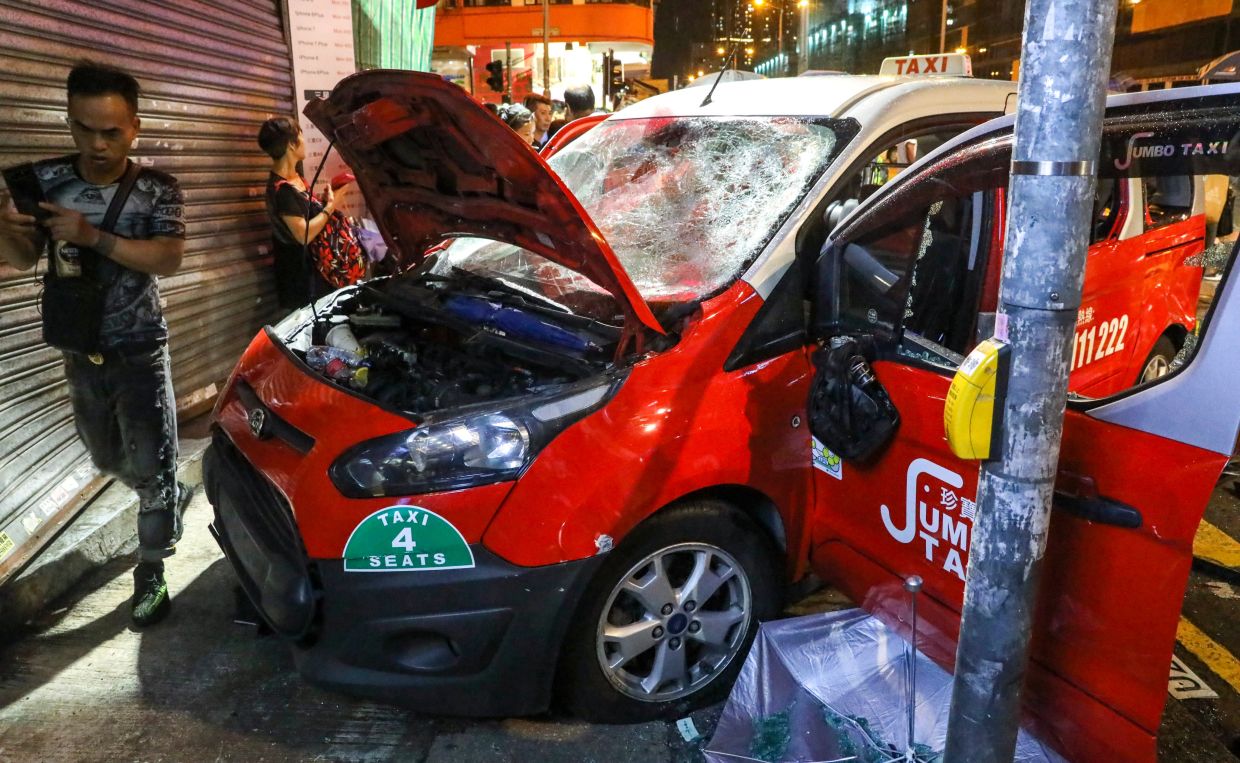
A Hong Kong kindergarten clerk is pursuing a compensation claim of HK$8.4 million (US$1.07 million) against a taxi driver whose vehicle struck her during the civil unrest that gripped the territory in 2019. Park Hoi-lam was seriously injured on October 6, 2019, in Sham Shui Po when taxi driver Henry Cheng Kwok-chuen's vehicle mounted the pavement and hit her on Yen Chow Street. The case, now being heard in court, highlights the lingering physical and psychological toll of the 2019 demonstrations on ordinary residents and raises complex questions about liability, culpability, and who bears responsibility when violence erupts in public spaces.
Park's legal team argues that Cheng's negligence was evident in the manner the collision occurred. Her counsel, Susanna Leong, emphasised that the taxi driver made no attempt to sound his horn or brake before his vehicle struck Park and another woman. The failure to exercise reasonable care in operating a motor vehicle—particularly in a crowded urban environment during heightened social tension—forms the core of the plaintiff's negligence argument. From Park's perspective, the mechanics of the accident itself demonstrate culpability, irrespective of what happened to the driver afterwards.
The defence has adopted a markedly different framing of events, characterising the taxi driver as an innocent victim rather than a negligent operator. Legal representatives for Cheng have stressed that he was subjected to a vicious assault by protesters who attacked him with metal rods and hard objects as he performed his duties. This counter-narrative seeks to position the driver within the broader context of violence that erupted during the 2019 protests, arguing that seeking damages from "another victim of the violence" does not serve justice. The defence contends that whatever injuries Park sustained, holding Cheng financially responsible is inappropriate given his own victimisation.
Park's testimony revealed that she was simply trying to reach Tsim Sha Tsui on the afternoon of the incident when road blockades forced her to exit her bus in Sham Shui Po. With railway services also suspended, she and her companions decided to walk toward Mong Kok, but became separated when she walked ahead of the group. She characterised the gathering of people as peaceful when she first arrived at the location. Her account portrays her not as a participant in the protest but as an unintended bystander caught between competing forces—the movement itself and the apparent panic or altercation involving the taxi.
The physical consequences of the collision have been severe and lasting. Park sustained critical injuries to her lower limbs requiring seven surgical interventions within the three months following the accident. Though discharged from hospital in January 2020, her recovery has plateaued at a level far below normal functioning. She continues to experience chronic knee pain and cannot walk for extended periods without requiring rest. These limitations have directly constrained her employment capacity; her current role as a kindergarten clerk near her home in Tuen Mun prevents her from performing tasks like lifting objects or comforting children through physical contact—functions typically central to such work.
The long-term medical outlook remains bleak. Park was informed that her condition would not improve further despite receiving two additional surgeries post-discharge, and that she faces the possibility of requiring knee replacement surgery in the future. A cosmetic surgeon has advised her to undergo reconstructive surgery to address scarring on her legs, but she lacks the financial resources for such a procedure. These medical realities underscore that Park's injuries are not minor or temporary but represent a permanent alteration to her physical capacity and quality of life—the precise type of harm that personal injury law seeks to address.
Central to the dispute is how "normal life" should be assessed and valued. The defence presented covert surveillance footage obtained by a private detective showing Park shopping and dining after work, arguing this demonstrated she was capable of leading a normal existence. Park's response to this evidence proved philosophically and practically insightful. She questioned whether performing routine activities like shopping and eating—activities any person might do—genuinely constitutes living a "meaningful life." Her riposte highlighted the gap between observable mobility and actual quality of existence, suggesting that the surveillance evidence captured only surface-level behaviours while obscuring deeper limitations and frustrations.
Park's initial involvement of legal representation when providing a police statement in March 2020—nine months after the incident—became a point of contention. Defence counsel Ashok Sakhrani suggested this indicated concern about legal consequences or protest involvement. Park denied both propositions, stating she was simply protecting her own interests. Her explanation reflects a rational response to uncertainty; having been struck by a vehicle, engaging legal counsel to safeguard one's position hardly suggests guilt or ulterior motive.
This case encapsulates broader tensions within Hong Kong society regarding the 2019 protests and their aftermath. The incident occurred at the height of the civil unrest, when the territory experienced sustained demonstrations against proposed legislation and subsequently broader grievances about governance and political freedoms. Multiple narratives intersect here: Park's experience as an injured civilian, Cheng's experience as a victim of protest-related violence, and the larger social upheaval that created conditions where ordinary people became collateral damage. The court must ultimately adjudicate not merely technical questions of negligence but also the uncomfortable reality that individuals on different sides of a conflict can simultaneously be victims of circumstances beyond their control.
The trial before Justice Simon Leung Chun-man is expected to extend over six days, suggesting the case involves complex medical evidence and competing interpretations of liability and causation. For Malaysian observers, the case offers sobering lessons about the human cost of civil unrest and the inadequacy of legal frameworks in addressing injuries sustained by unintended participants in social conflict. Park's situation—a non-political worker permanently disabled through no action of her own—demonstrates how public disorder affects those with minimal connection to the underlying dispute. The outcome may establish important precedent regarding liability standards when vehicles and people collide amid social tension, with implications extending beyond Hong Kong to other jurisdictions navigating similar civil upheaval.

